


A Complete Guide to Choosing and Buying a Concrete Mixer
The concrete mixer is the heart of any concrete-products line; the quality of its mixing has a direct effect on color uniformity, strength, surface finish and output. The right choice must match your concrete type (dry / semi-dry / flowable), your daily output and your level of automation (stationary / mobile). For example, to produce dry and semi-dry concrete (blocks, kerbstones, paving) a pan mixer or single-shaft mixer is usually the most cost-effective, while for very high output a twin-shaft mixer offers the best quality and speed; flowable / structural concrete can be prepared with a drum or twin-shaft mixer, and for lightweight materials such as perlite a vertical mixer is the better choice. Below we look at each type of mixer in more detail.
The Range of Tarahan Concrete Mixers
Pan Mixer
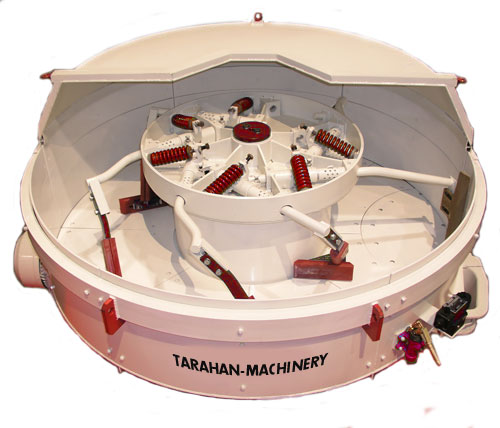
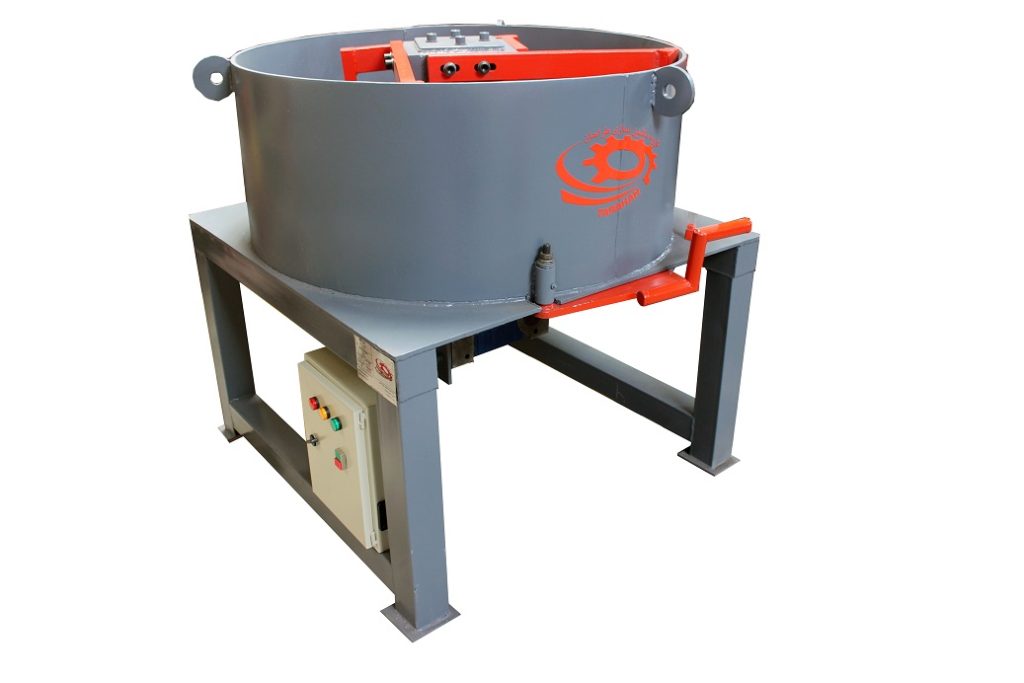
The pan mixer is the most common concrete mixer in most ready-mix applications. Tarahan pan mixers are built in 500, 750, 1000, 1500 and 2000-litre capacities. This circular mixer is used to blend dry and semi-dry concrete on concrete-products lines.
Thanks to its high uniformity, short mixing time and reasonable maintenance cost, it is the best choice for block making, kerbstone making, paving/flooring and flower-box production. The arms and blades of this mixer are designed so that the material is lifted from the floor of the pan and, as water, cement and admixture/pigment are distributed evenly, a homogeneous mix is produced.
Single-Shaft Mixer
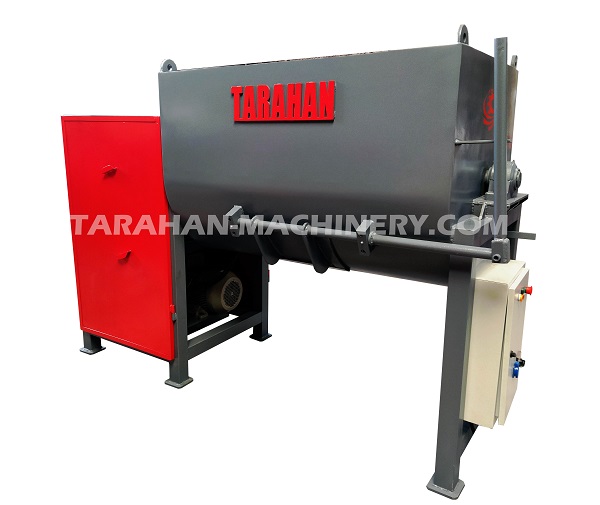
With a single-shaft mechanism and angled paddles, this machine creates a back-and-forth flow that produces a uniform mix in a short time; that makes it a sound choice for medium to high production volumes.
It is offered in stationary (factory) and mobile (deployable on the project site) versions and, as needed, can be integrated with PLC/HMI, load-cells, water and admixture dosing, and connected directly to block, kerbstone and paving machines. So if you are looking to buy a concrete mixer with fast set-up and simple maintenance, this option meets the quality and productivity requirements of your line.
Twin-Shaft Mixer
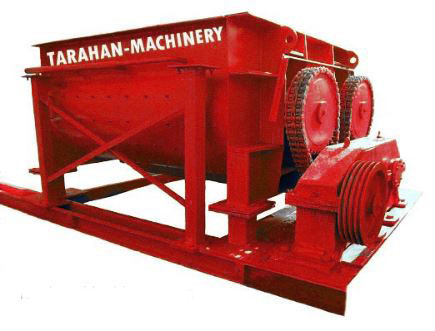
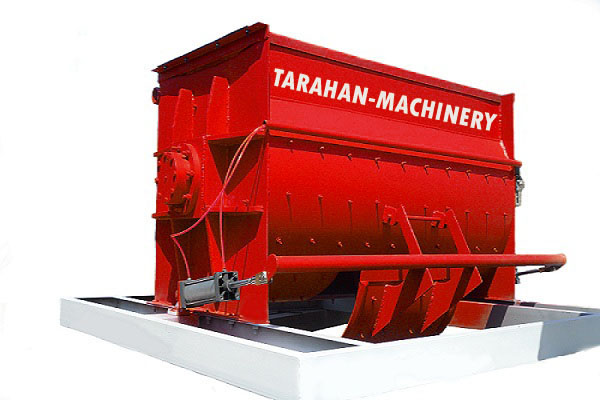
With two horizontal shafts rotating in opposite directions, the twin-shaft mixer produces highly uniform concrete for high output in a short time (typically 30 to 60 seconds). It suits a wide range of concretes — from dry and semi-dry (block, kerbstone, paving) to flowable and structural concrete — and integrates well with a batching plant, water/admixture/pigment dosing, belt or skip feed, cement screw, and block/kerbstone/paving machines.
Stationary versions of the twin-shaft mixer are available for fully automatic factory lines and mobile versions for on-site production; wear-resistant liners and blades together with reputable gearboxes guarantee the durability and lasting quality of the twin-shaft mixer.
Drum Mixer
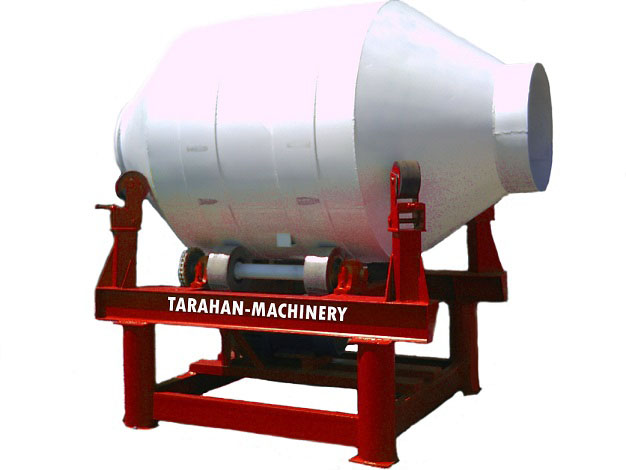
The Tarahan drum mixer is an economical, low-wear option for preparing flowable and semi-flowable concrete on civil projects. Mixing is based on the rotation of a cylindrical drum with internal blades that keep the material continuously moving, providing a uniform mix for in-situ pours, foundations and general structures.
Because of its simple structure, easy maintenance and low energy consumption, the drum mixer is a good choice for clients who need fast set-up on site and lower transport costs.
Vertical Mixer
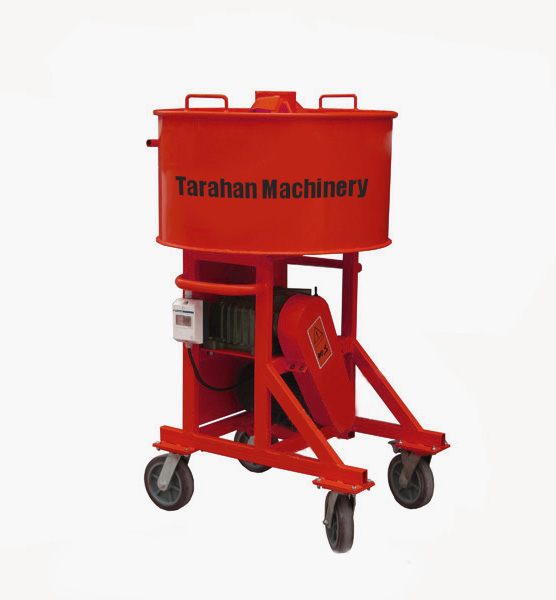
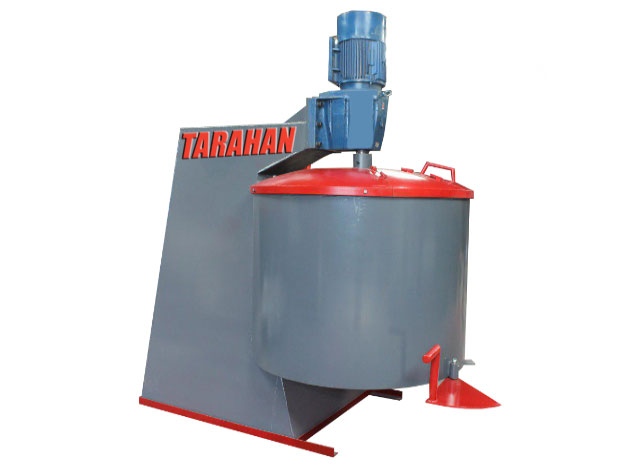
The vertical mixer (for lightweight/perlite materials), also known as a perlite mixer, is designed to blend lightweight perlite and pumice concrete. Its vertical shaft and special blades move light, bulky material gently and evenly so that a homogeneous mix with controlled density is achieved without crushing the grains.
The vertical mixer is used in particular for lightweight blocks and panels and for thermal/acoustic insulating renders (mortar-like layers applied to walls, ceilings or façades to reduce heat or sound transfer), and its lower energy use means lower maintenance costs.
Tarahan Grout Mixer
A grout mixer blends water and cement — and admixtures where needed — into a smooth, uniform slurry; this grout is then used for injection into cavities, micropiles and anchoring in tunnelling work. If the grout is not uniform it separates during injection and the quality of the work drops. This machine keeps the grout uniform right up to the moment of injection.
Comparison Table of Concrete Mixer Types
| Mixer type | Common applications | Suitable concrete/mortar | Typical net capacity (litre/batch) | Typical cycle time | Versions (stationary/mobile) | Line connectivity |
| Pan mixer | Block, kerbstone, paving, flower-box | Dry / semi-dry | 300, 500, 750, 1000, 1500 | 45–90 s | Both | Connects to batching/load-cell, block/kerbstone/paving machines |
| Single-shaft | Block, kerbstone, paving | Dry / semi-dry | 500, 750, 1000, 1500 | 45–75 s | Both | Connects to batching/load-cell, block/kerbstone/paving machines |
| Twin-shaft | Automatic high-output ready-mix lines | Dry / semi-dry / flowable | 750, 1000, 1500, 2000, 2250, 3000 | 30–60 s | Both | Batching, dosing pump, cement screw, connection to downstream equipment |
| Drum | In-situ pours, civil projects | Flowable / semi-flowable | 300, 400, 500, 750, 1000 | 2–6 min | Both | Water/admixture dosing, hopper/belt, control panel/generator |
| Vertical (perlite) | Lightweight concrete/mortar | Lightweight (perlite/pumice/CLC) | 300, 500, 750, 1000 | 2–5 min | Both | Water/admixture dosing, CLC foam generator, PLC/HMI |
| Grout mixer | Micropiles, anchoring, tunnelling | Cement grout (slurry) | 100, 200, 300, 400, 500 | 1–3 min | Both | Agitator, injection pump (screw/piston/diaphragm), water/admixture dosing |
* Daily output is for an 8-hour shift, assuming coordinated loading/discharge, a proper mix design, few stoppages and the given batch capacity.
Note: Every model can be customised for capacity (based on m³/shift, electrical/generator power, installation space, discharge type and automation level).
Key Criteria for Choosing and Buying the Right Concrete Mixer for Your Project
- Define the concrete type and application
- Stiff concrete (dry/semi-dry): pan mixer or single-shaft; twin-shaft if output is very high. (These mixers are designed for lower-water mixes and deliver high uniformity.)
- Flowable/structural concrete: drum mixer (economical, suited to field projects) or twin-shaft (high capacity and more uniform quality).
- Lightweight concrete or mortar: vertical mixer (gentle mixing that keeps light grains intact).
- Cement grout: grout mixer.
- Required capacity
- Daily output ≈ net batch capacity × (60 ÷ batch time in minutes) × effective working hours.
Effective working hours: the real productive time in a shift; usually taken as 5.5 to 6.5 hours (once loading/discharge and stoppages are reduced).
- If you sometimes face production peaks (work suddenly increases), either buy one size larger or run two smaller mixers in parallel.
- Place of use (stationary or mobile)?
- Stationary (factory): when you have the power/foundation infrastructure and produce continuously, a stationary concrete mixer is better. It allows permanent installation with full automation (PLC/HMI, load-cells, dosing) and continuous high-volume production.
- Mobile: if you work on temporary projects and need to produce concrete on site, or are far from the concrete plant, a mobile concrete mixer is the best choice. Note that if you have no mains power, a generator becomes important.
- Mixing quality
The machine must deliver a uniform mix. Typical times are 30–90 seconds for industrial mixers, 2–6 minutes for a drum, 2–5 minutes for a vertical (perlite) mixer, and 1–3 minutes for grout.
- Match to feeding and discharge: the material-inlet path (gravel, sand, cement and water) should be simple and controllable; discharge to a chute, hopper or concrete pump should happen without spillage or clogging, with discharge height and angle matched to project conditions.
- Power and energy: motor power must suit the working conditions so speed does not drop under heavy loads; for the mobile version, check carefully the generator power needed to run the machine.
- Durability and consumables: a strong body and drum, robust internal blades and quality bearings extend the machine’s life; easy access for daily washing and service matters, since built-up hardened concrete causes wear and quality loss.
- Safety and health: the necessary guards, an emergency stop and safe locks for the covers are essential; control noise and dust in enclosed spaces and provide enough room for the operator.
- After-sales service and spare parts: ask about replacing blades, bearings and other parts; operator training, a warranty and fast response from the maker or agent reduce the risk of downtime.
- Ease of use: a simple, clear control panel, distinct on/off and discharge buttons and, if possible, a mixing timer; clear labelling of the water and admixture inlets reduces operator mistakes.
- Documentation and a trial run: before buying, obtain the written technical specifications and be sure to watch a video of the machine in operation; if possible, run a trial batch with your own project materials and check the flowability, uniformity and discharge time.
Custom Design and Manufacturing of Concrete Mixers at Tarahan
At Tarahan a concrete mixer is not simply an off-the-shelf product; each type of mixer is designed and customised for you based on the concrete/product type (dry, semi-dry, flowable, lightweight perlite, grout), the target capacity (shift / m³) and the place of use (stationary factory or mobile on site). Our goal is stable mixing quality, a short cycle time, less wear, and lower repair and operating costs; so from needs assessment through to installation and training, we are alongside you.
The Order and Delivery Process for Custom Mixers at Tarahan
- State your requirements: tell the Tarahan team the type of machine the mould will be mounted on (block/kerbstone/paving), the product type and its exact dimensions, the concrete type, the target capacity (shift / m³) and whether it will be stationary or mobile.
- Technical review and consultation: your information is assessed by the Tarahan support team and the most suitable mixer model is proposed to you.
- Client approval: the client approves the model proposed by Tarahan so the order can move into the design stage.
- Preliminary design of mould and machine: the custom mould drawing is prepared alongside the mixer drawing (drum volume, discharge height, installation details) and sent to you.
- Final client approval: the drawings and the required accessories (control panel, water/admixture dosing, mobile chassis/generator if needed) are approved by the client.
- Build, assembly and testing: the mixer and mould are built and assembled, then safety and performance tests are carried out.
- Delivery, installation and commissioning: the machine is shipped and installed, final adjustments are made and the operator is trained; the documents are then handed over and operation begins.
Frequently Asked Questions
Which type of mixer is more suitable for producing blocks, kerbstones or paving?
For these products, which use dry and semi-dry concrete, pan mixers and single-shaft mixers are the best options. They give high mixing uniformity, offer good durability and have a reasonable maintenance cost.
What is the difference between a pan mixer, a single-shaft and a twin-shaft?
A pan mixer has a simple structure and is cost-effective for block and kerbstone lines. A single-shaft, with its single shaft and angled paddles, mixes faster, and a twin-shaft, with two simultaneous shafts, produces very uniform concrete in a short time and suits high output.
Which type of mixer is better for flowable or structural concrete?
On civil projects and for in-situ pours, a drum mixer is an economical, low-wear option. If more uniform quality and high output are needed, a twin-shaft performs better.
How is the right concrete-mixer capacity chosen?
Capacity depends on the daily production, the time of each mixing cycle and the net capacity of each batch. On projects with fluctuating volume, choosing a higher capacity or running two smaller machines at once is more sensible.
What is the difference between a stationary and a mobile mixer?
A stationary mixer is used for permanent factory lines with suitable power and foundation infrastructure and can be fitted with automation systems. A mobile mixer is designed for on-site production and is usually mounted on a movable chassis with the option to connect a generator.
Does lightweight concrete or mortar need a special mixer?
Yes. To produce lightweight perlite or pumice concrete and mortar a vertical mixer is used, so the light materials mix uniformly and the grains are not crushed. This type of mixer creates a homogeneous mix with controlled density.