


Batching is the precise weighing and measuring of cement, gravel, sand, water, and admixtures in the proportions set by the mix design, before they are mixed to make concrete. A mechanized station that does this work and delivers ready-mix concrete is called a concrete batching plant, and it comes in three types: stationary, mobile, and portable.
Concrete is one of the most important materials in construction, and its quality directly affects the strength and durability of a structure. Producing good concrete therefore takes accurate measurement of materials, control of the mix proportions, and a properly executed mixing process. Today, traditional manual methods have given way to mechanized systems called batching plants. By weighing cement, gravel, sand, water, and admixtures precisely, these plants produce uniform concrete that meets standards and keep human error to a minimum.
Below we explain the difference between batching and a batching plant, the parts of the machine, the working steps, weight and volume methods, and the stationary, mobile, and portable types, with comparison tables.
What Is the Difference Between Batching and a Batching Plant?
A common mistake is to use “batching” and “batching plant” interchangeably, but they are not the same thing. Batching is a process: the set of operations involved in measuring, weighing, and preparing raw materials for concrete production.
A batching plant, on the other hand, is the machine, or industrial station, that carries out this process in a mechanized, automatic way. In industry, the word “plant” means a production complex or factory. The plant is made up of sections such as material feeders (gravel and sand bins), weighing scales (digital scales), a cement silo, a material conveying system, a mixer (the mixing vessel), control equipment, and automation systems (a computerized control room). That is why, when people in the construction industry talk about a “batching machine,” they mean a batching plant, or central concrete production station, which produces concrete in defined batches, one after another.
Why Does the Concrete Industry Need Batching?
In the past, concrete was usually made by hand or in small mixers on site. Because materials were measured only approximately, quality varied from one batch to the next. As projects grew larger, this method could no longer keep up, and the need arose for an accurate, controllable system.
A batching machine solves this problem: by measuring raw materials accurately and automatically, it makes it possible to produce uniform concrete that meets standards. The main benefits of batching are:
- Less human error in weighing materials
- Consistent quality across all batches
- Precise control of the water-cement ratio
- Faster production
- Less material waste
This is why concrete production on professional projects today is almost impossible without batching.
Main Parts of a Concrete Batching Machine
The correct operation of each of these parts directly affects accuracy, production speed, and the final quality of the concrete:
- Material feeder (aggregate hopper): Separate steel bins that keep gravel and sand apart and store them. Modern systems are usually designed with in-line bins (storage bins in a row), which are filled by a loader.
- Weighing system: Scales fitted with load cells that measure the weight of the raw materials.
- Cement silo and screw conveyor: The silo is a waterproof storage tank for cement, and the screw conveyor moves the cement out of it.
- Control and automation system (PLC): The plant’s central computer, equipped with digital displays, manages production in a fully automatic, intelligent way. It can store multiple mix designs, and on advanced models it connects to microwave moisture sensors (wave-based sensors that detect how damp the sand is) so that it can automatically correct the water in the concrete according to the moisture in the sand.
How Does Batching Work? The Steps of Concrete Production
In a batching machine, each batch (a single load of concrete) goes through a defined cycle:
1. Storing and Preparing Materials
At the start of the process, aggregates are placed in material feeders (separate bins). Cement is stored in vertical steel silos to protect it from moisture and damp air. Water and liquid admixtures are also kept in separate tanks. Keeping materials separate at this stage prevents them from mixing unintentionally.
2. Precise Weighing of Raw Materials
The control system issues the weighing command according to the mix design. Each material is sent to its own scale and weighed using components called load cells (extremely sensitive electronic weight sensors).
Note: The strength, workability, and slump (fluidity) of the concrete all depend on the accuracy of this step.
3. Conveying Materials to the Mixer
Once weighing is finished, aggregates travel to the mixing vessel by belt conveyor (a moving rubber belt) or skip bucket (a hydraulic lifting bucket). Cement is delivered into the vessel by a screw conveyor (a spiral cement transfer tube), and water and admixtures by an intelligent pumping system.
4. Mixing the Concrete
The materials enter the mixer, and the blades begin turning at a set speed. Mixing time is adjusted according to the type of concrete and the type of mixer, in order to get a completely homogeneous (even) mix and prevent aggregate segregation.
5. Discharging and Transporting the Concrete
When the mixing time is over, the vessel’s hydraulic gate opens and the ready-mix concrete is discharged into a truck mixer or site hoppers, and the machine is ready to start the next cycle (a new batch).
Main Applications of a Batching Machine
- Commercial plants that produce and sell ready-mix concrete
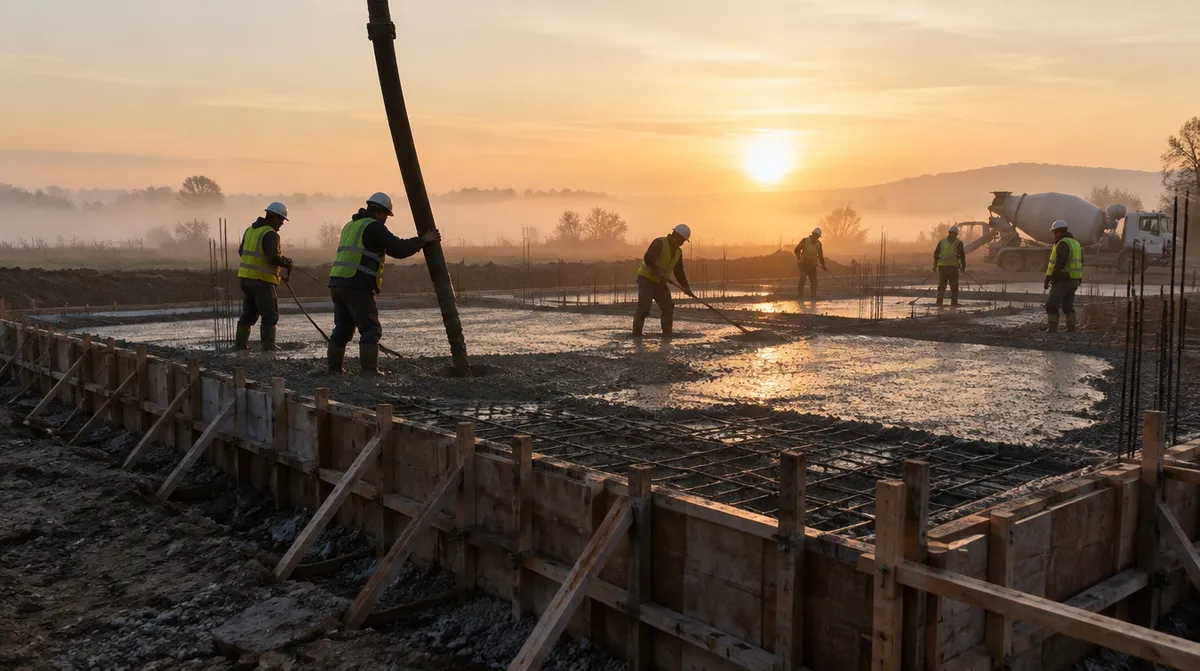
- Large construction projects (high-rise towers and mass housing)
- Infrastructure projects such as roads, bridges, dams, and tunnels
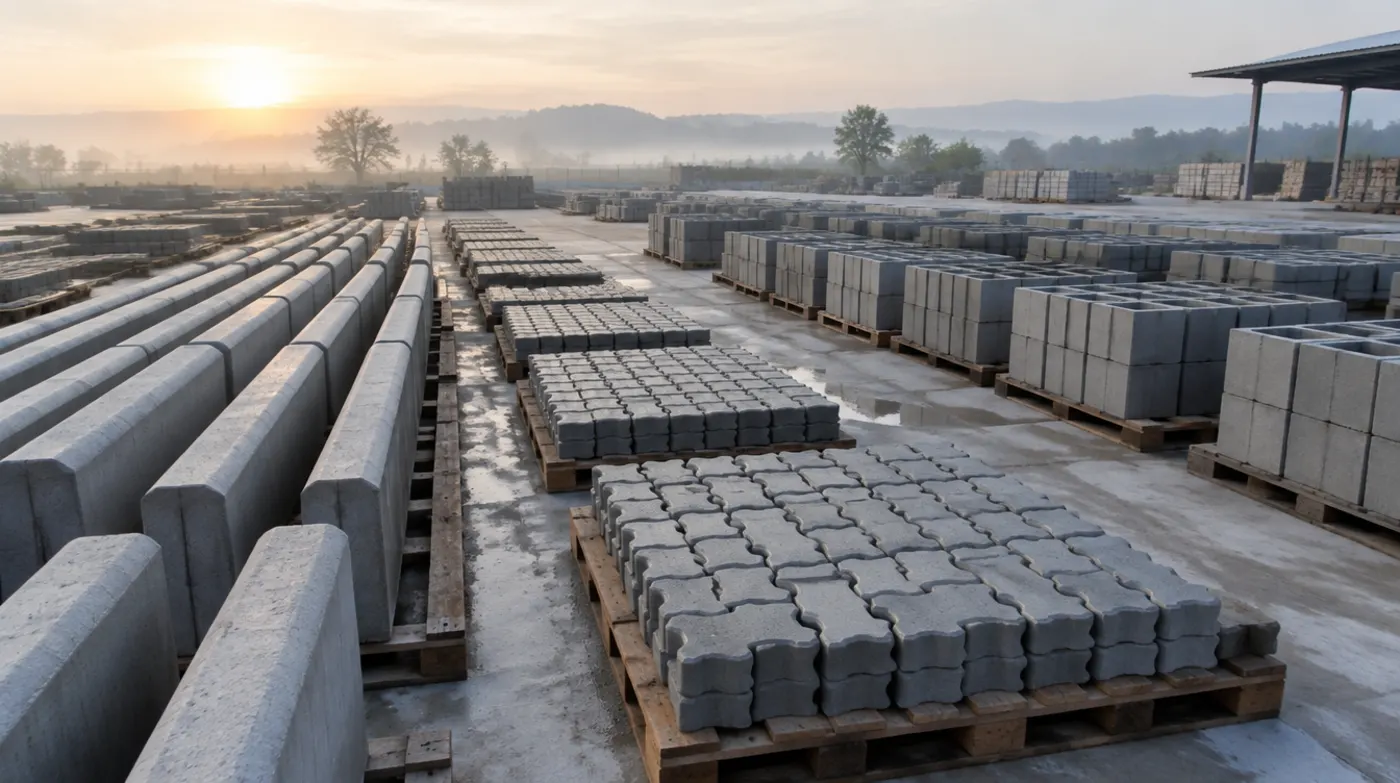
- Factories with a precast concrete production line (for products such as blocks, curbstones, and concrete walls)
Batching Engineering Basics: How Do Weight Batching and Volume Batching Differ?
Raw materials for concrete are measured in one of two ways: volume batching or weight batching. The difference lies in how the materials are measured, and this affects the accuracy and quality of the concrete. Most ready-mix plants today use the weight method.
Volumetric Batching
In this method, materials are measured by volume. Its main advantages are simplicity and lower cost. However, wet gravel and sand, or fluctuating moisture from rain or the environment, cause the water held in the materials to be counted as part of the measured quantity, so the final mix does not come out exactly as designed. For this reason, this type of batching is not widely used for high-quality concrete.
Weight Batching
In this method, materials are weighed on precise scales. Because weight is not affected by moisture, accuracy is higher and the mix design can be followed exactly.
Comparison Table: Volume vs. Weight Batching
| Criterion | Volume Batching | Weight Batching |
|---|---|---|
| Measuring accuracy | Low to medium (affected by moisture and by the bulking or swelling of materials) | Very high (not influenced by the shape or appearance of materials) |
| Measuring equipment | Site gauge boxes and simple water flow meters | Electronic load cells (weight sensors), digital displays, and a PLC system (the machine’s central computer) |
| International reference standard | ASTM C685 | ASTM C94 |
| Status under Iranian standards | Not permitted in Iran for critical and structural parts of a building | Standard and mandatory in Iran for all ready-mix concrete plants |
| Initial system cost | Very low; suitable for small projects | High, because of the sensors, heavy frame, and automatic systems required |
| Concrete production speed | Low; depends on how fast the workers are | Very high, with batches running back to back at factory scale |
Types of Batching Plants by Physical Structure
Concrete plants (batching plants) fall into three technical categories according to where they are installed and how easily they can be moved:
1. Stationary Batching Plant
A stationary batching plant is a heavy industrial structure designed to produce very large volumes of concrete over long periods. Its steel frame must be permanently installed on concrete foundations (a solid concrete base). This system is the best choice for large urban ready-mix plants, and it allows the use of large silos and stockpiles.
2. Mobile Batching Plant
A mobile batching plant is designed for temporary projects or remote areas. Its structure is compact: all components are mounted on a wheeled chassis and moved by truck. This model needs no heavy foundation, and it installs up to 50% faster.
3. Portable Batching Plant
A portable batching plant is the easiest option to transport between sites. It is built as a fully integrated unit on a single chassis and, with no dismantling (taking the parts apart), it is carried in one piece on a trailer. Within a few hours it is running at the new location, with no need for a crane or new cabling.
Types of Batching by Mixing Method
By mixing method, batching plants come in two main types: wet batching and dry batching. The difference is where the water is combined with the other materials, which affects both concrete quality and how the concrete is transported:
Wet Batching (Wet Mix)
In this method, all the raw materials (gravel, sand, cement, admixtures, and water) enter a mixer (a powerful fixed mixing vessel) together at the plant itself, and the mixing (complete blending of the materials) happens right there. The machine’s output is fully prepared, uniform concrete that is poured into the truck. The truck mixer then acts only as an agitator on the road, keeping the materials from settling and the concrete from stiffening before it reaches its destination. Because the amount of water is precisely controlled, this method produces exceptionally high-quality, uniform concrete, and it is the best option for short distances (under 30 minutes of transit).
Dry Batching (Dry Mix)
A dry batching system has no mixing vessel at the plant. After weighing, gravel, sand, and cement are loaded completely dry into the truck’s drum (the truck mixer), and water is stored separately in the truck’s own water tank. The real mixing takes place on the way to the site, or just before the concrete is discharged at the project: the driver spins the truck’s drum at high speed so that the materials mix with the water. This method is excellent for sending concrete over very long routes (more than 90 minutes away), but it presents several technical challenges:
- Cement balling (doughballs): If plasticizing admixtures are not used, the dry cement forms large, dry balls inside the drum when it comes into contact with water, which severely weakens the concrete.
- Slower hydration (the rate of the chemical reaction between cement and water): With this method, concrete sets and hardens later. That is an advantage in hot weather, but on projects that need fast troweling and final surface finishing, late hardening is a drawback and a cause of delays.
Engineering note: According to recent updates to the international standard ASTM C94, the 90-minute limit on hauling concrete is no longer an absolute rule. If set-retarding admixtures are used, and provided the quality and fluidity of the concrete are maintained, transit and hauling time can be extended to as much as 150 minutes.
Comparison Table: Wet vs. Dry Batching
| Criterion | Wet Batching | Dry Batching |
|---|---|---|
| Where mixing happens | Central mixer | Truck mixer |
| Concrete quality | Very uniform | Depends on mixing in the truck |
| Process control | Very high | Depends on truck mixer performance during transport |
| Suitable for | Structural and critical concrete | Transport over long distances |
Types of Mixers in a Batching Machine and Their Effect on Concrete Quality
The type of mixing vessel, or concrete mixer, has a direct effect on concrete quality and on machine wear:
- Twin-shaft mixer (two horizontal shafts): A twin-shaft mixer has two parallel rotating shafts that create a three-dimensional, spiral flow. This system is the best and most efficient choice for stiff, low-water concrete, such as roller-compacted concrete (RCC) for road building, and it has the highest mixing speed.
- Single-shaft mixer: A single-shaft mixer has a simpler structure, lower maintenance costs, and quality that is suitable for medium capacities.
- Pan mixer: In this mixer, mixing takes place in a circular tank with rotating spider arms. It is the best option for producing precast products, blocks, and curbstones.
- Drum mixer: This machine has no internal driven arms, and mixing is done solely by rotating the vessel (the drum) itself. Its mixing quality is lower than that of shaft mixers, and it is suited to small site work or low-grade concrete.
Batching Machine Maintenance Basics
To extend the machine’s service life (which is usually between 15 and 20 years), the following technical points are mandatory:
- Daily washing of the mixing vessel: Concrete left in the machine at the end of the day hardens in layers on the blades and puts strain on the gearbox. It also damages the internal wear-resistant tiles.
- Emptying the cement screw conveyor: If the machine stays off for more than 4 days, the cement inside the screw tube absorbs moisture from the air, sets as hard as stone, and burns out the motor.
- Gearbox lubrication: Gearbox oil must be changed after every 1,000 hours of operation (SAE 90 gear oil for winter and SAE 140 for summer).
- Operator safety: Wet concrete mix (cement combined with water) is highly alkaline and caustic. Personal protective equipment (such as special gloves, goggles, and a mask) is therefore mandatory, as is connecting the machine’s frame to a dedicated grounding electrode to prevent electric shock.
Conclusion
This article covered the concept of batching, how it differs from a batching plant, how the machine works, its main parts, the types of batching, the role of the control system, and how this equipment is used in construction projects.
If your goal was to understand batching technology and its role in ready-mix production, you now have a complete picture of how this system works. If, however, you are a project owner looking to choose a machine that fits the needs of your site, you also need to look at the project’s financial factors, in addition to capacity and mixer type. To review capacities from 30 to 160 cubic meters per hour in detail, and for advice and a batching plant price quote suited to the scale of your project, our specialists are ready to help.
Frequently Asked Questions About Batching
Do all batching plants have a mixer (mixing vessel)?
No. In wet batching (wet mix), the mixer is part of the machine. In dry batching (dry mix), however, the materials go directly into the truck mixer after weighing, and final mixing takes place inside it.
What is the difference between a portable and a mobile batching plant?
Both can be moved, but a portable batching plant is usually more compact and goes into production faster, with minimal installation and restart work.
Why does sand moisture matter for batching performance?
Because sand moisture affects the actual amount of water in the mix design. If it is not corrected, the water-cement ratio changes, and the strength, workability, and quality of the concrete all decrease.
How long does a batching machine last?
With proper maintenance, periodic servicing, and timely replacement of wear parts, a batching plant can run at good efficiency for more than 15 to 20 years. Actual service life depends on build quality, hours of operation, and operating conditions.
If you are choosing a machine, our guide to choosing a stationary, mobile, or portable batching plant compares capacities and suitable types side by side.






Submit Comment: