


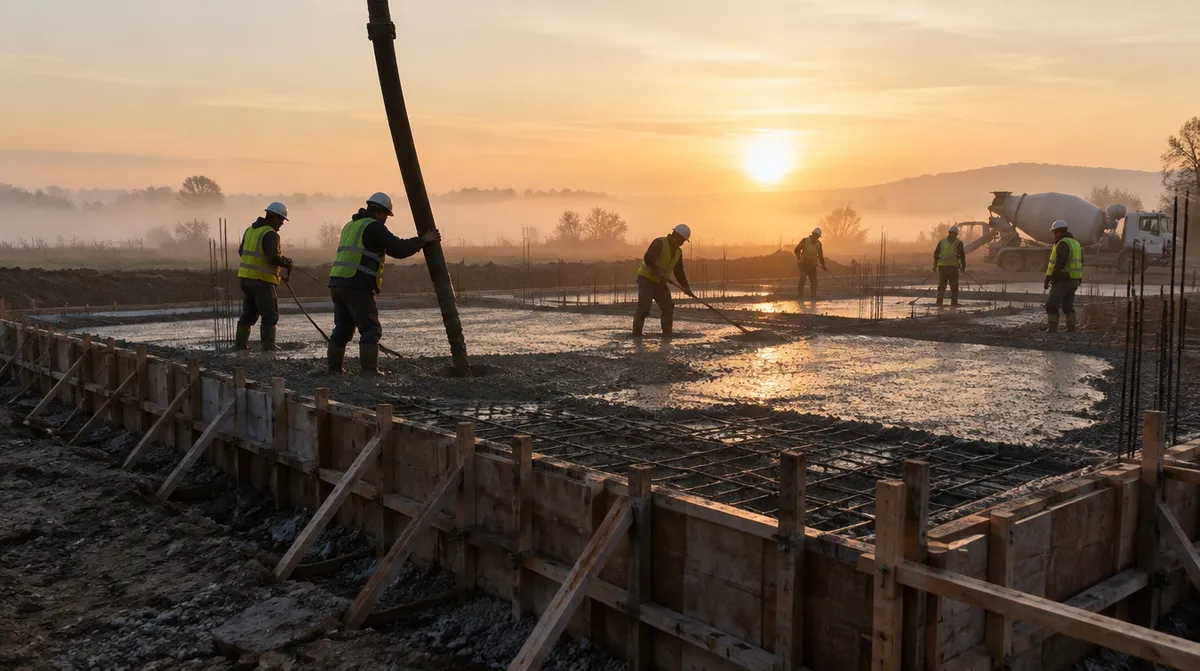
If you will produce concrete at one location for years, for example at a ready-mix plant or a precast yard, a stationary concrete batching plant is usually the more logical choice. If you are a contractor who moves to a new site every few months, a trailer-mounted mobile batching plant is a better fit. And if your project will stay on one site for several months to several years but you do not want to spend the money and time on a foundation and heavy installation, a portable batching plant sits between the two. As for capacity, choose it not by guesswork but from your daily concrete volume, actual working hours and peak pouring day.
This guide compares the three types of Tarahan Machinery concrete batching plant in terms of foundation, transport, installation time, land and power. It puts the capacities of all models, from 30 to 160 cubic meters per hour, side by side in one table and uses a simple example to show how to estimate the right capacity. If you are not yet familiar with the components and operation of this machine, read our article what is a batching plant before continuing.
Tarahan’s Three Types of Batching Plant: Stationary, Mobile and Portable
All three types weigh materials and produce concrete. The differences lie in their structure, how they are set up and the work required at the project site.
Stationary Batching Plant: For Long-Term Production in One Location
Tarahan’s stationary batching plant is built in capacities of 30, 60, 80, 100, 120, 140 and 160 cubic meters of dry concrete per hour. According to the product pages, these machines are customized based on information about the installation site, and their control system is fully automatic with a manual operating option.
The key point with a stationary plant is that it needs a foundation and infrastructure. The page for the 30 and 60 m³/h models states that complete installation, wiring and commissioning usually take 2 to 4 working days, depending on foundation and infrastructure preparation. For larger models, the total time from contract signing to commissioning is stated instead: 4 to 6 weeks for the 100 m³/h model, 4 to 8 weeks for the 120 m³/h model and 4 to 10 weeks for the 140 m³/h model.

Mobile Batching Plant: Mounted on a Trailer, No Foundation
Tarahan’s mobile batching plant, which the Iranian market also calls a “sayyar” (traveling) batching plant, comes in four models: 30, 60, 100 and 120 cubic meters per hour. On these models, all equipment is mounted on a trailer or integrated chassis. According to the product pages, the 120 m³/h model needs no foundation at all, the 100 m³/h model is ready to operate without a fixed, costly foundation, and the 60 m³/h model is commissioned “with no need for a foundation or with minimal civil works.” The 30 m³/h model needs only a simple concrete surface for setup, and installing and starting it up takes 2 to 3 hours.
Keep two practical points from these same pages in mind. First, loading the material feeder on all mobile models requires either installing a pre-feed system or building a ramp. Second, on the 60 m³/h model the chassis has no front support, so truck mixers can load from three directions (a 180-degree angle), a useful feature on narrow sites.
Portable Batching Plant: No Foundation Needed, for Long-Term Setup
Tarahan’s portable batching plant is also built in capacities of 30, 60, 100 and 120 cubic meters per hour. According to the product pages, these machines are transported as standard units on ordinary trailers, need no foundation work or heavy crane, and have their electrical wiring, water piping and pump installation completed at the factory. For the 30 m³/h model, the wording used is “minimal (or even no) need for a foundation.”
The page for the P.BP 120 model states the difference between portable and mobile clearly: the two versions have similar capacity, but the mobile version is designed on an integrated chassis for constant relocation, while the portable model, with its focus on reducing installation costs, suits projects that need long-term setup.

Comparison Table: Stationary, Mobile and Portable Batching Plants
The table below is based on the content of Tarahan’s product pages.
| Criterion | Stationary batching plant | Mobile batching plant | Portable batching plant |
|---|---|---|---|
| Available capacities (cubic meters per hour) | 30 to 160 (dry concrete) | 30, 60, 100, 120 | 30, 60, 100, 120 |
| Foundation | Required | None or minimal; Model 30 needs a simple concrete surface | Not required; Model 30 needs a minimal foundation or none |
| On-site installation | 2 to 4 working days after the foundation is ready (Models 30 and 60) | Assembled and tested at the factory (per the M.BP 100 page); Model 30 in 2 to 3 hours | No complicated installation or crane; ready to work once set in place |
| Transport and relocation | Not designed for frequent relocation | On a trailer; for constant relocation | In standard units on ordinary trailers |
| Land required | 250 to 1200 square meters depending on the model | No figure stated on the pages; compact structure | About 500 (Model 30) and about 750 square meters (Models 100 and 120) |
| Material feeding | Vibrating feeder | Requires a pre-feed system or ramp | Per the order specifications; ask a specialist |
| Best-fit scenario | Ready-mix plant, precast yard, multi-year project | Contractor with scattered projects and frequent relocation | Long-term project on one site without foundation costs |
| Warranty and service | 12-month warranty and up to 10 years of after-sales service (per the stationary and portable plant pages) | ||
Capacity Table for Tarahan Batching Plant Models
Before reading the table, note the difference between dry and wet capacity. Tarahan’s stationary plant pages give two figures for each model: dry concrete output (weighed materials delivered to a truck mixer for mixing) and wet concrete output (concrete mixed in the plant’s own mixer). Wet capacity is lower than dry capacity on every model; for example, the 80 m³/h stationary plant produces 80 cubic meters of dry concrete and 40 cubic meters of wet concrete per hour. If you make concrete in the plant’s mixer, the wet figure is the one that matters.
The mobile and portable plant pages give only one figure, labeled “concrete production capacity” (the M.BP 30 page explicitly says “30 cubic meters of wet concrete per hour”). When requesting a quote, ask the sales specialist what this figure is based on for the model you want.
Stationary batching plant
| Model | Dry concrete (m³/h) | Wet concrete (m³/h) | Mixer (m³) | Cement scale (kg) | Land (m²) |
|---|---|---|---|---|---|
| S.BP 30 | 30 | 15 | 0.5 | 300 | 250 |
| 60 m³/h stationary batching plant | 60 | 30 | 1 | 700 | 800 |
| S.BP 80 | 80 | 40 | 2 | 1000 | 800 |
| 100 m³/h stationary batching plant | 100 | 60 | 3 | 1250 | 1000 |
| S.BP 120 | 120 | 80 | 4 | 1750 | 1000 |
| S.BP 140 | 140 | 95 | 5 | 2000 | 1000 |
| S.BP 160 | 160 | 95 | 5 | 2250 | 1200 |
Mobile and portable batching plants
| Model | Stated capacity (m³/h) | Mixer type and capacity | Product page note |
|---|---|---|---|
| M.BP 30 (mobile) | 30 (wet concrete) | Pan, 0.5 m³ | Installation in 2 to 3 hours; feeder 2 × 5 m³ |
| 60 m³/h mobile batching plant | 60 | Single-shaft, 1 m³ | Two axles; 180-degree loading |
| 100 m³/h mobile batching plant | 100 | Twin-shaft, 2 m³ | No fixed foundation; feeder 4 × 10 m³ |
| M.BP 120 (mobile) | 120 | Twin-shaft, 3 m³ | No foundation; feeder 4 × 25 m³ |
| P.BP 30 (portable) | 30 | Single-shaft, 0.5 m³ | Power 50 kW; land about 500 m² |
| 60 m³/h portable batching plant | 60 | Single-shaft or drum, 1 m³ | Power 65 kW |
| 100 m³/h portable batching plant | 100 | Twin-shaft, 2 m³ | Power 100 kW; land about 750 m² |
| P.BP 120 (portable) | 120 | Twin-shaft, 3 m³ | Power 135 kW; land about 750 m² |
The figures above are taken from Tarahan’s product pages. The final specifications of each order are set out in the proforma invoice.
How to Calculate Batching Plant Capacity
Nominal capacity is what the plant produces in continuous operation with no stops. In practice, waiting for truck mixers, material feeding and short stoppages bring actual output below the nominal figure, so choose capacity with a safety margin.
Hypothetical example (only to show the calculation method, not machine specifications): Suppose your project needs 400 cubic meters of concrete on normal days and the site pours concrete 8 hours a day.
- Net hourly demand: 400 ÷ 8 = 50 cubic meters per hour.
- Assumed efficiency factor: If we assume the plant delivers about 70 percent of its nominal capacity on average in practice, the required nominal capacity is 50 ÷ 0.7 ≈ 71 cubic meters per hour. This factor varies from site to site and should be adjusted based on your own experience or with a specialist.
- Type of capacity: If you make concrete in the plant’s own mixer, compare the figure of 71 with wet capacity, not dry. In the table above, this figure exceeds the wet capacity of the stationary 80 and 100 m³/h models (40 and 60) and falls in the range of the 120 or 140 models. But if you are producing dry concrete for truck mixers, the 80 to 100 m³/h range is worth considering.
- Peak day: If on some days, for example for a large slab or foundation, you must pour 600 cubic meters without interruption, repeat the calculation for that day. A continuous pour usually matters more than the daily average.
Keep in mind that batching plant capacity is of little use without a sufficient delivery fleet. If the plant produces 50 cubic meters of concrete per hour but there are not enough truck mixers in line, the plant sits waiting. To plan the number of trucks, see our article on truck mixer capacity and work out the trips per hour based on the distance from the plant to the pour location.
Auxiliary Equipment: Mixer, Silo, Screw Conveyor and Scale
The mixer is the most important choice after capacity, and it directly affects the plant’s wet capacity. Tarahan’s batching plant models use pan, single-shaft, drum or twin-shaft mixers depending on capacity. A twin-shaft mixer is used on the 100 and 120 m³/h mobile and portable models and, according to the P.BP 100 page, is suitable for producing concretes such as RCC and HPC. Smaller capacities use a pan or single-shaft mixer; according to its product page, Tarahan’s pan mixer synchronizes with semi-automatic and fully automatic batching plants. The mixer type and capacity can also be changed on stationary plants; for example, the 100 m³/h model page states that single-shaft and twin-shaft mixers of up to 5 cubic meters can be installed in place of the 3 cubic meter mixer.
Cement silo and screw conveyor: Cement is carried from the silo to the scale by a screw conveyor (auger). The cement screw diameter on Tarahan models ranges from 6 inches (S.BP 30 and P.BP 30) to 10 inches (the 120 m³/h and larger models, and the 100 m³/h mobile and portable versions). Decide the number of silos based on daily cement consumption; according to the page for the stationary 120 m³/h model, an additional silo can be added.
Scale and controls: Cement weighing accuracy directly affects concrete quality. The pages for the stationary 80 and 100 m³/h models describe a digital cement scale with three load cells and ±0.5 percent accuracy, and the M.BP 30 model page refers to a PLC system with four-component weighing of aggregate, cement, water and admixture.
Land, Foundation and Power
Land: The stationary plant pages state the required land as 250 square meters (Model 30), rising to 800 square meters (Models 60 and 80), 1000 square meters (Models 100, 120 and 140) and 1200 square meters (Model 160). The 80 m³/h model page explains that this space covers the machine, silos, control room and machinery access, and that it must be level. Also allow for material stockpile space and the truck mixer queue in your site plan.
Foundation: A stationary plant needs a foundation, and part of the commissioning time goes into preparing it. On mobile and portable plants this cost is eliminated or greatly reduced, but the setup surface must be level and load-bearing, and on mobile models you should plan for a ramp or pre-feed system for the feeder.
Power: The stationary plant pages list required power separately for dry and wet operation; for example, 23 kW in dry mode and 60 kW in wet mode for the 60 m³/h model, and 50 and 230 kW for the 160 m³/h model. On portable plants, power ranges from 50 kW (Model 30) to 135 kW (Model 120), and for Models 60 and 120 a diesel generator of at least 75 kW and 150 kW, respectively, is recommended as an alternative to three-phase power. If your site has no industrial power supply, settle how you will provide this power before choosing a capacity.
Safety points for installation, site preparation and daily operation are covered in detail in our article on batching plant safety, installation and commissioning.
Common Mistakes When Buying a Batching Plant
- Comparing one machine’s dry capacity with another machine’s wet capacity: A bigger number does not necessarily mean more output; always ask what the figure is based on.
- Calculating from the daily average instead of the peak day: Continuous, high-volume pours are what determine whether a plant’s capacity is enough.
- Overlooking power: Power demand in wet mode is several times that of dry mode, and supplying it on sites without industrial power is a separate cost.
- Choosing a stationary plant for a short-term project: The cost and time of a foundation and dismantling are not justified on projects lasting a few months; look at a portable or mobile plant instead.
- Choosing a mobile plant with no plan for loading the feeder: Without a ramp or pre-feed system, material loading slows down.
- Not asking about after-sales service: Clarify spare parts lead times and technician dispatch before you buy. According to Tarahan’s stationary plant pages, a technician is dispatched no later than 48 hours after a request.
If your budget for a new machine is limited, also look at used batching plants, but have the condition of the mixer, scales and control system inspected by an expert before buying.
Frequently Asked Questions
What is the difference between a mobile batching plant and a traveling (sayyar) batching plant?
There is no difference; both names refer to the same type of machine. Tarahan describes its M.BP models as “traveling (mobile),” meaning a machine whose equipment is mounted on a trailer and which is moved and commissioned with no foundation or a minimal one.
Which is better, a portable or a mobile batching plant?
It depends on how long you stay on each site. According to the P.BP 120 page, the two versions have similar capacity; the mobile version is designed for constant relocation, and the portable version for projects that need long-term setup and lower installation costs.
What projects are Tarahan’s 60 m³/h models suitable for?
The product pages present the stationary 60 m³/h model for precast plants, ready-mix units and building and industrial projects with medium concrete volumes. The 60 m³/h mobile and portable versions are intended for contractors on urban and building projects and for those who move between several projects.
What mixer do Tarahan’s 100 m³/h models have?
The stationary 100 m³/h plant comes with a 3 cubic meter mixer as standard, and a single-shaft or twin-shaft mixer of up to 5 cubic meters can be installed instead. The 100 m³/h mobile and portable versions use a 2 cubic meter twin-shaft mixer.
What are the warranty and payment terms for Tarahan batching plants?
The product pages state a 12-month warranty and up to 10 years of after-sales service, including spare parts supply and periodic servicing. The pages also mention the option of paying in installments over up to 6 months, provided the market and exchange rate are stable. The final price, which depends on the mixer type, auxiliary equipment and payment terms, is stated in the proforma invoice.
Summary
Start choosing a batching plant with three questions: how long will you stay on one site, how many cubic meters of concrete do you need on your peak day, and will you make the concrete in the plant’s mixer or deliver it dry to a truck mixer? If you will produce at one location for several years, look at a stationary plant; if you relocate frequently, a mobile plant; and if you have a long-term project but do not want to pay for a foundation and heavy installation, a portable plant. Then choose the capacity on the correct basis (dry or wet).
To discuss your project requirements, compare models and get a proforma invoice, call the Tarahan Machinery specialists in Tabriz, Iran at +98 41 3630 4464.
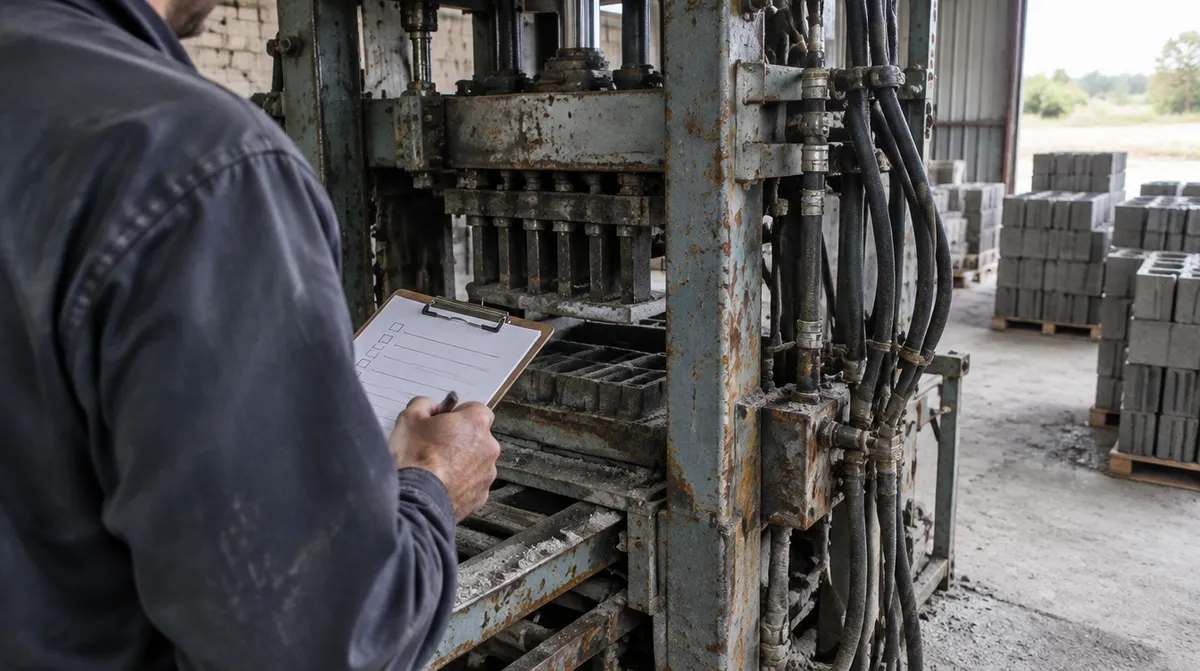
If you also run a block or paver production line alongside the batching plant, use our guide to the block making machine mixer to choose the mixer for that line; a dry mix calls for a different mixer.


Submit Comment: