


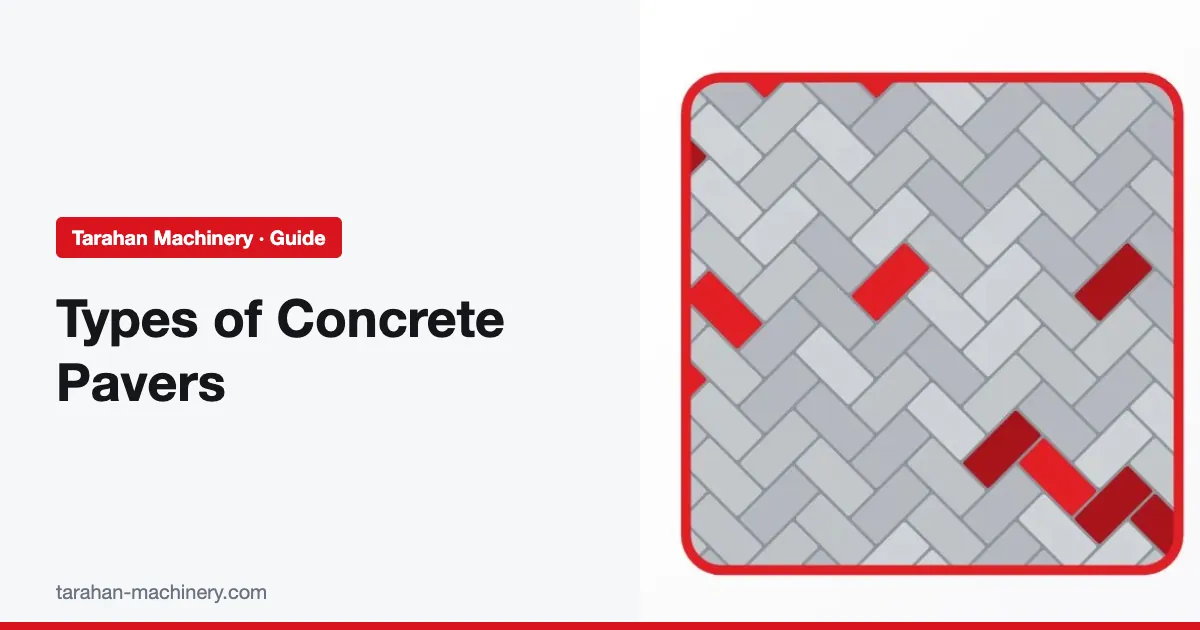
Types of concrete pavers are classified in three ways: by the shape and pattern of the unit (rectangular, dumbbell, hexagon, grass, tactile and others), by layer structure (single-layer, or two-layer with a colored face), and by thickness, which is chosen according to the load the surface will carry. A 6 cm paver is usually enough for walkways and yards, 8 cm is typical for parking areas and passenger car driveways, and 10 cm or more is typical for heavy vehicle roadways and industrial yards. The pattern is not just a matter of taste, either: a shape that interlocks better shifts less under vehicle loads.
Concrete Pavers and Concrete Paving Stones: One Product, Several Names
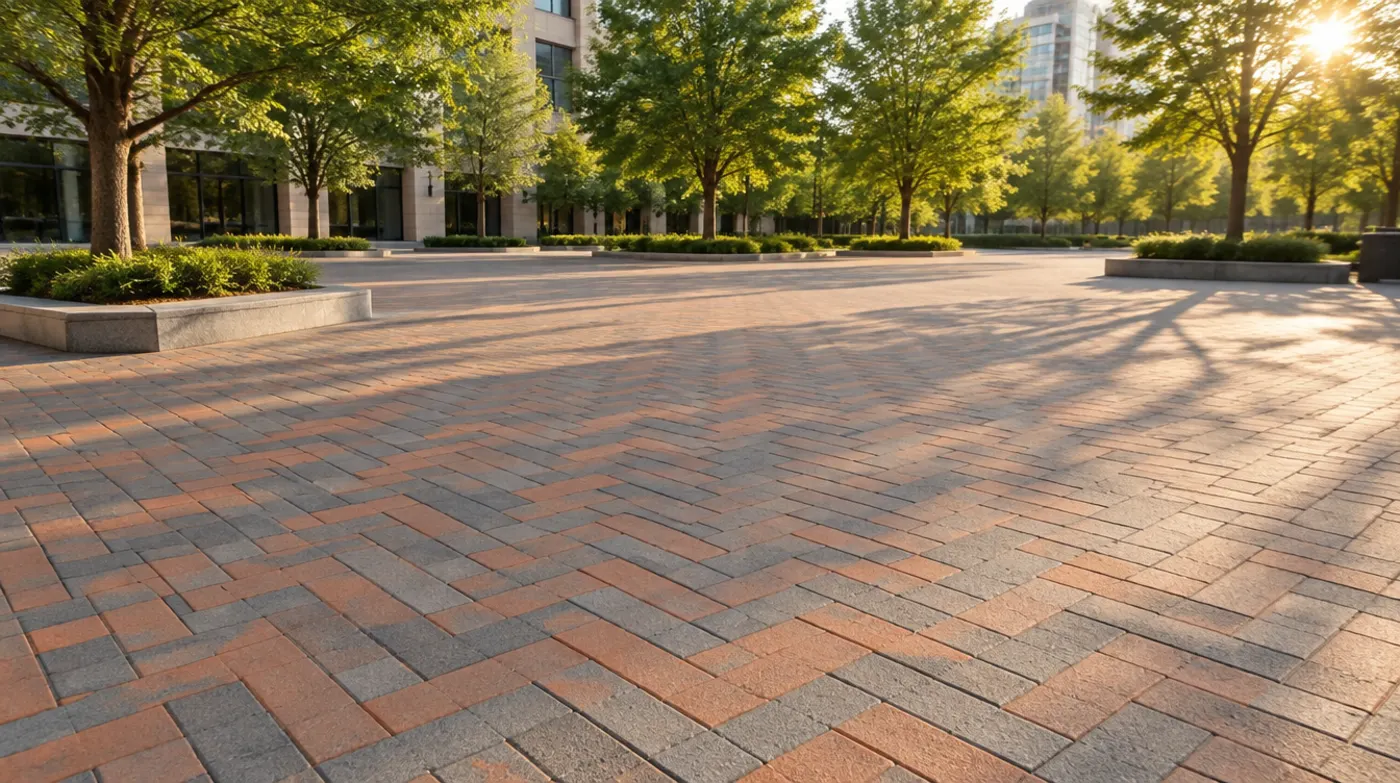
In the Iranian market, “concrete paver,” “concrete paving stone,” “pressed paver,” “cement paver” and sometimes “concrete puzzle” all refer to the same family of products: precast concrete units that are compacted at the factory by vibration and pressing, then laid side by side on a sand bed to form a continuous surface for a walkway, park, yard, parking area or industrial yard. The advantage is that each unit is separate. If an area settles or a utility line beneath it needs repair, you lift a few units and lay them again.
The term “paving,” which you will hear often in Iran as a word borrowed from English, is used in the machinery market mostly for the machine that produces these units. If the term is new to you, the article what paving is and how a paving machine works explains it in full.
Types of Concrete Pavers by Pattern and Shape
The shape of the unit does two jobs: it creates the look of the surface, and it determines how well the units interlock under load. Patterns with angled or toothed edges slide and shift less when a vehicle wheel brakes or turns on them. Simpler patterns such as squares and rectangles are faster to lay and, with the right laying pattern, suit most applications. These are the common patterns, all of which are also made in Tarahan Machinery paver molds:
Rectangular or Brick
One of the simplest and most widely used patterns. The familiar example is the 20 by 10 cm unit. Its main advantage is that a single unit can create several laying patterns: running bond (in rows), basket weave (pairs set at right angles to each other) and herringbone (angled, zigzag). For surfaces that carry vehicles, herringbone is usually recommended because it spreads braking and turning forces across more units.
Dumbbell (Interlocking)
A unit with two wide ends and a narrow waist, shaped like a dumbbell. Each unit locks into the one beside it, which makes it a common choice for parking areas, alleys and yards with vehicle traffic. Patterns of this kind, whose edges lock into each other, are also called “interlocking.”
Woven or Wave
A unit with wavy or toothed edges that together form a texture resembling woven matting. It interlocks well and offers more variety than a plain rectangle, so it is seen often on city walkways and in residential grounds.
Square and Larger Formats
Square units look neat and modern. Sizes such as 20 by 20, 30 by 30 and 40 by 40 cm are common on the market, and these units are used mostly for walkways, plazas, yards and public spaces. A unit that is large relative to its thickness is more likely to crack under a vehicle wheel, so keep it for foot traffic.
Hexagon, Star and Cross
These are more decorative patterns, used in parks, green spaces, plaza edges and parts of a site that you want to stand out. Hexagons fit together with no extra joints and also interlock fairly well. The cross and star patterns are chosen mostly for appearance and are usually combined in different colors.
Nostalit
A set of units in different sizes with soft edges that together give the look of old, hand-laid cobblestones. It suits historic districts, cobbled alleys and spaces that call for an old-world feel. If it also goes through a tumbler machine after production, the edges become more distressed and the look more antique.
Tactile Pavers (for the Blind)
Pavers with raised features on the surface that blind and visually impaired people can sense with a cane or the soles of their feet. There are usually two types: the linear type, which shows the direction of travel, and the dotted (button) type, which warns people to stop, for example at a curb edge, in front of stairs or at a pedestrian crossing. The color is also usually chosen to contrast with the surrounding surface.
Grass Pavers
A unit with open cells that are filled with soil and planted with grass. The surface stays stable under vehicle loads, while rainwater soaks into the ground and the green look is preserved. It is used for open-air villa parking, path edges and low-traffic access roads.
Tarahan Machinery’s mold list also includes a pattern called “Saso.” In practice, almost any pattern can be made with a custom mold. If you have a drawing or sample of what you want, the concrete paving mold page explains the terms for making a custom mold.
Concrete Paver Patterns Compared at a Glance
| Pattern | Interlock under load | Best use | Note |
|---|---|---|---|
| Rectangular / brick | Good, better with herringbone laying | Walkway, yard, parking area, alley | One unit, several laying patterns |
| Dumbbell | High | Parking area, alley, high-traffic yard | Fast to lay, simple look |
| Woven / wave | High | City walkway, residential grounds | More varied look than a rectangle |
| Square | Medium | Walkway, plaza, yard | Keep large units for foot traffic |
| Hexagon, star, cross | Medium to good | Park, green space, decorative areas | Works best in color combinations |
| Nostalit | Medium | Historic district, cobbled alley | Takes on an antique look with a tumbler |
| Tactile | Depends on the base shape | Curb edge, station, in front of stairs | Color contrasting with the surface |
| Grass | Good for light traffic | Open-air parking, access road | Rainwater infiltration and a green surface |
Concrete Paver Thickness by Application
After choosing the pattern, thickness is the most important decision. A thin paver breaks or chips under vehicle loads, while a very thick paver on a walkway only drives up the cost. These are the ranges common in practice (the figures are general guidance; on civil engineering projects, the design specifications and the consultant’s instructions take priority):
- Walkways, yards, parks and bike paths: usually 6 cm. The load on these routes is light, and a 6 cm paver on a proper base lasts for years.
- Passenger car parking, building entrances and low-traffic alleys: usually 8 cm. Where cars pass or park occasionally, this thickness gives a better safety margin.
- High-traffic roadways, industrial yards, warehouses and areas with truck or forklift traffic: usually 10 cm or more, along with a stronger base and an interlocking pattern.
One important point: extra thickness does not make up for a weak base. A 10 cm paver on poorly compacted soil will still settle. Decide on thickness and base together.

Stationary paver machines can usually adjust product height over a wide range; on Tarahan Machinery’s TM series models, for example, product height is adjustable from 50 to 300 mm. That means 6, 8 and 10 cm pavers are all produced on the same machine, simply with the right mold for each thickness.
Single-Layer vs. Two-Layer Pavers: What Is the Difference?
Concrete pavers come in two structural types. In a single-layer paver, the full thickness of the unit is made from one concrete mix; if it is colored, the pigment is spread through the whole unit. A two-layer paver has two parts: a thicker lower layer called the “base layer,” made of concrete with coarser aggregate, which carries the load, and a thin upper layer called the “face layer,” made of finer materials, usually with pigment, which gives the unit a smooth, dense, colored surface.
Advantages of Two-Layer Pavers
- Savings on pigment and face materials: face materials and pigment cost more than base materials. When only the top layer is colored, pigment consumption falls and colored production becomes more economical.
- A denser, more uniform surface: the fine-grained face has fewer surface pores, looks cleaner and resists foot and vehicle wear better.
- Flexibility in mix design: the producer can adjust the face mix design separately and more precisely without making the whole unit more expensive.
Single-layer pavers still have their place: for plain gray pavers and industrial uses, they are simpler to produce. In a colored single-layer paver, the color runs through the full thickness, but more pigment is consumed.

Producing two-layer pavers requires a machine with two separate hoppers: one for the base concrete and one for the face concrete. These machines are called “double-hopper.” The main difference between single-hopper and double-hopper machines is exactly this ability to produce two-layer and two-color pavers. You can see examples in the stationary double-hopper machines category.
Paver Color and Surface Texture
Gray pavers (the natural color of cement) are the cheapest and simplest option, but many landscaping projects call for a mix of colors: red, yellow, black, brown, or a combination of two colors to mark paths, borders and parking spaces. Paver color usually comes from mineral pigments, and in a two-layer paver it is added only to the face layer. A few practical points:
- Get all the pavers in one order from the same production batch; a slight difference in cement or sand makes two batches look different in color.
- The white bloom or efflorescence that sometimes appears on new pavers usually fades with time and rain, but heavy, lasting efflorescence can be a sign of poor curing or a poor mix design.
Surface texture also comes in several forms:
- Smooth: the usual surface of a pressed paver; it is easy to clean.
- Grooved, wavy or brick-textured: a surface pattern formed in the mold itself, which both varies the look and makes the surface less slippery.
- Washed concrete: after production, the paver surface is washed with high-pressure water so that aggregates such as granite or fine marble chips are exposed on the face layer. This is done by the concrete washing machine (washed concrete), and the result is a stone-like, slip-resistant look.
- Antique or tumbled: units knock against each other and the wall of a rotating drum, which chips the edges and gives the units an aged look. This is done with a tumbler machine and works well on patterns such as Nostalit.
How to Recognize a Good-Quality Concrete Paver
Two pavers with the same pattern and color can have completely different service lives. The main enemy of a paver is porosity in the concrete: a porous unit absorbs water, scales during freeze-thaw cycles and wears out sooner under traffic. Check the following before buying or at delivery:
- Water absorption: a good paver absorbs little water. A simple on-site test is to put a few drops of water on the surface; if they soak in immediately and leave a large dark stain, the unit is porous. For large projects, ask a laboratory for water absorption and strength tests.
- Strength and sound: tap two units together gently. A dry, ringing sound usually indicates good compaction, while a dull, muffled sound can indicate low compaction or incomplete curing.
- Chipped edges and corners: edges should be intact and sharp, or have a uniform chamfer. Heavy chipping across a shipment means the concrete is weak, the mold is worn, or the units were moved too early.
- Uniform dimensions and thickness: units that differ in thickness create an uneven surface once laid. Place a few units side by side and measure them with a tape.
- Face layer: on a two-layer paver, the face layer should be uniform and bonded to the base layer, and should not scratch easily with a fingernail or coin.
- Curing: pavers should be adequately cured before shipping. A unit loaded a few days after production may look sound but has not yet reached sufficient strength.
Paver quality comes down above all to concrete density, and density is the result of the right combination of vibration and pressing, mix design and curing. To learn how dry pressing, wet pressing and vibrated molding affect paver durability, see the article on production methods for concrete pavers and paving stones.
Laying Concrete Pavers: What Determines the Final Quality
Much of the damage blamed on pavers is actually due to installation errors. The usual way of laying interlocking pavers is “flexible,” meaning the units are laid on sand rather than mortar, and it generally involves these steps:
- Preparing and compacting the subgrade: loose soil and topsoil are removed, and the subgrade is compacted with a suitable slope for drainage.
- Base construction: one or more layers of crushed stone (subbase and base) are spread and compacted layer by layer. The thickness of these layers depends on the traffic load and soil type, and is greater for roadways than for walkways.
- Installing edge curbs: the surface must be restrained all the way around, usually with concrete curbs. Without edge restraint, the pavers spread outward under load and the joints open up. To learn about curb types and uses, see the article what a concrete curbstone is.
- Sand bed: a thin layer of sand, usually a few centimeters thick, is spread and leveled with a screed. Do not walk on this layer before laying the units.
- Laying the units: units are laid with even joints in the chosen pattern (running bond, basket weave or herringbone), and the edge units are cut to fit.
- Vibrating and sanding the joints: the surface is compacted with a plate compactor to seat the units in the sand. Fine, dry sand is then swept over the surface and the surface is vibrated again until the joints are completely filled. It is this joint sand that completes the interlock between the units.
Laying pavers on sand-cement mortar is also common, but it makes repairing and moving the units harder.
If You Want to Produce Pavers
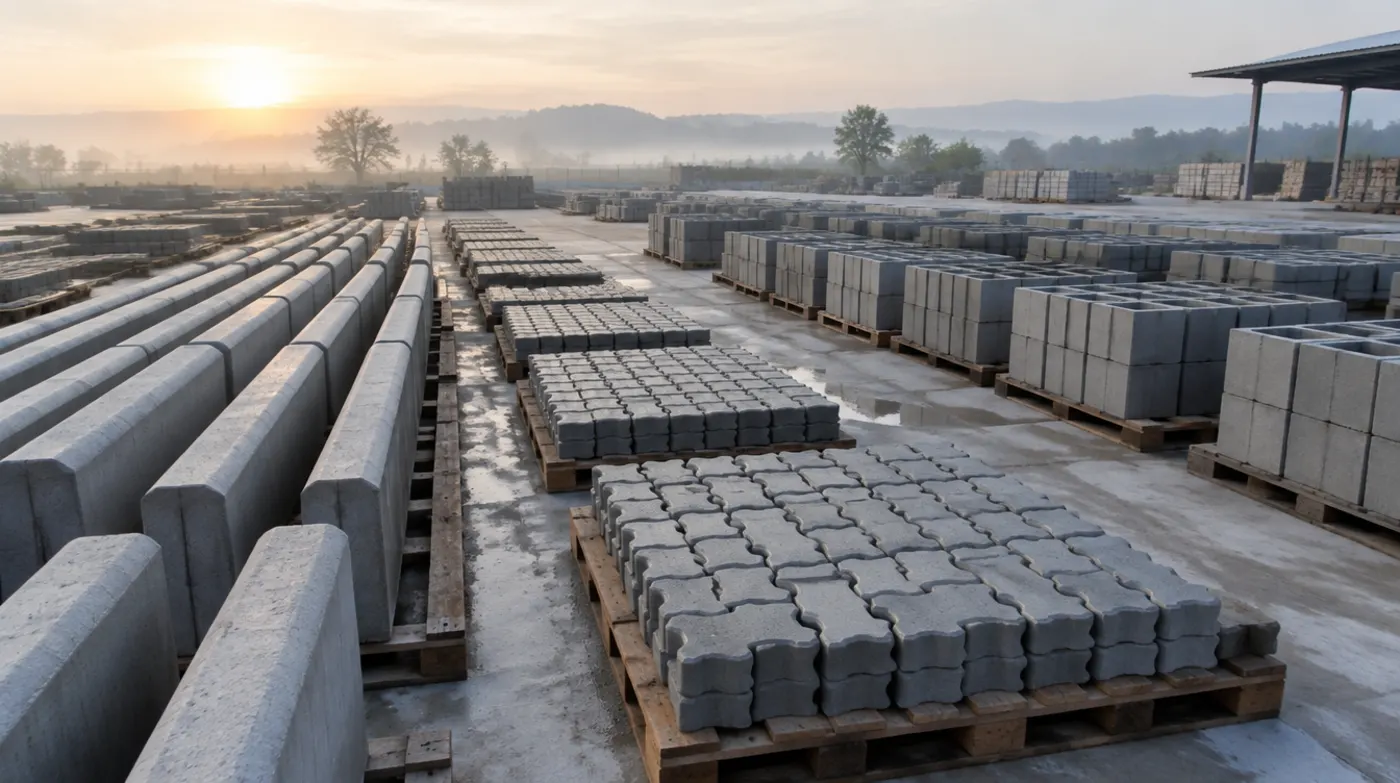
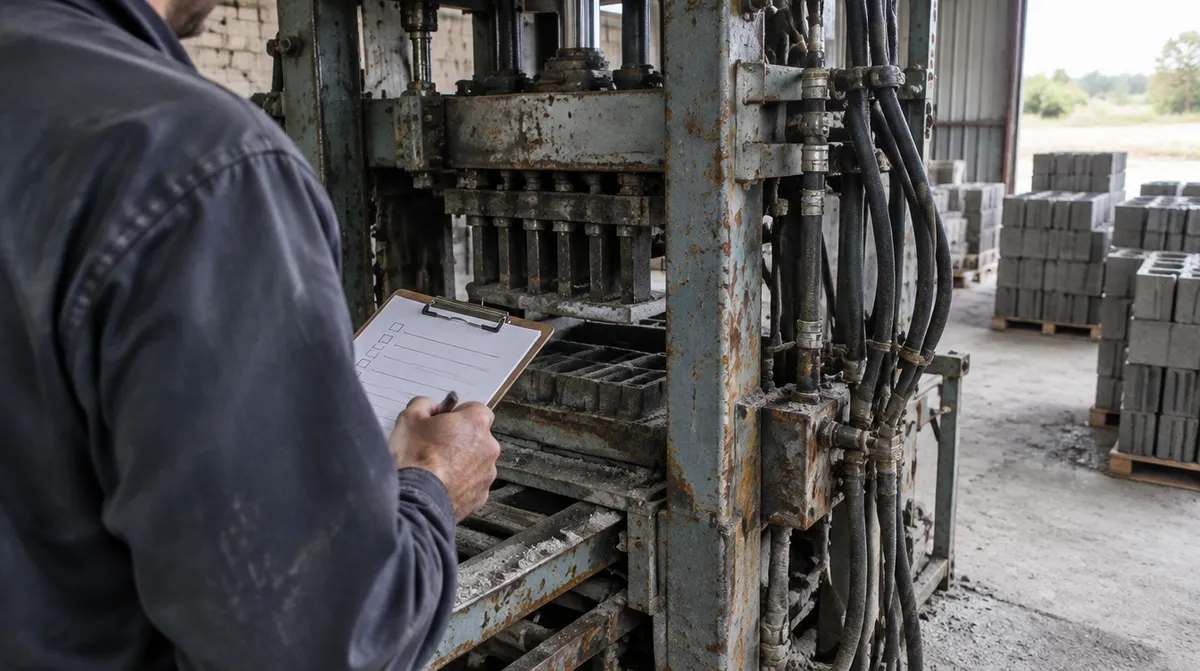
If you are reading this guide to start production, here is the short version: good-quality pressed pavers are made on a stationary machine that fills a steel mold with semi-dry concrete, compacts it with vibration and hydraulic pressing, and delivers the units on a pallet. By changing the mold, the same machine also makes blocks and curbs. Mobile machines work for blocks and curbs but are not recommended for pavers and paving stones because of their weaker vibration and pressing. The older method, using plastic molds on a vibration table, is still used for decorative units and artificial stone, but its product is usually weaker than a pressed paver.
Your main choice is between two groups:
- Single-hopper: for single-color, single-layer pavers, blocks and curbs. If your market mostly wants gray or single-color pavers, this group is enough.
- Double-hopper: for two-layer and two-color pavers with a fine-grained face. If you want to compete with colored and decorative pavers in landscaping and municipal projects, consider this group.
Tarahan Machinery builds stationary models in both groups, and a full comparison of the models, with the capacity and pallet size of each, is on the paving block making machine page.
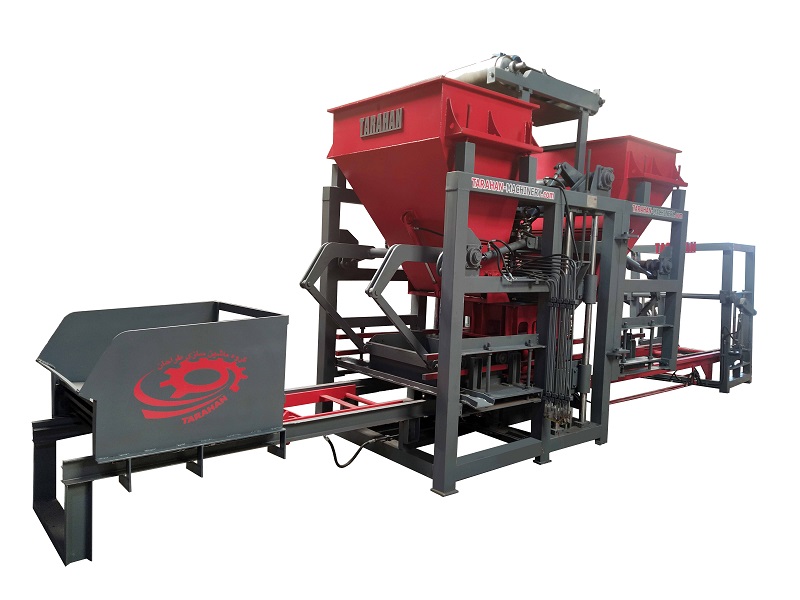
To start producing two-layer pavers, the TM-208 double-hopper machine is the smallest double-hopper model from Tarahan Machinery: it produces two-layer and colored pavers and, with a mold change, also makes blocks and curbs. Its product height adjusts from 50 to 300 mm, so it produces 6, 8 and 10 cm pavers with the corresponding molds. For higher output and a larger pallet, the TM-218 double-hopper model belongs to the same family.
The Mold: Where the Paver Pattern Is Made
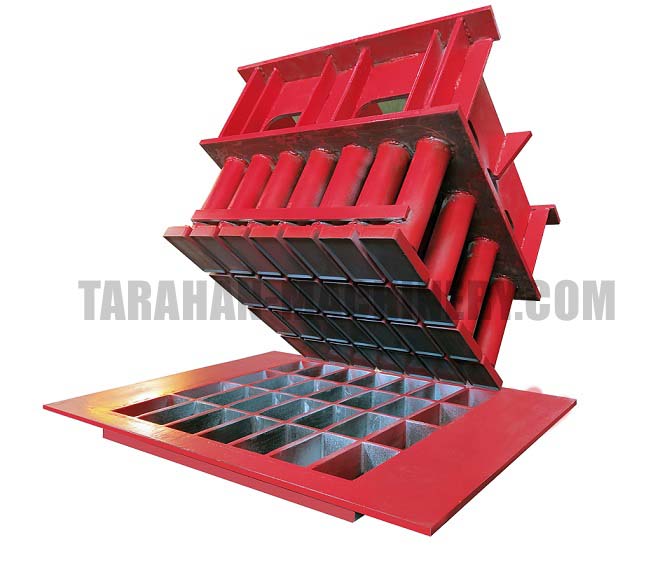
The machine stays the same, but each paver pattern and thickness needs its own mold. Tarahan Machinery’s steel molds (for a full overview, see the article on types of concrete molds) are built to fit the mold area of each machine and cover patterns such as dumbbell, square, Nostalit, rectangular, hexagon, woven, cross, tactile, star, Saso and grass. A one-piece mold, with its slots cut by CNC from a solid plate, offers greater precision and a longer life, while a welded multi-piece mold is cheaper but less precise and less durable. Strong mold edges also directly affect chipping of the unit as it leaves the mold.
Equipment Around the Machine
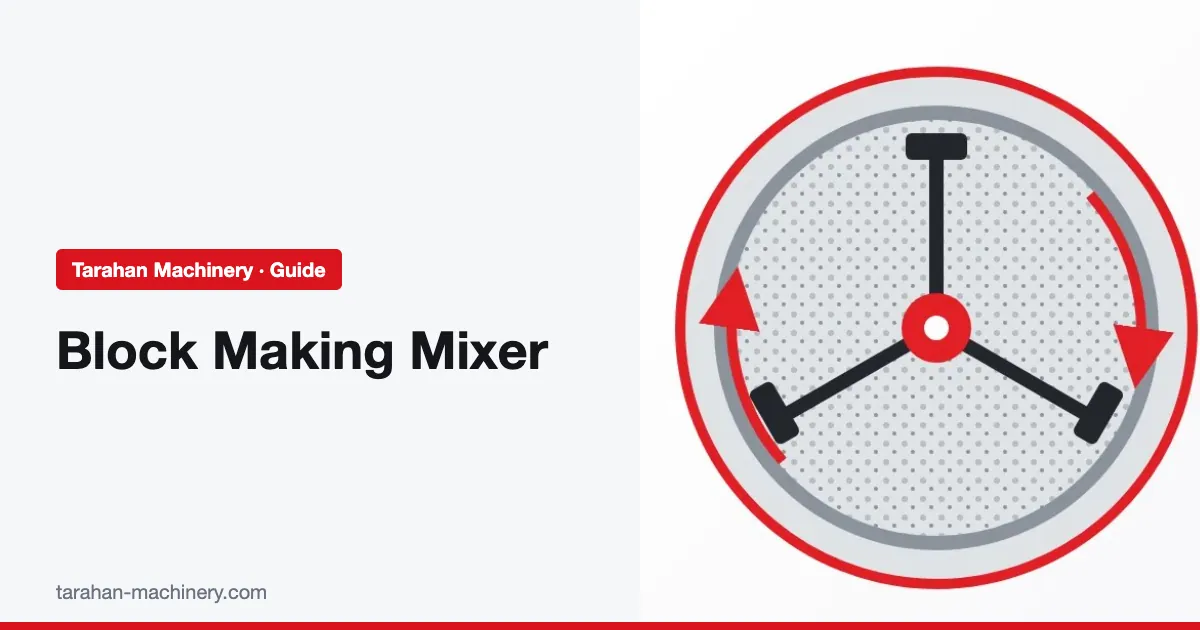
A paver machine alone is not a production line. At a minimum, you need a material weighing or batching system, a mixer suited to semi-dry concrete, a conveyor, pallets and curing space. Semi-automatic and automatic lines add lifting and lowering robots, and an automatic line also adds a stacking robot. For two-layer pavers, the mixing quality of the face layer matters more; for help choosing a mixer, see the guide to choosing a mixer for block and concrete product manufacturing.
Frequently Asked Questions
What thickness of concrete paver is right for a home parking area?
For passenger car parking, an 8 cm paver is usually chosen, in an interlocking pattern such as dumbbell or a rectangular unit laid in herringbone. A 6 cm paver is suited to walkways and is more likely to break and shift under vehicle wheels.
Are two-layer or single-layer pavers better?
For colored pavers and landscaping, two-layer is usually the better choice: the surface is denser and more uniform, and pigment is used only in the face layer. For plain gray pavers and industrial uses, single-layer is sufficient and simpler.
Where are grass pavers a good fit?
For open-air villa parking, low-traffic access roads and path edges, where you want a green surface and also want to keep vehicles from sinking into mud. Rainwater also soaks into the ground through their cells.
Why do pavers start to scale after one or two winters?
Usually because of high porosity in the concrete: the unit absorbs water, and repeated freezing and thawing flakes off the surface. Insufficient compaction during production, a poor mix design and too short a curing period are the three main causes.
Can one machine produce several paver patterns and thicknesses?
Yes. On stationary machines, the mold determines the pattern and thickness. With different molds, the same machine produces several paver patterns and thicknesses, as well as blocks and curbs.
Summary
To choose a concrete paver, first define the application: walkways and yards usually take a 6 cm paver, passenger car parking 8 cm, and heavy vehicle roadways 10 cm or more. Then choose a pattern that matches that load, consider two-layer pavers for a colored, durable surface, and make sure of the production quality and of proper installation of the base and edge curbs. If you plan to start paver production or upgrade your current line to two-layer production, Tarahan Machinery’s specialists can guide you in choosing the machine, mold and supporting equipment; for advice and current prices, call +98 914 584 1914.


Submit Comment: