


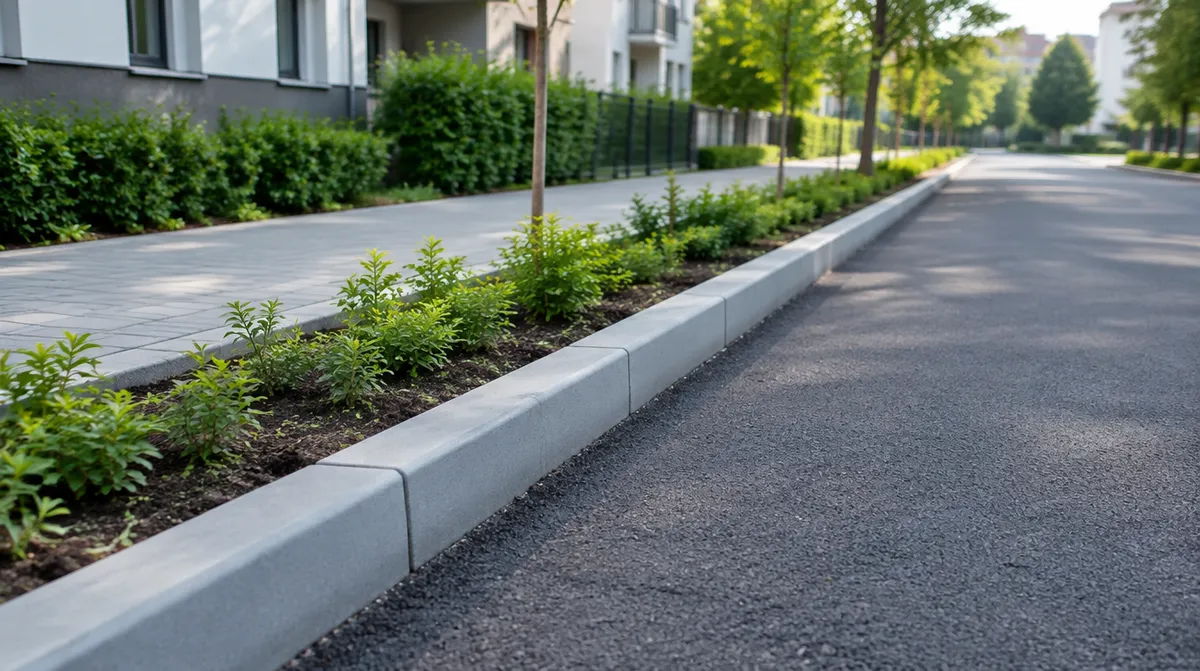
A concrete curb is a precast, prism-shaped unit of dense concrete laid in rows along streets, sidewalks, garden beds and yards. It marks the boundary between surfaces, holds the edge of asphalt and pavers in place, and carries surface water to the drain. The most common sizes on the Iranian market are 30×50 and 50×50 cm, and most curbs are made by pressing.
- Main useSeparating surfaces, restraining edges, directing surface water
- Common sizes30×50 and 50×50 cm, plus custom sizes
- Edge typesSquare, chamfered and rounded
- Usual production methodPressing (low-moisture concrete + vibration and pressure) in a steel mold
What Is a Concrete Curb and What Is It Used For?
A concrete curb (in everyday speech also called a “cement curb”) is a fairly narrow, prism-shaped unit that forms a continuous edge when laid end to end. It is part of the everyday infrastructure of any city: wherever a roadway is separated from a sidewalk or a green space from a walkway, there is probably a row of concrete curbs doing the job.
The main uses of a concrete curb can be summed up as follows:
- Separating surfaces: dividing roadway from sidewalk, bike path from green space, and parking from the surrounding yard.
- Edge restraint: holding the edge of asphalt, paving stone or concrete pavers so it does not open up and spread under traffic.
- Directing surface water: creating a path for rainwater toward channels and inlets, especially when installed together with canyo or drain units.
- Safety and visual order: showing drivers and pedestrians where the path ends and creating clean lines in the cityscape.
- Landscaping: framing garden beds, tree pits and green areas in parks, residential complexes and factory grounds.
Types of Concrete Curbs
Curbs can be classified in several ways: by where they are used, by cross-section and by surface appearance. Here are the most common types.
Roadside or Street Curbs
The street curb is one of the most widely used types and is installed along roads, boulevards and traffic circles. Because it is exposed to wheel strikes, traffic loads and freeze-thaw cycles, it is usually taller and thicker, and the density of its concrete matters a great deal. The top edge of these curbs is often chamfered or curved so it chips less on impact.
Garden and Landscape Curbs
In garden beds, along lawns, on park footpaths and around buildings, a curb carries no heavy traffic; its job is mostly to hold back soil and separate areas visually. That is why garden curbs are usually shorter and lighter, and are sometimes made in simpler shapes or with a patterned surface to match the landscape design.
Drain and Canyo Units
Alongside curbs, units are also made to collect and carry surface water. A canyo is a channel unit that carries water along the side of a street, parking lot or industrial yard, and its cross-section can be semicircular, trapezoidal or rectangular. A drain unit is installed with cross-sections such as U, V, trapezoid or box. What matters most in these units is an accurate cross-section so water flows smoothly, and a secure end-to-end joint (tongue and groove, for example) to prevent leaks and shifting. For details on how these units are made, see the concrete canyo mold and concrete drain mold pages.
Colored and Two-Layer Curbs
Urban beautification projects also use curbs with a colored surface. One common industrial way to make them is the “two-layer” method: a colored face layer and a structural layer underneath are compacted in a single process. This requires double-hopper machines that deliver the materials for the two layers to the mold separately. The advantage of the two-layer method is that pigment is used only in the top layer, while the body of the unit stays ordinary concrete.
Square, Chamfered and Rounded Curbs: The Difference Is in the Top Edge
Apart from where they are used, curbs are also identified by the shape of the top edge, and this small detail has a big effect on the durability and appearance of the curb line:
- Square-edge curb: the top corner is a right angle. It looks crisp and geometric, but the sharp corner is the weak point of the unit and chips sooner than the others during handling, laying and wheel strikes. It is seen mostly in landscaping and garden beds, where impacts are fewer.
- Chamfered curb: the top corner is cut at an angle. The chamfer reduces stress concentration at the corner, cuts down on chipping, and is also less hazardous to pedestrians and car tires. That is why pressed chamfered curbs are so common along city streets. The chamfer is formed in the mold, so its uniformity along the whole length of the unit is a sign of mold accuracy.
- Rounded or curved curb: the top edge is rounded to a radius. It has a softer look and is used in parks, on footpaths and in beautification projects; it also resists impact better than a square edge.
Curved, Corner, Start and End Units
At street corners, traffic circles, parking entrances and around tree pits, the curb line needs corner units, curved units, and start and end units, all made with separate molds. Take the list of these units from the drawings and include it with your curb order, so straight curbs are not cut on site, which leaves a weak, irregular edge.
Common Concrete Curb Sizes
Curb dimensions depend on where the curb is used, the project drawings and the production machine, and no single size fits every project. Still, a few sizes are very well known on the Iranian market. In common naming, the two main numbers refer to the height and length of the unit, and thickness is sometimes stated separately. Because sellers do not all write dimensions in the same order, always ask for height, length and thickness separately before ordering.
| Dimensions (cm) | Typical use | Notes |
|---|---|---|
| 50×50 | Street curbs and boulevard edges | A taller unit for edges with a greater level difference or heavier loads |
| 30×50 | Sidewalk edges, side streets and yards | One of the most common sizes on the Iranian market |
| 30×50×15 | Same use, with thickness stated | When three numbers are given, the third is usually the thickness |
| Custom sizes | Garden curbs; corner, start and end units | Made to the client’s drawings and within transport limits |
| Length 50 to 100 | Canyo units | Width and height are set by slope and runoff volume |
If your project has specific drawings, take the curb dimensions from the drawings and the project’s technical specifications.
How to Read and Measure Curb Dimensions
At delivery, these two simple checks prevent most later disputes:
- At delivery, take a few units from several different pallets and measure height and thickness at both ends of each unit. A difference between the two ends points to a skewed mold or a mold that did not fill completely.
- On projects where pavers or asphalt meet the curb, coordinate curb height with the thickness of the pavement layers, so that after installation the curb does not sit too high or too low.
Pressed, Vibrated and Cast-in-Place Curbs: What Is the Difference?
Concrete curbs are made in three general ways. Each method suits particular conditions, and the final quality depends on how well the process is controlled.
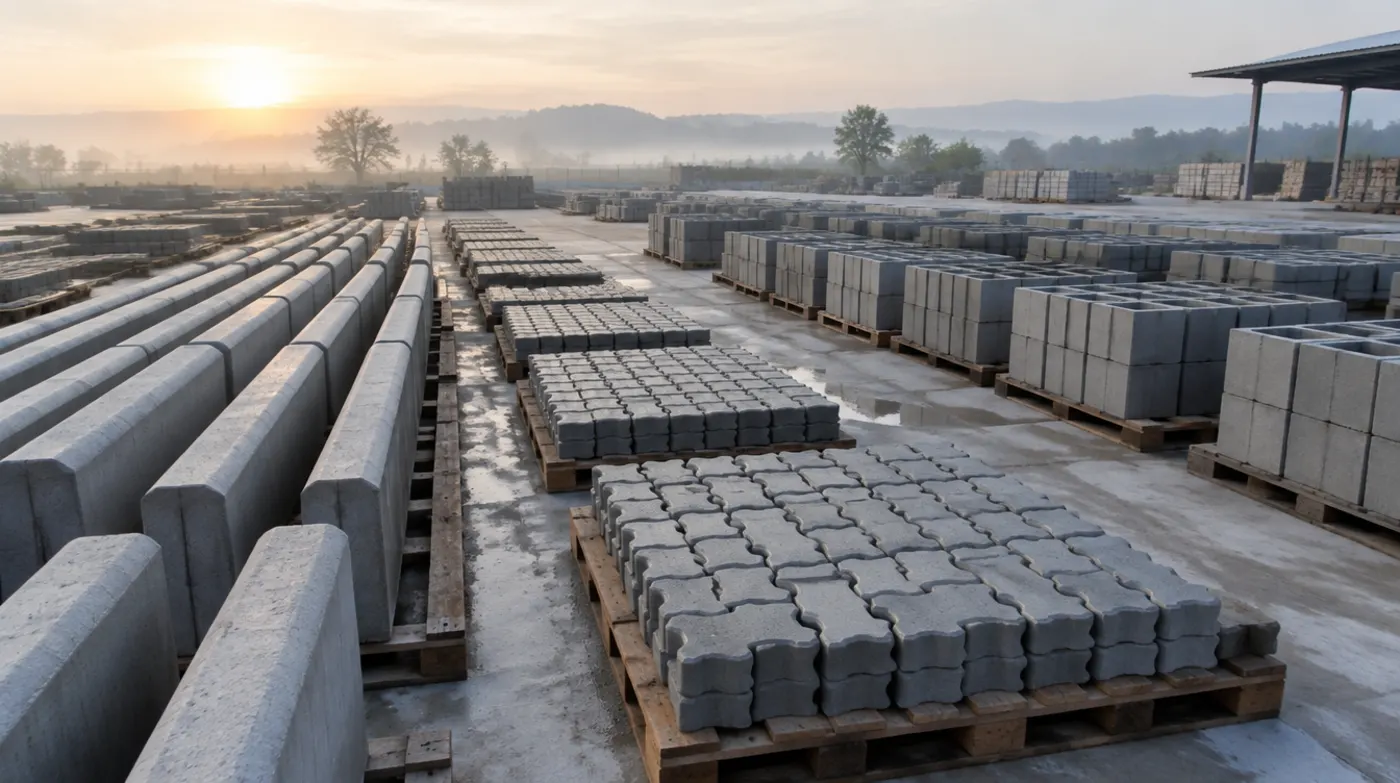
- Pressed curb: low-moisture concrete (known as dry concrete) is placed in a steel mold and compacted by a combination of vibration and press force. The unit leaves the mold immediately and the mold is ready for the next cycle. The result is a dense unit with uniform dimensions, which is why this method is common in mass production.
- Vibrated curb: more fluid concrete is poured into the mold and compacted by vibration alone. The unit has to stay in the mold for some time to reach initial set, so high output requires a large number of molds.
- Cast-in-place curb: the curb is built directly on the project site using continuous formwork. It is used on some long or curved routes, but its quality control depends more on site conditions, weather and the installer’s skill, and local repairs are also harder.
To learn more about production challenges, the water-cement ratio and quality standards, read our article on concrete curb production.
Pressed or Hand-Made Curbs: What Is the Difference for a Buyer?
What the market calls a “hand-made” or “molded” curb is usually a vibrated curb made with more fluid concrete, or a workshop curb made without a press. For a buyer, the difference between the two shows in the finished product, not in the name:
| Feature | Pressed curb | Hand-made or vibrated curb |
|---|---|---|
| Edge and chamfer | Sharp and consistent along the whole length | Sometimes rounded or incomplete because the mold corner did not fill |
| Suitable for | City streets, contractor projects and high volumes | Low output, special units and light landscaping use |
How to Check Concrete Curb Quality at Delivery
Once installed, a concrete curb spends years under traffic, water, salt and frost, and replacing it costs more than buying it. For official projects, laboratory tests (strength, water absorption and durability) are carried out according to the contract’s technical specifications and the relevant national standard, and those remain the final reference. Before the lab, however, a few simple checks at the point of delivery reveal most serious defects. As a manufacturer of curb machines and molds, we recommend the same checks to customers setting up a production line, because each one traces back to a specific production stage:
| What to check | How to check on site | Usual source of the defect |
|---|---|---|
| Dimensional uniformity | Lay several units side by side on level ground and measure height, length and thickness with a tape. A stepped top edge or uneven joints are a warning sign. | Worn or deformed mold, uneven mold filling |
| Chamfer and edges | The chamfer should be straight and the same width along the whole length, and edges should not crumble under normal handling. | Mold manufacturing accuracy, insufficient compaction at the corners |
| Surface and porosity | The surface should have no large voids, honeycombing or hairline cracks, and running a hand over it should not rub off powder or loose grains. | Wrong water-cement ratio, too little vibration or pressure, poor aggregate grading |
| Water absorption | Pour a little water on the dry surface of a cured unit. If the water sinks in very quickly and a dark stain spreads fast, the unit is probably porous. This is only an indication and does not replace a laboratory water absorption test. | Low density and incomplete curing |
| Curing and age of the unit | Ask for the pallet’s production date. A unit fresh from the mold, still dark and damp, is too young to load and install. | Rushed delivery, not enough space for curing |
| Color uniformity | Units in a shipment should be close in color, especially colored and two-layer curbs. | Change of cement or pigment between batches, uneven mixing |
| Breakage in transit | Count the broken and chipped units on each pallet. A high share of rejects points to low strength, not just careless handling. | Low strength, loading before sufficient set |
If you are a producer yourself, this table is really your production line’s checklist: dimensional accuracy and the chamfer come down to the concrete curb mold; density and porosity to the machine and its vibration and press settings; water absorption and color to the mix design and curing. The production stages and their common errors are covered in the production methods article mentioned above, so we will not repeat them here.
Machines and Molds for Making Curbs in a Workshop
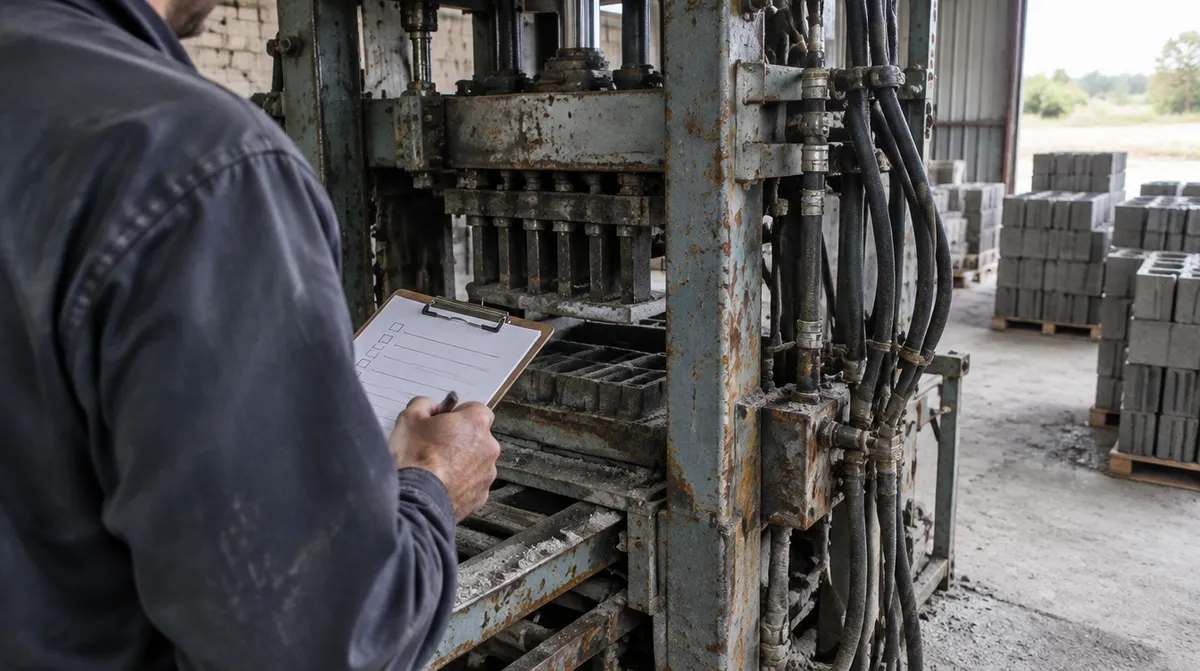
Making curbs at workshop or industrial scale takes two main components: a machine that compacts the concrete in the mold and releases the unit, and a mold that sets the unit’s shape and dimensions. The choice of equipment depends on production volume, workshop space, product range and budget. Below we go through the machines in two groups, mobile and stationary; the full list is on the curbstone making machine page.

Mobile Curb Machines
Mobile machines are designed for production on the project site or in small and medium workshops, and the mold stands upright in them.
- M.CS mobile hydraulic curbstone making machine: a machine with a 1 m³ hopper and a dual hammer and press system with 4 tons of force, producing 30×50 and 50×50 curbs in cycles of about 2 minutes. Its specifications list a curb length of 30 to 100 cm, and a PLC or a winch can be added. This model is dedicated to curbs and does not make blocks.
- M.KC semi-hydraulic curbstone machine: a model without a hopper, with a non-hammer hydraulic press and two adjustable vibrators at the front and rear of the mold, producing curbs up to 50 cm high. Besides 30×50 and 50×50 curbs, it is also offered for ancillary units such as canyo and drain units. A PLC cannot be added to this model, and it requires an 800-liter mixer and a 32-amp three-phase power supply.
Multi-Purpose Stationary Machines
Stationary machines work on pallets and, with a mold change, make blocks and pavers as well as curbs. In these machines, the curb mold is usually designed to lie flat.
- TM-110 single-hopper machine: a capacity of 80 to 120 pallets per hour, 180 bar hydraulic pressure and product height adjustable from 50 to 300 mm; it makes six 30×50 curbs per pallet.
- TM-210 double-hopper model: a capacity of 80 to 120 pallets per hour, making six 30×50 curbs per pallet.
- TM-218 double-hopper machine: hydraulic pressure up to 200 bar and a capacity of 80 to 100 pallets per hour, making eight 30×50 curbs per pallet. Its double-hopper system allows a colored face layer and a structural layer to be produced at the same time, and it is offered for two-layer colored curbs and pavers.
All these figures come from the manufacturer’s published specifications, are approximate, and depend on factors such as materials, mix design and operator skill. If your initial budget is limited, a used curbstone making machine is also an option; just have an expert check the hydraulics, vibrators and mold compatibility before buying. For a comparison with one of the well-known machines on the market, see our article on the specifications and operation of the Cadona curb machine.
Which Tarahan Machine Makes Which Curb?
If you want to make curbs yourself, the first question is what curb each machine makes and how many units you get per run. The table below lists only the figures stated consistently across the curbstone making machine and product pages of Tarahan Machinery. On stationary machines a “run” means one pallet, and on mobile machines it means one cycle.
| Machine | Type | 30×50 curbs per run | 50×50 curbs per run | Suitable for |
|---|---|---|---|---|
| M.KC | Mobile, semi-hydraulic | 6 pcs | 6 pcs | Small and medium workshops, on-site production; canyo and drain units too, with the matching mold |
| M.CS | Mobile, fully hydraulic | 6 pcs | 6 pcs | Contractors and municipalities with several scattered projects; a PLC can be added |
| TM-208 | Stationary, double-hopper | 3 pcs | — | Small fixed-site workshops that also want colored curbs or pavers |
| TM-110 | Stationary, single-hopper | 6 pcs | — | Continuous production of curbs, blocks and single-color pavers |
| TM-210 | Stationary, double-hopper | 6 pcs | — | Same uses as the TM-110, plus two-layer products |
| TM-112 | Stationary, single-hopper | 8 pcs | — | Higher output with a single hopper |
| TM-118 | Stationary, single-hopper | 8 pcs | — | Concrete products plants doing mass production |
| TM-218 | Stationary, double-hopper | 8 pcs | — | Mass production of two-layer colored curbs and pavers |
The “—” mark means no figure for the 50×50 curb appears in that model’s published specifications; check with a technical expert whether a mold can be made for it. All figures are approximate and depend on materials, mix design and operator skill. The practical point of this table is that the number of mold cavities is set by the size of the machine’s pallet or mold carrier, so if you later want to change curb dimensions or edge type, a new mold must be made for that same machine.
The Curb Mold: The Component That Determines Visual Quality
The machine provides the compaction, but the mold determines the curb’s final shape, edge and surface. Industrial curb molds are usually made of ST37 steel and, where needed, the inner surfaces are made from wear-resistant plate such as CK45 or Hardox to extend mold life in continuous production. Building an accurate mold involves laser cutting the plate, welding with distortion control, machining critical areas, and a dimensional check before delivery.
When ordering a concrete curb mold, specify the following: curb dimensions (length, height and thickness), edge type (square, chamfered or curved), surface finish (smooth or patterned), number of cavities (single-cavity for limited output, multi-cavity for high output) and machine model. The mold must be matched to your machine’s mounting points and vibrator locations so the unit releases cleanly. Complementary units such as corner, start and end units also need separate molds. Other molds for concrete products are in the concrete molds category.
Which Curb Is Right for Each Project?
Choosing a concrete curb starts with where it will be used, not with the price. A curb that is fine for a garden bed soon breaks under wheel strikes on a boulevard edge, and a heavy street curb along a lawn is just extra cost and weight. The table below is an initial guide; on projects with drawings, the project’s technical specifications take priority:
| Location | Suitable curb | What to watch for |
|---|---|---|
| Street, boulevard and traffic circle edges | Pressed street curb, usually chamfered | Sufficient thickness, high density, and curved and corner units planned for intersections |
| Sidewalks and side streets | Pressed curb in common sizes such as 30×50 | Matching height to the sidewalk pavers and a uniform curb line |
| Parks, garden beds and residential grounds | Shorter garden curb, rounded or chamfered | Appearance and color matter more than load capacity; a colored or two-layer curb is a good option |
| Parking lots and industrial yards | Heavy-duty pressed curb together with canyo or drain units | Design the surface water path and the connection between curbs and drain units from the start |
| Yards and small personal use | Ready-made curb or hand-made with a simple mold | For a few meters of curb, making it at home is possible; for a public road, it is not |
A few more points to settle before ordering or starting production:
- Match the drawings: check dimensions, edge type and color against the project specifications, and include complementary units (corner, start and end) in the order.
- For producers: before buying a machine, determine your daily production volume, workshop space, available power and future product range (curbs only, or curbs, blocks and pavers). These four factors decide between a mobile and a stationary model.
Making a Concrete Curb at Home: Is It Possible?
In short: for small jobs, yes. If you need a few meters of curb for a garden bed or yard, you can make a few units with a simple cement curb mold (metal or wood with a smooth inner surface), ordinary concrete and a little patience. The general procedure is:
- Clean the mold and coat its inner surface with form oil so the concrete does not stick.
- Mix the concrete with a fixed ratio of materials and water. Extra water makes it easier to work but lowers the strength of the unit.
- Pour the concrete into the mold in layers and tap the mold body or rod the concrete to drive out air bubbles.
- Level the surface and keep the unit in the mold until it has set sufficiently.
- After demolding, keep the unit moist for several days and cure it out of direct sunlight.
You should be realistic about the limits, though. Without industrial vibration and pressing, the concrete does not compact uniformly: the unit is likely to be more porous, its edges break sooner, and it holds up less well to freeze-thaw cycles. The units rarely come out exactly the same size, either. Each mold yields only one or a few units per run and you have to wait for the concrete to set, so output is very low. That is why a homemade curb is acceptable for a garden bed and personal use, but public roads, contractor projects and products for sale call for machine production.
Concrete Curb FAQ
What is the difference between a pressed curb and a hand-made curb?
A pressed curb is made from low-moisture concrete by a combination of vibration and press force in a steel mold, and leaves the mold immediately; the result is high density, few voids and uniform dimensions. A hand-made or vibrated curb is made from more fluid concrete compacted by vibration alone, stays in the mold for some time, and its quality depends more on the worker’s skill; it is better suited to low output and special units.
What are the most common concrete curb sizes?
30×50 and 50×50 cm are among the best-known sizes on the Iranian market. Because sellers do not all write dimensions in the same order, specify length, height and thickness separately when ordering. Custom sizes are usually used for garden curbs and for corner, curved, start and end units.
What is a chamfered curb and what is its advantage?
A chamfered curb is one whose top corner is cut at an angle. The chamfer reduces stress concentration at the corner, cuts down on chipping during handling and wheel strikes, and is less hazardous to pedestrians, which is why it is common along city streets. The chamfer is formed in the mold itself and should be uniform along the whole length of the unit.
What is the difference between a concrete curb and a cement curb?
In market usage, the two names refer to the same product. The curb is made of concrete (a mix of cement, aggregate and water) and cement is only its binder, so “concrete curb” is the more accurate name.
How do you check concrete curb quality at delivery?
Lay several units from different pallets side by side and check the uniformity of dimensions and the top line, inspect the chamfer and edges for chipping, examine the surface for voids, hairline cracks and powdering, and ask for the pallet’s production date to confirm adequate curing. On official projects, laboratory strength and water absorption tests under the project’s technical specifications are the final reference.
Conclusion
A concrete curb looks like a simple unit, but it plays an important role in keeping roads orderly, restraining paver edges and directing water. Choosing the right one means knowing the curb type (street, garden, drain and canyo, or colored), paying attention to the dimensions your project needs, and making sure of proper compaction and curing. For small jobs, making curbs at home with a simple mold is possible, but reliable production for roads and contractor projects requires a press or vibration curb machine and an accurate mold.
If you plan to start curb production or order a mold and are unsure about choosing between a mobile and a stationary machine or about mold dimensions, call the experts at Tarahan Machinery at +98 41 3630 4464 for guidance based on your production volume and workshop conditions.



Submit Comment: