


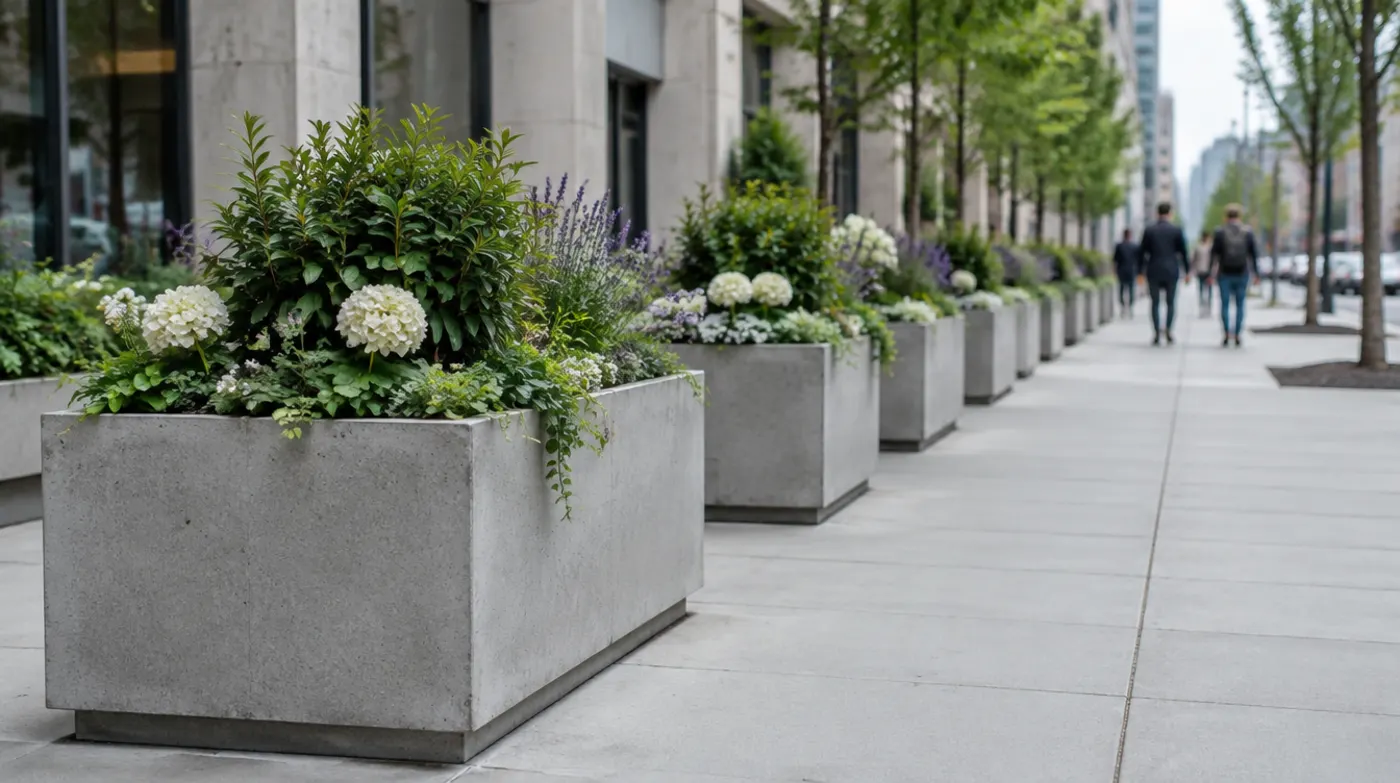
A concrete flower box is a precast concrete planter or planter block made for growing plants in urban spaces, building grounds, green walls, and soil slopes. These units are produced in a workshop or factory using steel molds, vibration, and controlled curing, then delivered to the project site ready for use. If you need only a few planters, you can make them by hand, but uniform series production calls for a steel mold and either a vibration table or a press machine.
Below, we distinguish the two main families of cement flower boxes, explain where each one is used, compare the four Tarahan concrete flower box molds using their actual specifications, and show how industrial production differs from handmade work and what to check when buying a mold.
What Is a Concrete Flower Box and What Types Are There?
On the market, the name “concrete flower box” covers two fairly different products. It pays to tell them apart from the start, because each one has its own mold, production method, and customer base.
1. Urban and Landscape Planters
This is what most people picture when they hear “flower box”: large cubic, cylindrical, or rectangular planters placed on sidewalks and squares, in parks and parking lots, and at the entrances of building complexes. These units are usually freestanding, with a base and walls. They are decorative and sometimes also act as barriers, for example by keeping cars off a sidewalk. Surface appearance, clean edges, and uniform color matter a great deal with this type, because the unit stands in plain view.
2. Planter Blocks for Green Walls and Slopes
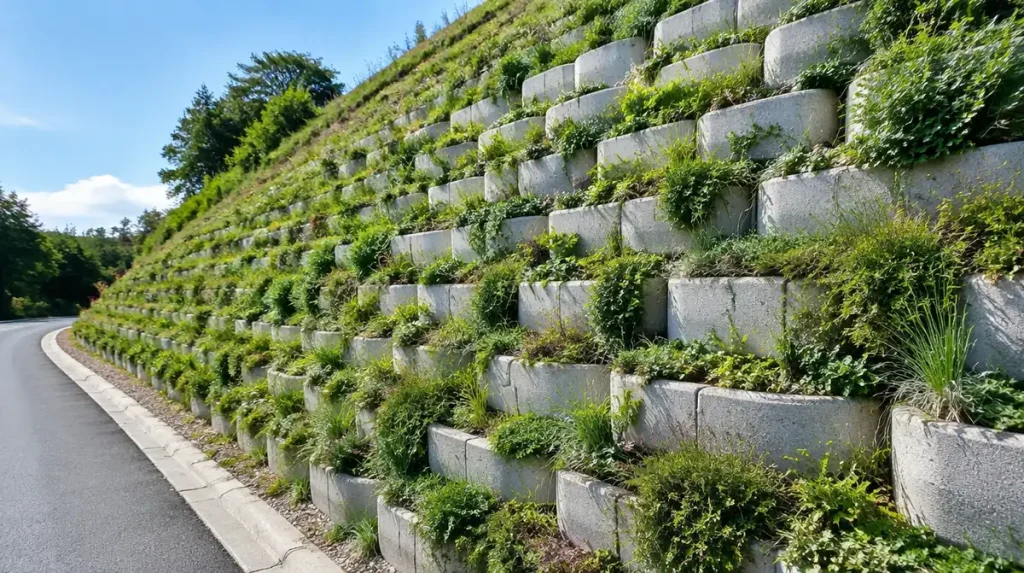
The second type, also known on the market as “slope planters,” consists of blocks stacked on top of and next to each other to form a wall or stepped slope, with soil and plants set into each block. These blocks are used in road cuts, earth embankments, highway edges, sloping gardens, and any site where soil slippage and erosion must be stopped. Three of Tarahan’s four mold models (Model 1, Model 2, and the Terra model) are designed specifically for this job, and the stepped model is used for stairs, concrete seating, and sloped walls.
The key difference between the two groups is that with slope blocks, what decides the outcome is not only appearance but also the weight of the unit, the wall angle, the achievable height, and how the wall ties into the soil behind it (soil reinforcement).
Uses of Cement Flower Boxes
- Street furniture: Large planters on sidewalks, squares, boulevards, and in parks. Municipalities and landscaping contractors are among the main buyers of these units.
- Building landscaping: Entrances to residential complexes, offices, hospitals, shopping centers, and parking lots, where both greenery and clearly defined paths are wanted.
- Erosion control and slope stabilization: In road cuts and earth slopes, planter blocks form a retaining wall while plant roots hold the soil in place.
- Green walls: Tall stepped walls that create a green surface in place of gray concrete.
- Terraces and sloping gardens: Creating planting platforms on steep residential plots and in gardens.
- Stairs and concrete seating: Stepped blocks that serve as both stairs and planting space, or as both seating and a garden bed border.
Along with curbs, pavers, and drainage channels, the concrete flower box counts as a landscape concrete product. For a fuller picture of this family, see our article on the types of concrete products and their uses. To learn about a closely related product, the curb, our article What Is a Concrete Curbstone? is also useful.
Four Tarahan Concrete Flower Box Mold Models
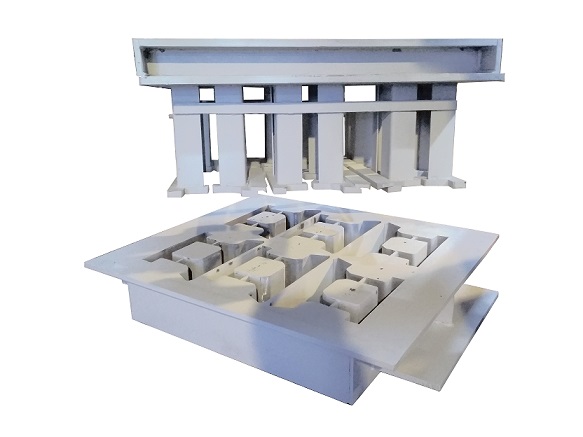
Tarahan Machinery offers its flower box mold in four main models, each suited to a particular type of slope and project. The table below lists the specifications given on the product page:
| Specification | Model 1 | Model 2 | Model 3: Stepped | Model 4: Terra |
|---|---|---|---|---|
| Main use | Sloped areas of medium height | Large civil projects and tall walls | Stairs, concrete seating, and sloped walls | Gardens on sloped surfaces and erosion control |
| Weight per block | About 52 kg | About 82 kg | About 18 kg | About 20 kg |
| Wall angle / site slope | Wall 45 to 70 degrees | Wall 60 to 90 degrees | Site slope 20 to 40 degrees | Site slope 35 to 90 degrees |
| Cut height | Up to 3 m | Up to 20 m without an intermediate terrace | Not stated | Not stated |
| Soil volume | Medium | Large | Not stated | Not stated |
| Cement content / compressive strength | 400 / 350 | 400 / 350 | Not stated | Not stated |
| Root-to-soil connection | Through the base | Through the back | Not stated | Not stated |
| Soil reinforcement | Geogrid and geotextile | Geogrid, geotextile, polymer or steel strips | Not stated | Not stated |
| Plant type | Seasonal and deciduous plants | All kinds of plants, including evergreens | Not stated | Not stated |
| Special note | Limited for evergreens and sensitive-rooted plants | Suited to tall walls | Serves as both a stair and a planter | About 16 blocks per square meter; size and angle can be adapted to the installation site |
Model 1: Slopes of Medium Height
Model 1 is designed for cuts up to about 3 m high, with a wall angle of 45 to 70 degrees. Each block weighs about 52 kg, and plant roots reach the soil below through the base of the block. Because each block holds a medium volume of soil, it works best with seasonal and deciduous plants, and its use for evergreens or sensitive-rooted plants is limited. If your project is a roadside or a site with an ordinary change in elevation, this model, with its lower weight and lower allowable height, is a better fit than Model 2.
Model 2: Tall Walls and Large Civil Projects
Model 2 is the heaviest model (about 82 kg) and is specified for walls up to 20 m high with no need for an intermediate terrace. The wall angle is 60 to 90 degrees, which means you can build an almost vertical wall. The larger soil volume and the root connection through the back of the block let you plant all kinds of species, including evergreens. At this height, soil reinforcement (geogrid, geotextile, or polymer or steel strips) is a critical part of the design and must be coordinated with the project’s geotechnical consultant.
Model 3: Stepped
The stepped model weighs about 18 kg, is intended for slopes of 20 to 40 degrees, and is used in the design of stairs, concrete seating, and sloped walls. Its lighter weight makes it easier to move and lay by hand, and it is a good choice for parks, gardens, and public spaces that need both a walkway and greenery.
Model 4: Terra
The Terra model is made for building gardens on sloped surfaces and controlling soil erosion, and it covers a wide slope range: 35 to 90 degrees. Each block weighs about 20 kg, and about 16 blocks are laid per square meter, a figure that helps with a first estimate of unit count and production volume. An important feature of the Terra is that its size and angle can be changed to suit the installation site.
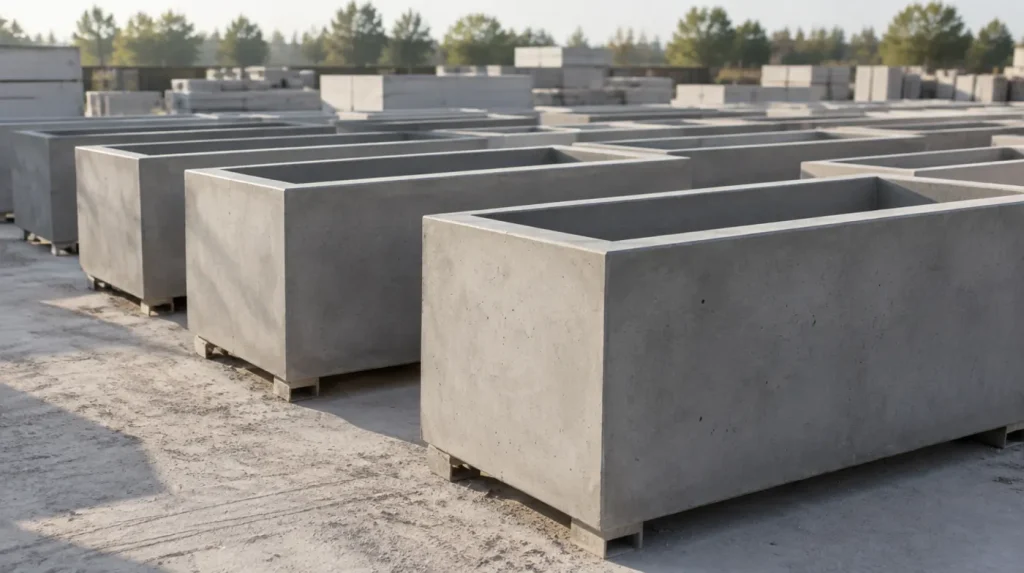
How Is a Concrete Flower Box Made in a Factory?
In principle, industrial flower box production is no different from that of other precast concrete products. The main steps are:
- Mold preparation: The steel mold is cleaned, oil or release agent is applied to the contact surfaces, and the mold parts are assembled and aligned with their locks and clamps.
- Concrete preparation: Cement, sand, fine gravel, and water are blended in a mixer in set proportions. For units with an exposed face, a finer gradation and a more uniform mix usually give a better surface. If you want color, concrete pigment is also added at this stage. The exact mix design must be adjusted and tested based on the available materials and the target strength.
- Casting and compaction: Concrete is poured into the mold and compacted by vibration to drive out trapped air and make the concrete fill every corner and edge. In mold-based production, this is usually done on a vibration table; on press lines, vibration and pressing work simultaneously.
- Demolding: When the mold can be opened depends on the type of concrete and the production method. With wet-cast molds, the unit usually has to stay in the mold for some time until it is firm enough; a mold that opens and closes quickly makes this stage shorter and less risky.
- Curing: The unit must stay moist and protected from direct sun and wind for several days so that the cement hydrates properly. Incomplete curing means a powdery surface, fine cracks, and lower strength than expected. We cover curing principles for concrete products in more detail in our article on principles of cement block production and curing.
- Quality control and storage: Checking dimensions, chipped edges, cracks, and surface voids, then stacking the units on pallets for shipping.
For slope green wall units, Tarahan’s product page lists a cement content of 400 and a compressive strength of 350 for Models 1 and 2. Reaching this strength depends on the mix design, material quality, compaction, and curing, and cement content alone does not guarantee it, so take concrete sampling and testing seriously.
Vibration Table or Press Machine?
There are two main routes to series production of flower boxes:
- Mold + vibration table: Concrete is poured into the mold and compacted on a vibration table. This route needs less initial capital and suits larger units, varied designs, and medium production volumes. Output depends on how many molds you have and how long each unit stays in its mold. According to the product page, Tarahan’s flower box mold is compatible with vibration tables and semi-automatic lines.
- Stationary press and vibration machine: According to Tarahan, the stationary TM series machines can produce concrete planters as well as curbs and pavers by changing the mold. The unit leaves the mold immediately after pressing and output is much higher, but this route requires more capital, space, and infrastructure. The stationary TM series models offered for this work are listed on the flower box making machine page.

If you are still undecided between these two routes, our overview of the types of concrete product machines shows where each machine sits in a production line. For a workshop that wants to produce several landscape products (planters, curbs, pavers) side by side, a semi-automatic production line is also worth considering. For lower output, a semi-automatic block making machine is another option to look at.
Making a Cement Flower Box at Home or in a Small Workshop
If you only want a few planters for your own yard, terrace, or building entrance, making them by hand is entirely feasible. The simple method is:
- Build a double-walled mold: an outer box and a smaller inner box (made of plywood, plastic sheet, or even two plastic buckets or tubs of different sizes). The gap between the two boxes becomes the planter’s wall thickness.
- Oil the inside of the outer mold and the outside of the inner mold so the concrete does not stick.
- Pour the base first and set a piece of pipe or a wooden dowel in it to form a drainage hole.
- Place the inner mold on the base, hold it down with a weight, and fill the gap between the two molds in layers. Tap the sides of the mold or shake it to release trapped air.
- For larger planters, place wire netting or a light mesh in the middle of the wall to improve resistance to cracking and impact.
- Once the concrete has set, open the mold and keep the planter moist and covered for several days.
To be realistic, this method works for a few pieces but not for commercial sale or municipal projects. Wooden and plastic molds warp after a few uses, the units do not come out the same size, the surface fills with tiny voids without vibration, and the edges chip quickly. When you have to deliver dozens or hundreds of identical planters, or make blocks that interlock in a slope wall, you need a precise steel mold and uniform vibration. The same applies to curbs and similar products.
What to Check When Buying a Flower Box Mold
Whether you need a concrete box mold for urban planters or a planter block mold for slopes, the mold determines the final quality of the unit. Tarahan focuses on the points below when building its urban concrete planter mold, and you should ask about them when comparing any mold:
- Inner surface quality: The mold’s contact surfaces must be polished so the unit comes out smooth, without voids or fine cracks. Every line and rough patch on the mold repeats on every unit.
- Chamfers and edge radii: Sharp concrete edges chip during demolding and shipping. A good mold has suitable chamfers and radii built into its design.
- Drainage holes and irrigation path: A planter that holds water damages roots. The mold must provide for drainage holes and, where needed, a path for an irrigation hose.
- Handling points: In a large cement planter mold and for heavy units, hand grips, lifting inserts, or reinforced points for safe handling must be built into the mold.
- Body material: A steel body that withstands concrete pressure and moisture lasts longer in repeated industrial use and deforms less.
- Quick-release fasteners: Mechanical locks and clamps speed up opening and closing, giving you more cycles per working day.
- Replaceable liners: If the surfaces that wear most can be replaced, the mold has a longer economic life.
- Guide pins and plates: For precise alignment of the mold parts and to prevent seam marks on the planter surface.
- Compatibility with your equipment: The mold must match your vibration table or production line. Tarahan’s flower box mold can be used on semi-automatic lines and on vibration tables.
- Customization options: If your project needs special dimensions or a special shape, find out whether the manufacturer will build the mold to your drawing. Tarahan also builds molds in custom dimensions and designs.
The mold manufacturing process matters too. At Tarahan, mold making includes engineering design, laser cutting, controlled welding, localized heat treatment, and finally dimensional and surface quality control. You can see other landscape molds, such as curb, drainage channel, and paver molds, in our concrete molds category. To learn more about the models, also read our guide to types of concrete molds.
What Information to Prepare When Ordering a Mold
Prepare the drawing or the required project specifications: the shape of the planter or block, its dimensions, handling requirements (unit weight and handling method), and irrigation requirements. If you want slope blocks, also state the site slope angle and the wall height so the right model can be recommended. After reviewing these, Tarahan’s technical team will provide a technical proposal, the manufacturing time, and a cost estimate.
Installation Tips for Planter Blocks on Slopes and Green Walls
A slope planter block is not just a planter; it is part of a soil-retaining structure. A few key points:
- Choose the model by slope and height: Model 1 is specified for cuts up to about 3 m, Model 2 for tall walls up to 20 m, the stepped model for slopes of 20 to 40 degrees, and the Terra model for slopes of 35 to 90 degrees.
- Take soil reinforcement seriously: The product page lists geogrid and geotextile for Model 1, and geogrid, geotextile, or polymer or steel strips for Model 2. Geogrid reinforces the soil layers behind the wall, while geotextile usually acts as a separator and filter so that fine soil is not washed out with the water. The length and spacing of these layers must be set by the structural or geotechnical designer.
- Foundation and first course: The first course must be laid on a compacted, level bed; any misalignment in the first course grows larger in the courses above.
- Drainage behind the wall: Water collecting behind the wall exerts heavy pressure. Include a drainage layer and a water outlet path in the design.
- Match the plant to the model: Seasonal and deciduous plants are better suited to Model 1; if you want evergreens, Model 2, with its larger soil volume and root connection through the back, is the better option.
Urban Flower Box or Planter Block: Which Suits Your Production Better?
If your customers are municipalities, parks departments, and volume housing developers, urban and landscape planters with a clean look and varied dimensions have the more direct market. If you work with road contractors, civil projects, and landscaping on sloped land, slope planter blocks such as Models 1, 2, and Terra see project-based, high-volume demand, meaning a single contract can call for hundreds or thousands of units. Either way, a few molds and a vibration table make a low-cost starting point, and if the market responds, you can move up to a semi-automatic line or a stationary machine. A factory looking to expand its product range can produce flower boxes alongside curbs and pavers on a concrete products production line.
Frequently Asked Questions
How does a concrete flower box differ from an ordinary cement planter?
There is little difference in material. “Flower box” mostly refers to large urban planters and precast planter blocks for projects, produced with steel molds and vibration in identical dimensions and with more consistent quality.
Can I make a cement flower box at home?
Yes. For a few pieces, it is feasible with a double-walled wooden or plastic mold, release oil, a drainage hole, and moist curing. Uniform series production requires a steel mold and vibration.
How much do Tarahan flower box blocks weigh?
According to the product page: Model 1 about 52 kg, Model 2 about 82 kg, the stepped model about 18 kg, and the Terra model about 20 kg.
Which model is suitable for a tall green wall?
Model 2, which is specified for walls up to 20 m high without an intermediate terrace, with a wall angle of 60 to 90 degrees, and which also allows evergreen planting.
Does a flower box mold work with a vibration table, or does it need a machine?
Tarahan’s flower box mold is designed for use on semi-automatic lines and on vibration tables. For very high output, stationary machines with dedicated molds are also available.
Can the mold be made in custom dimensions?
Yes. Tarahan builds molds in custom dimensions and designs; just send the shape, dimensions, and the project’s handling and irrigation requirements. The size and angle of the Terra model can also be changed to suit the installation site.
How much does a concrete flower box mold cost?
The price depends on the model, dimensions, degree of customization, and number of molds, and it is not fixed. The price of the concrete flower box itself also depends on its dimensions, unit weight, and order volume. For current prices, contact Tarahan’s specialists.
Conclusion
The concrete flower box comes in two distinct kinds: urban and landscape planters, where appearance matters, and slope and green wall planter blocks, where weight, angle, and connection to the soil are decisive. For a few personal pieces, handmade work is enough; for series and project production, the quality of the steel mold, proper vibration, and controlled curing determine the quality of the work. See the specifications of the four models and manufacturing details on the buy concrete flower box mold page, and for advice, model selection, and current prices, call +98 914 584 1914.


Submit Comment: