


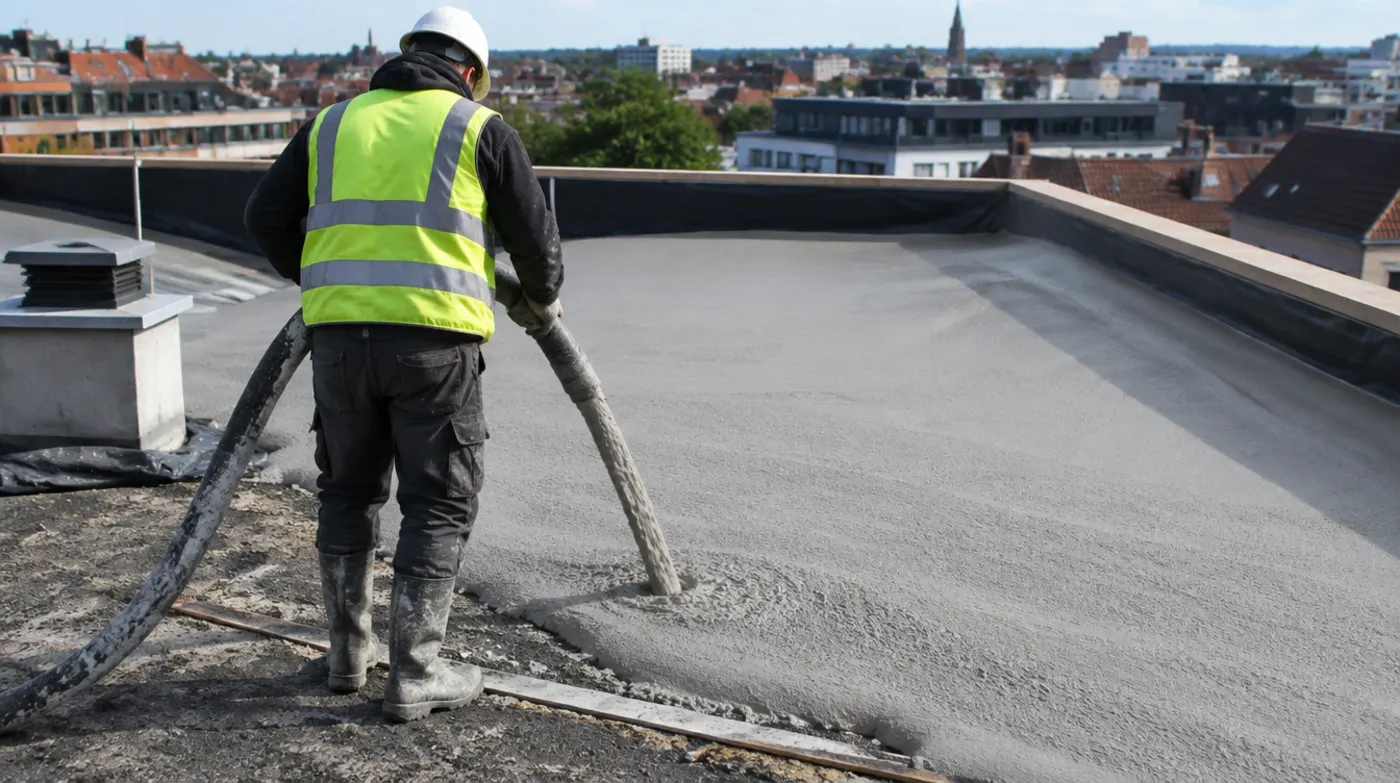
Foam concrete is a type of lightweight concrete made by blending cement slurry (cement, water and sometimes fine sand) with preformed foam. The foam traps tiny closed bubbles in the mix, and the result is a light, flowable, insulating material. A foam concrete machine does this work right on the job site: using a compressor and a lancer, it turns a foaming agent into foam, blends that foam with cement slurry in a mixer, and pumps the finished foam concrete through a monopump and hose up to the upper floors and the roof.
What Is Foam Concrete?
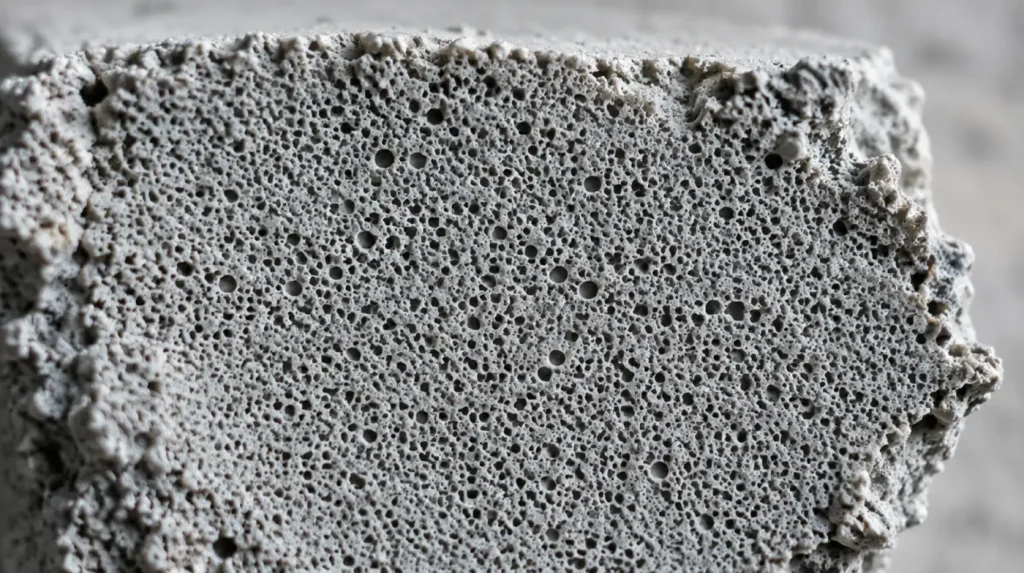
Normal concrete is made of cement, water, sand and gravel, and its coarse, heavy aggregate makes it heavy. Foam concrete leaves out the gravel, and air bubbles fill a large share of the volume instead. These bubbles come from a foaming agent, which is diluted with water and turned into stable foam by compressed air. The preformed foam is added to the cement slurry and mixed so the bubbles spread evenly through the mix. When the cement sets, the bubbles are locked inside the concrete, leaving a porous, cellular structure.
That is why foam concrete is also called “lightweight cellular concrete” or “foamed concrete,” and in technical literature it is known as CLC (short for Cellular Lightweight Concrete). The important point is that its density is not fixed. The larger the share of foam, the lighter and better insulating the concrete becomes, but its strength drops; the larger the share of mortar and sand, the heavier and stronger it gets. So the mix design has to be set according to the application, not taken from one fixed recipe for every job.
How Foam Concrete Differs from Normal Concrete
Foam concrete does not replace structural concrete. Columns, beams, slabs and foundations are built with normal and reinforced concrete, while foam concrete is used for non-structural layers, where the goal is to reduce weight, fill volume, create a slope or insulate. Its main advantage is that it is light and also flowable enough to fill a surface on its own and travel by pump to considerable heights.
Is Foam Concrete the Same as AAC (Hebel)?
No. Hebel, or AAC, is also a porous lightweight concrete, but its bubbles are created by a chemical reaction in a factory, and the blocks are cured in an autoclave (high-pressure steam). This takes heavy investment and factory equipment. Foam concrete, or CLC, is made with preformed foam, needs no autoclave and cures at normal temperature; it can be poured in place in a building or cast in molds to produce lightweight blocks. If you are curious about AAC itself and where it stands among lightweight blocks, see our article comparing lightweight wall blocks.
Foam Concrete Applications in Construction
Foam concrete is both placed in situ (pumped directly into the building) and used to produce lightweight blocks. These are the common applications:
- Roof sloping: Instead of the traditional pumice fill, foam concrete is pumped onto the roof slab to form the slope that directs water to the drains. The dead load on the slab is lower, and you also gain a thermal insulation layer.
- Floor filling (floor leveling): Filling height differences in floors, over piping and building services, before the mortar and final floor covering are installed.
- Thermal and sound insulation layer: The bubble structure of foam concrete transmits less heat and sound than normal concrete, which is why it is used as an insulating layer in floors and roofs.
- Void filling: Behind retaining walls, in trenches, in voids under floors or pipes, and in cavities that are hard to reach. Because foam concrete is so flowable, it fills every corner without vibration.
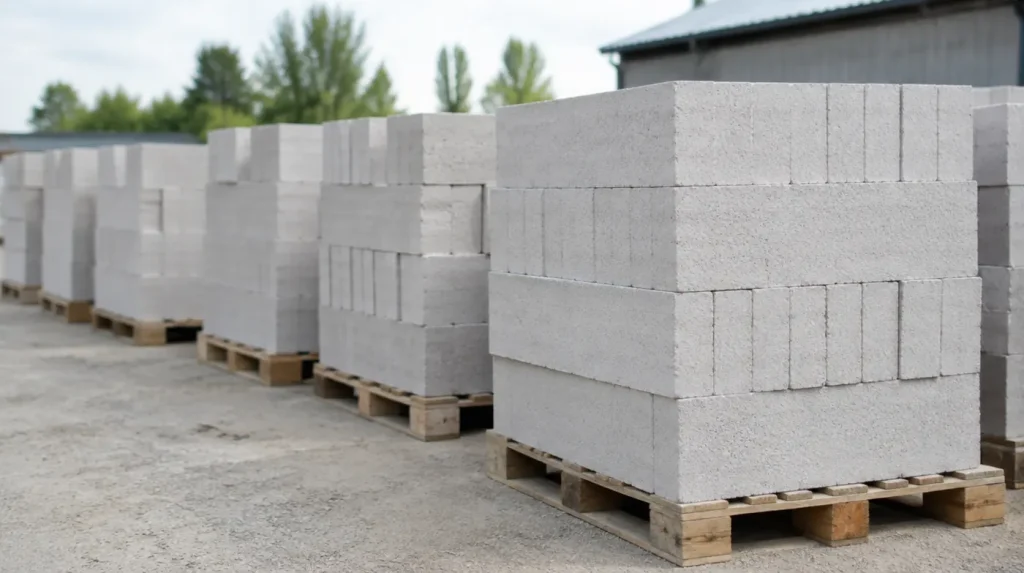
- CLC lightweight block: Foam concrete is cast in molds and, once set, used as a lightweight wall block for partitions and non-load-bearing walls.
What Is a Foam Concrete Machine and What Are Its Components?
A foam concrete machine is an assembly that performs three tasks in sequence: making foam, blending the foam with cement slurry, and delivering the foam concrete to the point of placement. The Tarahan foam concrete machine can be mounted on a Nissan pickup or a truck so it can move from one project to the next.

Air Compressor
The compressor supplies the compressed air that turns the water and foaming agent solution into foam. Models FM 20 and FM 22 use a 180-liter compressor, and models FM 37 and FM 40 use a 220-liter compressor. In the manufacturer’s table, the compressor column for FM 48 and FM 50 is blank (“–”), and an automatic foam injector is listed alongside the lancer; check with a sales specialist for details of the foam generation system on these two models. Stable air pressure directly affects bubble uniformity: unstable foam breaks down in the mix, and the concrete comes out heavier than designed.
Foam Generator, or Lancer
The lancer is a pipe in which the foaming solution and compressed air collide, so that dense, fine-bubbled foam comes out of its tip. Foam quality, meaning how fine and uniform the bubbles are, depends on this part and its correct adjustment, as well as on the quality of the foaming agent and the air pressure. Tarahan models use a 2-inch lancer, and on the two larger models, FM 48 and FM 50, the lancer works together with an automatic foam injector. Many people look for ways to build a homemade foam concrete lancer. The reality is that a non-standard lancer usually produces coarse, unstable foam, and the initial savings are lost in concrete quality and foaming agent consumption.
Mixer
The mixer is where the cement slurry is prepared and the foam is added to produce a uniform mix. Mixer volume on Tarahan models is 1, 2 or 2.5 cubic meters, and it directly affects the machine’s daily capacity. Mixing has to be just enough, because long, intense mixing breaks the bubbles. To learn more about the differences between mixer types in concrete lines, see our guide to concrete mixer types.
Monopump and Hose
The monopump (a screw pump) sends foam concrete into the hose at steady pressure, without pulsing. This type of pump suits foam concrete because its gentle flow breaks fewer bubbles. Pumping height on Tarahan models is 35 or 60 meters, which means the machine stays on the ground while the concrete travels through the hose up to the roof of a multi-story building.
Electrical Panel and Electric Motors
According to the manufacturer’s specifications, the electrical components of Tarahan foam concrete machines are LS-LG brand, and the electric motors are made by Motogen of Tabriz.
How Does a Foam Concrete Machine Work?
For in-situ work (roof sloping, for example), the process usually has these steps:
- Prepare the foaming solution: The foaming agent is diluted with water at the ratio recommended by its manufacturer.
- Generate the foam: The solution enters the lancer along with compressed air from the compressor, producing stable foam.
- Make the slurry: Cement and water (plus fine sand if needed) are mixed in the mixer to produce a uniform, lump-free slurry.
- Blend foam and slurry: The foam is added to the slurry, and the mix is stirred until its color and texture are even.
- Pump: The monopump delivers the foam concrete through the hose to the point of placement.
- Spread and level: On the roof, the concrete is poured between screed rails or preset level points and smoothed to the designed slope.
- Cure: The surface is kept moist and protected for several days to prevent cracking, and then the following layers, such as mortar and waterproofing, are applied.
For block production, steps 1 to 4 are the same, but instead of being pumped to a roof, the foam concrete is cast in molds. After initial setting, the blocks are removed from the molds and cured.
Tarahan Foam Concrete Machine Model Specifications
Tarahan Machinery builds the foam concrete machine in six models. The main differences between them are pumping height, mixer volume and, as a result, working capacity in an 8-hour shift:
| Model | Pumping height | Compressor | Monopump | Lancer | Mixer volume | Capacity in 8 hours |
|---|---|---|---|---|---|---|
| FM 20 | 35 m | 180 liters | 60 – 2 inch | 2 inch | 1 m³ | 20 m³ |
| FM 22 | 60 m | 180 liters | 80 – 2 inch | 2 inch | 1 m³ | 22 m³ |
| FM 37 | 35 m | 220 liters | 60 – 2 inch | 2 inch | 2 m³ | 37 m³ |
| FM 40 | 60 m | 220 liters | 80 – 2 inch | 2 inch | 2 m³ | 40 m³ |
| FM 48 | 35 m | – | 60 – 2 inch | 2 inch, automatic foam injector | 2.5 m³ | 48 m³ |
| FM 50 | 60 m | – | 80 – 2 inch | 2 inch, automatic foam injector | 2.5 m³ | 50 m³ |
The table follows a simple pattern: models FM 20, FM 37 and FM 48 are for a 35-meter pumping height, while models FM 22, FM 40 and FM 50 (monopump “80 – 2 inch” in the manufacturer’s table) pump up to 60 meters. Within each group, daily capacity rises as the mixer gets bigger. For more details, visit the portable foam concrete machine page.
Portable Foam Concrete Machine or CLC Lightweight Block Production Line?
Before choosing a model, be clear about whether you want to place foam concrete or produce it. A contractor who does roof sloping and floor filling needs a machine that can go to the project site and pump concrete up to the upper floors. Someone who wants to sell lightweight blocks needs a fixed workshop, molds, a silo and material handling equipment. For the second case, the Tarahan CLC lightweight block production line is the right option, and its capacity is designed around the needs of each workshop.

| Criterion | Portable foam concrete machine (FM) | CLC lightweight block production line |
|---|---|---|
| Main use | In-situ placement: roof sloping, floor filling, void filling | Producing lightweight blocks for sale or for project use |
| Work location | Project site; can be mounted on a Nissan pickup or a truck | Fixed workshop or factory |
| Concrete transfer | Monopump and hose up to a height of 35 or 60 m | Casting in molds |
| Capacity | 20 to 50 m³ in 8 hours (depending on model) | Depends on line design and number of molds (check with a sales specialist) |
| Accompanying equipment | Compressor, lancer (with automatic foam injector on FM 48 and FM 50), mixer, monopump | Cement silo, sand hopper, belt conveyor, cement screw conveyor, mixer, weighing scale, foam generator, air compressor, concrete cart and block cart |
| Revenue model | Contracting and placement priced by the meter | Block sales |
The Tarahan CLC line comes in two forms: with one-piece molds, where the blocks are cut with a cutter after setting and the line runs on rails, or with multi-piece molds, which need no cutter and cost less to invest in. According to the product page, all machinery in this line carries a one-year warranty. You can find the full equipment list for this section in the stationary CLC lightweight concrete production line machinery category.
What Does “Manual Foam Concrete Machine” Mean?
Many people who search for a “manual foam concrete machine” are really looking for a small, portable, simple machine that one or two workers can operate, not a machine that runs entirely by hand. Making stable, uniform foam without foam-generating equipment is very difficult, and blending foam with slurry by hand does not give uniform concrete. For smaller jobs, the smaller models in the FM family, such as the FM 20 with its 1 m³ mixer, are the more sensible option; see the small, portable models in the portable foam concrete machine category.
Advantages and Limitations of Foam Concrete
Foam concrete is a good material for the jobs it is meant for, but it does not work everywhere. Here is the realistic picture:
Advantages
- Low weight: It puts less dead load on the slab and the structural frame, which matters especially for roof sloping and floor filling.
- Insulation: Its bubble structure lets less heat and sound through than normal concrete.
- Flowability and fast placement: It fills the surface on its own, needs no vibration and reaches the upper floors by pump, with no hauling of materials by wheelbarrow and hoist.
- Adjustability: By changing the ratio of foam to mortar, you can balance lightness against strength.
Limitations
- Lower strength: Foam concrete is not a structural material and must not be used in place of load-bearing concrete.
- Sensitivity to workmanship: Foam quality, mix design and operator skill have a big effect on the result.
- Water absorption: The surface of foam concrete is porous, and on a roof it always needs a protective layer and waterproofing.
- Risk of shrinkage and cracking: If curing is not done properly or too much thickness is poured at once, surface cracks are likely.
Common Mistakes in Placing Foam Concrete
Most complaints about foam concrete, such as settlement, cracking or a dusting surface, come down to workmanship rather than the material itself. We see these mistakes often:
- Unstable foam: A poor-quality foaming agent, incorrect dilution or irregular air pressure makes the bubbles burst in the mixer or hose, and the concrete arrives heavy and settled.
- Overmixing: The mixer should run only until the mix is uniform; long mixing destroys the bubbles.
- Extra water: Adding water to make pumping easier lowers strength and increases shrinkage.
- Pouring too much thickness in one pass: For thick roof slopes, placing in layers gives a better result.
- Neglecting curing: Fast drying under sun and wind cracks the surface. Keeping the surface moist during the first days is essential; the same curing principles followed in curing concrete blocks apply here too.
- Incomplete cleaning of the machine: Slurry left in the monopump and hose after work will lock up the pump the next day. Thoroughly washing the mixer, pump and hose at the end of every shift should be part of the routine.
Which Foam Concrete Machine Model Should You Choose?
Choosing a model comes down to four questions. Once you know the answers, picking among the six FM models is simple.
1. How Many Stories Do the Buildings You Work On Have?
Pumping height is the most important criterion. If most of your projects are low-rise and mid-rise buildings, the 35-meter models (FM 20, FM 37, FM 48) are enough. If you work in big cities on towers and taller buildings, consider the 60-meter models (FM 22, FM 40, FM 50). Horizontal length and bends in the hose route also add to the load on the pump, so allow some safety margin.
2. How Many Cubic Meters of Work Do You Have per Day?
Compare your daily workload with each model’s 8-hour capacity. For a simple calculation, multiply the roof or floor area by the average layer thickness to get the foam concrete volume for each project. If your contracts are usually small, the 20 and 22 m³ models will get the job done; for a contractor who takes on mass-housing projects or several buildings at once, the 48 and 50 m³ models with a 2.5 m³ mixer shorten the working time on each project.
3. How Will You Move the Machine?
The Tarahan foam concrete machine can be mounted on a Nissan pickup or a truck. If you have a transport vehicle or plan to buy one, match the dimensions and weight of the chosen model to the vehicle’s capacity, and raise this with a sales specialist when you order.
4. Will You Only Place Foam Concrete, or Is Block Production Also in the Plan?
If your goal is contracting only, a portable machine is enough. If you also want to produce lightweight blocks, you need a CLC line, molds and workshop space for curing and storage. For a broader comparison of block types and which family makes more sense for starting production, read our guide to block types and their production. If you are still torn between mobile production and a fixed workshop, the logic of the comparison in our article mobile or stationary block machine helps with foam concrete too. For planning land, labor and capital, setting up a concrete block workshop gives a good framework.
What Determines the Price of a Foam Concrete Machine?
The price of a foam concrete machine changes regularly because of fluctuations in the cost of steel sheet, motors and electrical parts, so no fixed figure can be published. These are the factors that set the price:
- Pumping height and monopump size (60-meter versus 35-meter models)
- Mixer volume and daily capacity
- Type of foam generation system (plain lancer or lancer with automatic foam injector)
- Brand of electrical parts and electric motors
- Vehicle mounting and custom accessories
When comparing prices from different sellers, do not look only at the final figure; put pumping height, mixer volume, parts brands and after-sales service terms side by side. Contact Tarahan Machinery for the current foam concrete machine price and models.
Frequently Asked Questions About Foam Concrete and Foam Concrete Machines
Is foam concrete or pumice better for roof sloping?
Foam concrete is usually lighter and more uniform when placed, reaches the roof by pump and eliminates the need to haul pumice and mortar by hoist. On the other hand, it requires a machine and an operator who knows the work, and waterproofing must always be applied over it.
What materials does a foam concrete machine work with?
Cement, water, foaming agent and, in some mix designs, fine sand. Gravel and coarse aggregate are not used in foam concrete.
What is the capacity of a Tarahan foam concrete machine?
Depending on the model, from 20 m³ (FM 20) to 50 m³ (FM 50) in 8 hours of work.
How high can a foam concrete machine pump?
Models FM 20, FM 37 and FM 48 have a pumping height of up to 35 meters, and models FM 22, FM 40 and FM 50 up to 60 meters.
Can a foam concrete machine be mounted on a vehicle?
Yes. The Tarahan foam concrete machine is designed to be mounted on a Nissan pickup or a truck so it can move easily between projects.
What is the difference between CLC blocks and AAC (Hebel) blocks?
Both are porous lightweight concretes, but AAC (Hebel) is cured in an autoclave in a factory, while CLC is made with preformed foam at normal temperature. That is why setting up a CLC line is less demanding and simpler.
Can a portable foam concrete machine also produce blocks?
On a small scale and with molds, yes. For continuous production and block sales, however, a stationary CLC production line with a silo, belt conveyor, weighing scale and suitable molds makes the work organized and economical.
Conclusion
Foam concrete is a lightweight cement slurry filled with tiny air bubbles by preformed foam, and it is used for roof sloping, floor filling, insulation and CLC lightweight block production. A foam concrete machine makes foam with compressed air and a lancer, blends it with slurry in a mixer and sends it to the point of placement with a monopump. To choose a model, compare the height of the buildings you work on with the 35- or 60-meter pumping height, and your daily workload with the capacity of 20 to 50 m³ in 8 hours.
To pinpoint the right model for your work, see the full specifications of the foam concrete machine, and call +98 914 584 1914 for advice and current prices. If your goal is block production, Tarahan specialists can also guide you on the capacity and mold type of a CLC line.

Submit Comment: