


Today’s construction materials market offers many types of building blocks: heavy cement blocks and lightweight LECA blocks, aerated concrete such as Hebel AAC blocks and Perlex, foam and polystyrene blocks, clay blocks, and even gypsum blocks. Each was designed for a particular class of project, and each behaves differently in weight, insulation, installation speed, and cost.
Project owners, contractors, and investors considering a block production line usually have a few main questions:
- Which type of block suits a yard wall, an interior partition, an exterior wall, or a site boundary?
- What are the real differences between these blocks in weight, thermal and sound insulation, installation speed, and total cost?
- If I want to become a producer, which block family is the most logical starting point for a production line and for buying a block making machine?
With these questions in mind, this article from the Tarahan Machinery blog gives a complete, easy-to-follow picture of the types of building blocks, so you have clear criteria for choosing a block on your next project and, if you are thinking of setting up or expanding a block production line, a general view of the options and production methods.
What is a building block, and what role does it play in a structure?
In most modern buildings, the main frame of reinforced concrete or structural steel carries the load. In most projects the block is not a primary structural member; it is a material for shaping space and closing the openings in the frame. Interior walls and partitions, yard and site walls, and perimeter separating walls are among the main places where the various types of blocks are used. In some low-rise or traditional buildings, part of the load-bearing walls is still built with blocks or similar materials, but in conventional urban construction the frame does the main work of carrying the load.
Even so, the type of block you choose directly affects several key factors:
- The dead weight of the building and the load on the frame
- Energy use for heating and cooling, depending on how well the wall insulates
- Acoustic comfort and how much sound passes between units and rooms
- Installation speed and the size of the crew needed to build the walls
- The total cost per square meter of wall (block price, mortar, finishing, and labor)
- On some projects, the appearance and architectural quality of the wall
This is why the market has moved toward a wide variety of blocks, offering different options for different structural conditions, climates, and budgets.
General classification of building blocks
For a clear picture, building blocks can be viewed from two main angles: material and application.
Types of blocks by material
By material, the main families found on the Iranian market are:
- Concrete and cement blocks
- Autoclaved aerated concrete (AAC) blocks such as Hebel and Perlex
- Clay blocks
- Gypsum blocks
- Foam and polystyrene blocks (plastofoam, foam-core blocks, etc.)
Each of these families has its own common names and sub-types. In the concrete family, for example, you will come across terms such as cement block, heavy block, LECA block, pumice block, foam concrete block, and foamed concrete block, each of which is covered in more detail below.
Types of blocks by application
By application, blocks can also be placed in a few broad groups:
- Wall and partition blocks for non-load-bearing interior and exterior separating walls
- Slab blocks and fillers used in various floor and roof systems
- Blocks whose main role is facade, daylighting, or decoration.
Many concrete and lightweight aggregate blocks belong to the first group, polystyrene blocks are used mainly in floor and roof slabs, and glass blocks serve daylighting, interior design, and facades more than any structural purpose.
Below, we go through the families one by one and explain for each group what it is made of, its common names, the kinds of projects it is used on, and its advantages and limitations.
Concrete and cement blocks
Concrete and cement blocks are both the oldest and the most widely used block family in construction today. In all of these types, cement acts as the main binder and is mixed with water and aggregates, and the resulting concrete takes the shape of a block in special molds. The sub-groups of this family differ in the type and density of their aggregates, the method used to reduce weight, the shape of the cores, and ultimately the block’s weight and thermal and acoustic performance.
The most important sub-groups on the market are:
- Heavy cement block
- Lightweight aggregate concrete block, such as LECA block and pumice block
- Foam concrete block and foamed concrete
Let us look at each of these block types separately:
Heavy cement block
The heavy cement block, known on the market as a cement block, heavy block, or heavy concrete block, is made from cement, sand, and gravel or other normal-density aggregates. These blocks are usually produced hollow, with two or more regular cores, to control material use while keeping each unit at an acceptable weight for handling and laying. Even so, because of the type of aggregate, this group counts as heavy blocks.
Common applications
Heavy cement blocks are mostly used for:
- Site walls and yard walls
- Walls between two plots of land or two properties
- Many non-load-bearing separating walls in outdoor spaces
On projects where acceptable strength, easy access to materials, a lower initial price, and crews’ familiarity with the method matter more than weight and insulation, this type of block is still one of the main choices.
Advantages
- Adequate compressive strength for typical separating walls
- Can be produced with relatively simple equipment in small and medium workshops
- Raw materials are easy to obtain in most regions
- Contractors and masons already know the installation method
Limitations
- Relatively high weight per unit, which increases the dead load of the wall
- Moderate thermal and sound insulation compared with lighter blocks
- The final quality of the wall depends heavily on careful workmanship, level courses, and uniform mortar
Key points for producers
For a producer, the heavy cement block is usually the first product a production line takes to market. Demand for it is broad and steady, but price competition is also intense. In such a market, real differentiation mostly comes from:
- Uniform block dimensions and height
- Good surface quality and intact edges
- Consistent approximate weight per unit
- Maintaining quality across different production shifts

Lightweight aggregate concrete block (LECA block, pumice block)
Lightweight aggregate concrete blocks use lightweight aggregates such as LECA (expanded clay) or natural pumice in place of ordinary gravel and stone aggregate. This substitution lowers the final density of the block and makes it possible to improve the wall’s thermal and acoustic performance. These blocks are also usually produced hollow with regular cores, but each unit weighs less than a heavy cement block.
Common market names for this family include lightweight block, lightweight concrete block, LECA cement block, LECA block, natural pumice block, and pumice-aggregate block. By nature, all of them are sub-types of the lightweight aggregate concrete block.
Common applications
Lightweight aggregate blocks are mostly used in:
- Interior walls between units and between rooms
- Non-load-bearing exterior separating walls in multi-story buildings
- Projects where controlling structural weight and energy use is important
In residential and office buildings where thermal and sound insulation and lower energy use are taken seriously, the lightweight aggregate block is usually a more logical choice than the heavy cement block.

Advantages
- Lighter walls and therefore a lower dead load on the frame
- Better wall performance against heat and sound transfer
- Suitable for projects with stricter energy requirements
- A better surface than heavy block for some finishing systems
Limitations
- Greater sensitivity to production quality and mix design
- Risk of a loose, porous structure or chipped edges if pressure, vibration, and curing are set incorrectly
- A higher price than heavy cement blocks in many markets
- Need for closer control during transport and unloading to prevent damage
Key points for producers
For a workshop with experience in heavy cement blocks, moving into lightweight aggregate blocks is a step toward higher-value products. Along the way, however, a few key points must be taken seriously:
- A correct mix design matched to the type of lightweight aggregate
- A machine and mold that maintain dimensional accuracy and uniform vibration
- Planning for proper curing (moisture and temperature), especially in the first days
- Continuous monitoring of block weight, strength, and surface quality during production
Foam concrete and foamed concrete blocks
Foam concrete and foamed concrete blocks also belong to the cement-based group, but the way they are made lighter differs from lightweight aggregate blocks. Instead of physical lightweight aggregates, this system adds a foaming agent to the cement and water mix, creating many tiny bubbles in the concrete. These bubbles remain in the block’s structure after the concrete hardens and lower its density.
The result is a block that weighs less than ordinary concrete and, thanks to its fine air voids, has some insulating properties. Depending on the mix design and target density, blocks of different strengths and weights can be produced.
Common applications
Foam concrete blocks are usually used in interior walls and some non-load-bearing exterior walls, where a lower dead load, fast installation, and a degree of insulation matter and the wall is not expected to carry the main structural load. When these blocks are produced to good quality, their fairly uniform surface can make finishing simpler.

Foam concrete block vs. aerated concrete (AAC) block
An important point: foam concrete should not be confused with AAC. In AAC, the cellular structure forms through chemical reactions followed by curing in an autoclave under high pressure and temperature. In foam concrete, air bubbles are introduced into the mix mechanically with a foaming agent, and curing normally takes place under ordinary conditions or with moist storage. This difference shows up in:
- The usual shape and dimensions of the blocks
- Mechanical properties and compressive strength
- Cutting method, installation, and construction details
- The type of equipment required for production
Advantages
- Lower weight than ordinary concrete blocks
- Blocks can be produced in a range of densities and strength classes
- A fairly uniform surface suited to some finishing systems
- Suitable for non-load-bearing interior walls where the aim is less weight and some insulation
Limitations
- Final strength is highly sensitive to the water ratio, the amount of foaming agent, and the mixing process
- Risk of crumbling and damage during handling and laying if quality control is inadequate
- Need for close control of curing to prevent cracking and loss of strength
- Performance differs from ordinary blocks, so the project contractor must be familiar with this type of block.
Key points for producers
Producing foam concrete blocks demands more complex process control than heavy cement blocks and lightweight aggregate blocks. A producer considering this field should be clear about a few things:
- Access to the right technical know-how for mix design and foaming agent selection
- The ability to continuously control and monitor block density, strength, and surface quality
- Plans to educate the market and contractors on the correct use of this type of block
For this reason, many workshops prefer to first achieve stable production of conventional concrete blocks (heavy and lightweight aggregate) and then, if there is clear market demand, move on to more specialized products such as foam concrete.
Aerated concrete blocks (AAC: Hebel, Perlex, and autoclaved aerated concrete)
On the Iranian market, aerated concrete or AAC blocks are mostly known as Hebel blocks, Perlex blocks, gas concrete, and autoclaved blocks. In this system, a mix of cement, silica powder, lime, and water is combined with a gas-forming agent. During the reaction, the gas creates fine, uniform bubbles throughout the concrete, which expands in a controlled way. The mass is then cut into large units, and the pieces are cured in an autoclave under high pressure and temperature.
This process produces relatively large blocks with a regular cellular structure, far less weight than ordinary concrete, and good resistance to heat and sound transfer.
Common applications
AAC blocks are usually used in:
- Interior walls between units and different spaces
- Non-load-bearing exterior walls in multi-story buildings
- Projects where lower structural weight and better thermal and sound insulation are priorities.
Because each block is relatively large and light, AAC walls usually go up faster than many traditional block walls.

Advantages
- Very low weight compared with ordinary concrete blocks
- Good thermal insulation that helps reduce energy use
- Acceptable sound insulation, depending on wall thickness
- Can be cut, grooved, and trimmed to size on site with simple tools
- Faster installation thanks to the larger size of each block
Limitations and installation notes
- Specific construction details must be followed at connections to the frame and adjacent walls
- Sensitivity to moisture under some conditions, so a suitable coating and finish must be chosen
- Requires mortars and adhesives compatible with the AAC system
- Final quality depends on following the factory production procedures
Key points for producers
Unlike concrete and lightweight aggregate blocks, which can be produced in small and medium workshops and plants, AAC production usually requires heavy investment, advanced industrial equipment, an autoclave, and factory infrastructure. As a result, most small and medium block producers do not enter AAC production, and the field remains largely in the hands of large industrial plants.
For a producer evaluating a block production line, AAC is usually not the first choice, unless there is a clear plan, sufficient capital, and a broad target market for the product.
Clay blocks
Clay blocks are made from clay that is shaped and then fired in a kiln. They are molded with perforations to reduce weight and improve thermal and acoustic behavior. These blocks are usually brick-colored, leaning toward red or orange, and their common dimensions suit partition building and interior walls.
Common applications
- Interior partitions between rooms and units
- Non-load-bearing interior walls in residential and office buildings
- In some cases, non-load-bearing exterior walls with specific construction details
In many cities, the clay block has been a common choice for interior partitions for years, and many contractors know how to work with it.
Advantages
- Lighter than traditional pressed bricks
- Available in many regions
- Contractors are generally familiar with the installation method
- Acceptable performance in interior walls with suitable finishing
Limitations
- Sensitivity to firing quality: under-fired or over-fired blocks can be brittle or undesirably porous.
- Possible cracking in the finish if construction details are not followed
- Moderate thermal and acoustic performance compared with some lighter, more modern blocks
- Limited use in very damp spaces or environments with special requirements
Key points for producers
Clay block production requires a production line, kiln, and infrastructure different from those of a concrete block line. For a workshop thinking about concrete products and cement blocks, entering clay production means setting up a different business, not simply adding a new product to the same line.
Gypsum blocks
Gypsum blocks are made from gypsum and water, sometimes with special additives, and are produced in molds of fixed dimensions for interior partitions. They are often supplied solid or semi-solid, with a fairly smooth surface and sharp corners, which makes building the wall and finishing it easier.
Common applications
- Interior partitions in dry spaces such as rooms, corridors, and parts of office areas
- Projects where installation speed and a surface ready for paint or coating are important.
Gypsum blocks are not recommended in spaces where high moisture is likely, such as bathrooms without proper waterproofing details.
Advantages
- High installation speed compared with many traditional materials
- A fairly smooth surface, ready for paint or finish coating with minimal correction
- Lighter than some traditional wall materials
- Relatively cleaner installation with less waste on site
Limitations
- Sensitive to moisture and unsuitable for damp spaces without proper waterproofing
- Limited use as exterior walls or walls exposed to impact
- Depends on factory production quality to avoid porosity and low strength
Key points for producers
Like clay blocks, gypsum blocks have their own process and equipment and cannot be produced directly on the same lines as concrete blocks. So for a company working in concrete products, the gypsum block is better seen as a complementary product from other suppliers than as something to make on the same machines.
Foam and polystyrene blocks (plastofoam, foam-core blocks)
Blocks in this category are made from expanded polystyrene (EPS) or similar foam materials. The best-known example is the EPS slab block, used in various slab systems as a lightweight filler between joists or structural elements. In some systems, foam blocks serve as part of a permanent, insulating formwork alongside concrete and rebar.
The term foam-core block can refer to systems in which the block has a polystyrene foam core reinforced on both sides with layers of concrete or mortar. In many common uses, however, when people speak of plastofoam or EPS blocks, they mean slab blocks.
Common applications
- Lightweight filler in beam-and-block slabs and similar systems
- Part of insulating concrete form (ICF) systems on some special projects
- Insulation work and filling non-structural spaces
This article focuses mainly on their role in slabs, because in wall construction, foam blocks alone do not play as broad a role as concrete, AAC, or clay blocks.

Advantages
- Very low weight, which helps reduce the slab’s dead load
- Good thermal insulation in slabs
- Easy to carry and move around the site
- Easy to cut and shape to suit project details
Limitations
- Different behavior in a fire, and the need to comply with the relevant fire standards
- Correct construction details are needed to avoid acoustic and vibration problems in the slab
- Limited structural role: these blocks are fillers, not load-bearing members
Key points for producers
Foam and polystyrene block production requires its own equipment and production line and cannot be done directly on concrete block making machines. For this reason, a company focused mainly on concrete products and cement blocks usually treats this field as a separate industry.
Glass blocks
The glass block sits between building material and decorative element. These blocks are made of hollow or semi-solid glass, formed as two halves during production and joined at the factory. The surface can be smooth, frosted, wavy, or patterned to control how much light and visibility pass through.
Common applications
- Translucent walls in stairwells, bathrooms, and semi-private spaces
- Dividing space in offices and work areas that need natural light
- Use on facades as a design and lighting element
In practice, these blocks are not used as main load-bearing walls. They create semi-lightweight, translucent decorative walls, and the details of their connection to the main structure and of their joint sealing must be followed precisely.
Advantages
- Natural light passes through while relative privacy is preserved
- A distinctive architectural effect and design in the space
- Better moisture resistance than many interior wall materials
Limitations
- Limited load capacity and limited use as a main wall
- Higher cost per square meter than many ordinary blocks
- Precise installation is needed to prevent water and air from getting through the sealed joints
Overall comparison of block types by weight, insulation, installation speed, and cost
To sum up, the overall picture can be condensed into the following comparison table of block types:
| Block type | Approximate weight | Thermal insulation | Sound insulation | Installation speed | Material cost (relative) | Common applications |
| Heavy cement block | High | Medium | Medium | Normal | Low to medium | Yard walls; perimeter walls; non-load-bearing exterior separating walls |
| Lightweight aggregate concrete block (LECA, pumice) | Medium to low | Good | Good | Normal to good | Medium to high | Interior walls; non-load-bearing exterior walls in multi-story buildings |
| Foam concrete / foamed concrete block | Low to medium | Fairly good | Fairly good | Good (with a suitable system) | Medium | Non-load-bearing interior walls; special weight-reduction projects |
| Aerated concrete block (AAC: Hebel, Perlex) | Very low | Very good | Good to very good | High | Higher than ordinary blocks | Non-load-bearing interior and exterior walls on weight- and energy-sensitive projects |
| Clay block | Medium | Medium | Medium | Normal | Medium | Interior partitions in conventional residential and office buildings |
| Gypsum block | Low to medium | Medium | Medium | Very good | Medium to high | Interior partitions in dry spaces; speed-driven projects |
| Foam / polystyrene block (plastofoam) | Very low | Good to very good | Poor to medium | High (in slab construction) | Medium | Lightweight filler in slabs; part of insulating formwork systems |
| Glass block | Medium to high | Medium | Medium | Low to medium | High | Translucent walls; decorative interior and facade walls |
Which block suits which project?
To simplify the decision, consider a few common scenarios:
- For yard walls and perimeter walls, where strength, initial price, and material availability matter more than weight and insulation, the heavy cement block is usually the logical choice.
- For interior walls and non-load-bearing exterior walls in multi-story buildings, where controlling structural weight and energy use matters, lightweight aggregate concrete blocks and aerated concrete (AAC) blocks are the stronger options. The choice between the two depends on climate, budget, contractor experience, and material availability.
- For interior partitions in dry spaces, where installation speed and a surface ready for paint or finishing matter, gypsum blocks and, in many cities, clay blocks are worth considering, provided their sensitivity to moisture and their construction details are taken into account.
- In slabs, foam and polystyrene (plastofoam) blocks are less a competitor to wall blocks than a part of the slab system and its thermal insulation, and the decision on them is usually made at the slab design stage.
- In spaces where natural light and design matter, the glass block can play an important role in special partitions and semi-transparent walls, but not in general-purpose walls.
From a producer’s point of view, which blocks are best suited to industrial production on a block making machine?
For a producer looking to set up or expand a concrete products line, the blocks covered in this article are not all on the same level. In terms of equipment type, required capital, and the feasibility of workshop-scale or factory-scale production, this practical classification usually applies:
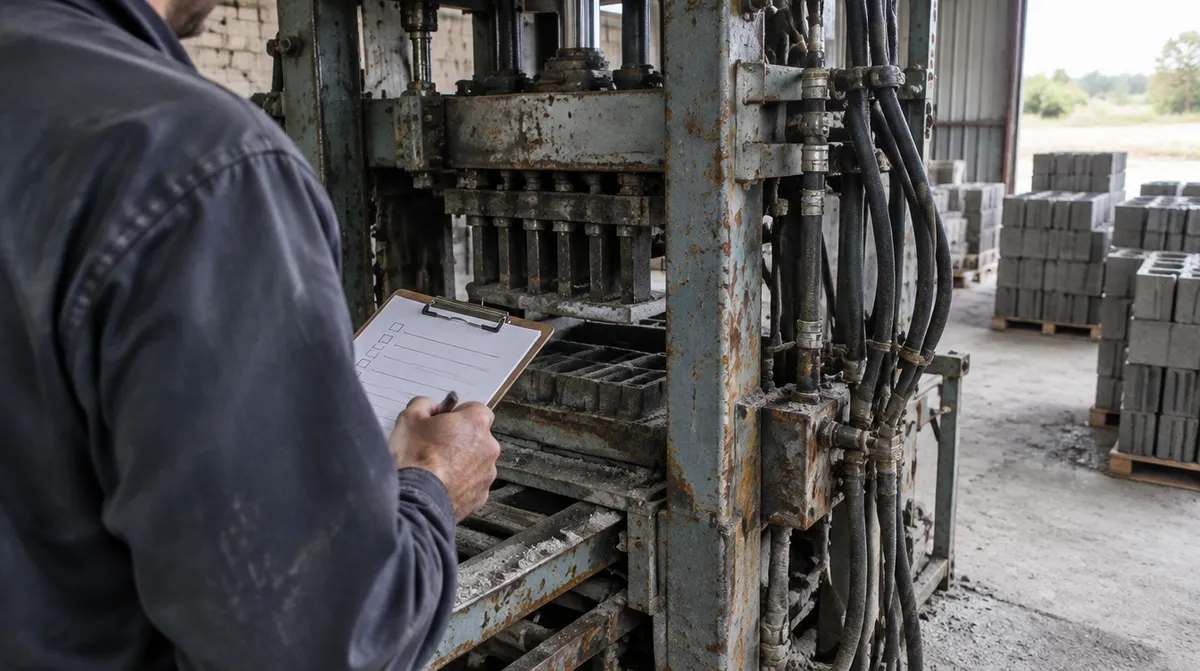
- Concrete and cement blocks (heavy, lightweight aggregate, foam concrete) can be produced directly on vibropress block making machines with suitable block molds, and they are the usual starting point for many workshops.
- Aerated concrete blocks (AAC) need an industrial production line, an autoclave, and heavy investment, and are mostly produced at large factory scale.
- Clay and gypsum blocks each have their own process, raw materials, and equipment and are usually not produced on the same line as concrete blocks.
- Polystyrene and foam blocks also need separate production lines and belong to the polymer and plastics field, not concrete.
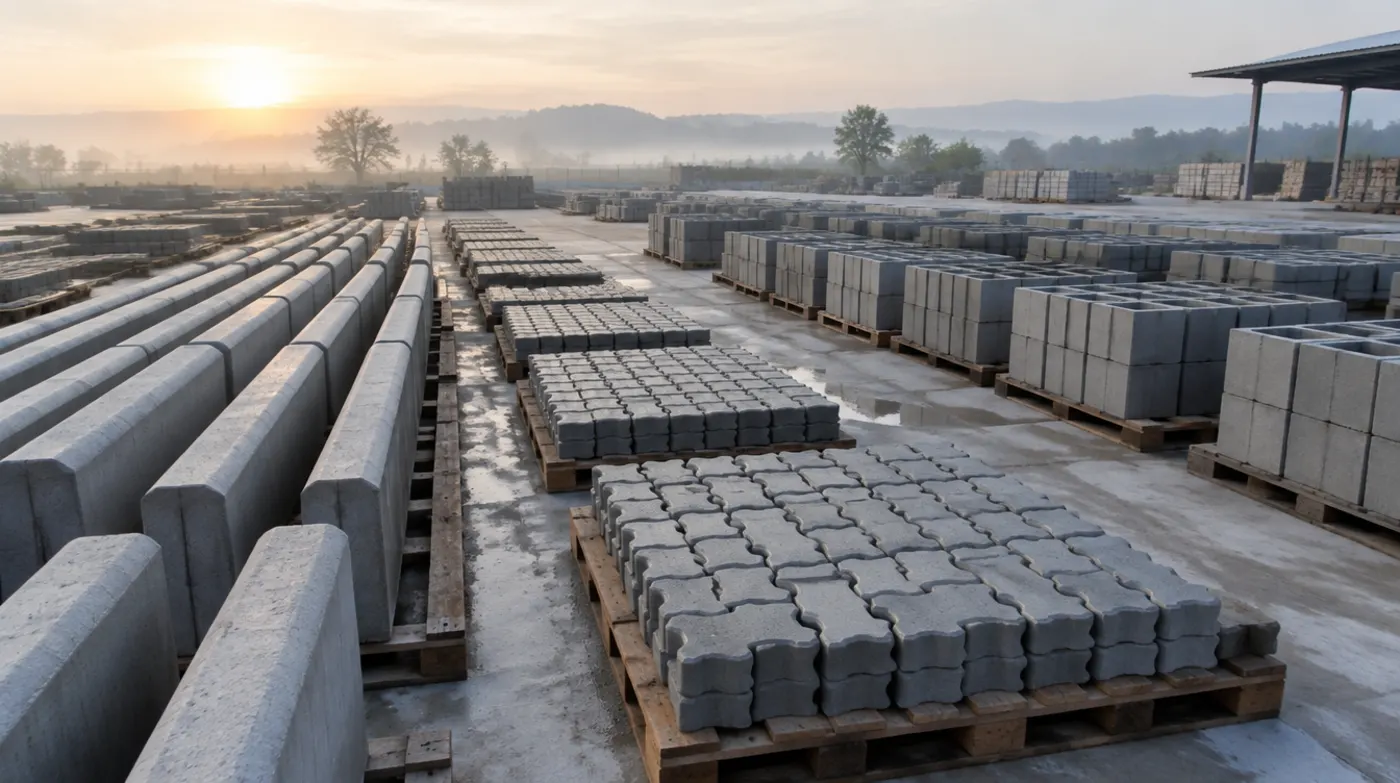
For a company like Tarahan Machinery, which focuses on designing and building block making machines, curbstone making machines, paver machines, and concrete products lines, it is natural that the main focus falls on the concrete and cement block family. Here, by choosing the right block making machine and designing different molds, a range of products such as cement blocks, lightweight aggregate blocks, interlocking blocks, curbstones, and pavers can be covered on one production line or on related lines.

What characteristics does a standard building block have?
Whatever family a block belongs to, a few general criteria help identify a standard, reliable block:
- Uniform dimensions, with no noticeable variation in the length, width, and height of the blocks
- Relatively flat surfaces and intact corners and edges, without severe chipping
- Compressive strength appropriate to the block type and intended use
- No irregular voids, abnormal porosity, or deep cracks
- Proper curing, and no use of very fresh, under-cured blocks in wall construction
- Compliance with the national standard or quality control sheets, where they exist
Paying attention to these simple points before buying and at delivery can prevent many construction problems and much rework on the project.
From choosing a block to choosing a production line: what is the next step?
So far, we have reviewed the types of building blocks in terms of material, application, weight, insulation, installation speed, and cost. We know that the heavy cement block is the more economical fit for yard walls and perimeter walls; lightweight aggregate and aerated concrete blocks have the advantage on weight- and energy-sensitive projects; clay and gypsum blocks perform acceptably in interior partitions; and foam and glass blocks play mostly complementary and decorative roles in slab systems and daylighting.
In practice, though, choosing a block is not just a site-level construction decision. For many companies, this choice can be the prelude to a bigger one: what type of block they want to use on future projects, and whether it makes sense to set up a dedicated production line for that block instead of continually buying from others.
If you work in a region where demand for cement blocks, lightweight aggregate blocks, interlocking blocks, or other concrete products is rising, you can use this basic knowledge to go one step further: examine which type of block best matches your target market, investment budget, workshop space, and current team. At this stage, the question is not only “Which block is better?” but “Given my situation, which block and which production line are the smarter choice?”
This is where Tarahan Machinery can step in. Drawing on its experience in designing and building block making machines, curbstone making machines, paver machines, and specialized molds, our technical team can help you turn the block type you have chosen into a real production plan, from selecting the capacity and type of block making machine to designing the right mold and planning future product expansion. If after reading this article you feel the time has come to move from block consumer to block producer, a conversation with the Tarahan Machinery specialist team can be a confident first step on that path. For a free consultation, call +98 914 584 1914.
For more on lightweight pumice blocks and how they are made, see our guide to pumice block production.

Submit Comment: