


Buying a used concrete mixer makes financial sense when you see the machine in person and test it with real mix before you pay. The most important points to check are the floor and walls of the tub, the blades and liners, the gearbox and electric motor, the bearings, the discharge gate and the electrical panel. The price of a used mixer depends above all on its type and capacity, its manufacturer, how worn it is and what repairs it will need after purchase, so always weigh the listed price against transport, parts and repair costs. If you don’t have a specific machine in mind yet, start with the used concrete mixer listings and take this checklist along when you inspect your shortlisted options.
Which type of mixer should you buy used?
Mix for block and curbstone production is semi-dry and low in water. It won’t become uniform by simply tumbling in a rotating tub; it needs a mixer that works the materials with blades and arms, in other words a forced-action mixer. That is why the main options for a block plant are the vertical (round) mixer, the pan mixer and the horizontal mixer, plus shaft mixers in larger factories. If you aren’t yet familiar with the differences between these machines, read our article on types of concrete mixer before you buy; choosing the right type matters more than whether the machine is new or used.
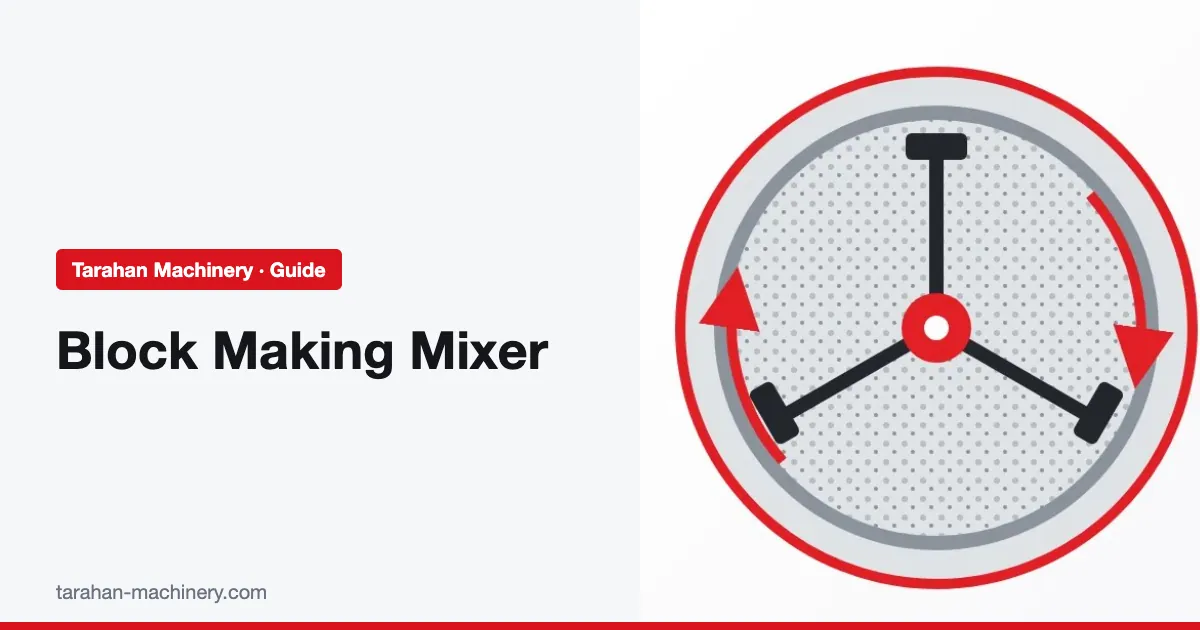
Vertical mixer (round or “pot” mixer)
This type is common in block plants, and listings often describe it only by its opening diameter, sometimes with the words “round mixer.” These mixers have a vertical shaft, the blades drive the materials around the tank, and discharge is from the bottom. Thanks to the simple design and parts that are relatively easy to find, buying this mixer used involves less trouble than the other types.
A practical tip: many sellers list only the “opening” instead of the capacity. For comparison, in the Tarahan DM.V vertical mixer the 300-liter model has a 90 cm opening, the 500-liter model 120 cm and the 800-liter model 150 cm. Other manufacturers don’t necessarily use these sizes, so check the capacity and motor power on the machine’s nameplate.
Pan mixer
In a pan mixer, arms rotate inside a stationary tub and use pressure to push the mix up from the floor. This type suits stiff, low-water concrete and colored paver mix. When buying used, the most important items are the condition of the wall and floor wear liners, the arm protection springs and the health of the gearbox. In some pan mixers (such as the Tarahan pan mixer) the liners are bolted on and can be replaced without any cutting; if the liners are welded in, budget more for refurbishment.
Horizontal mixer (U-shaped)
In a horizontal mixer, the shaft rotates along the length of a U-shaped tank and the materials move both radially and along the shaft. This mixer is built for continuous work on production lines, so it has probably seen more wear on the shaft, blades and walls. During your inspection, take shaft play and the bearings at both ends seriously.
Single-shaft and twin-shaft mixers
Single-shaft and twin-shaft mixers mostly work in concrete batching plants and large factories. They have high capacity, usually have automatic shaft lubrication, and their bodies are lined inside with replaceable wear parts. Buying one of these used only makes sense if you have a production line of matching size and your technical team knows shaft-end sealing, lubrication and gate adjustment.
The drum mixer is another mixer type. It works by rotating the drum and letting the materials fall, and it is used to produce ready-mix concrete, but if your main job is semi-dry block mix, forced-action mixers are a better fit. To choose more precisely among these options, also see our article on choosing the right mixer for a block making machine.
| Mixer type | Suited to | Critical point when buying used |
|---|---|---|
| Vertical (round) | Small and medium block and curbstone plants | Remaining floor thickness, blade adjustment, gearbox |
| Pan mixer | Stiff, low-water mix, colored pavers | Floor and wall liners, arm springs |
| Horizontal (U-shaped) | Continuous block, curbstone and paver production lines | Shaft play, bearings at both ends, inner walls |
| Single-shaft and twin-shaft | Batching plants and high-capacity factories | Shaft-end sealing, lubrication, wear parts |
Before the visit: how to read a listing
You can size up many listings with a single phone call:
- Manufacturer and model: Parts are easier to find for a mixer whose manufacturer is known and still in business.
- Capacity, opening and motor power: These three must match. A large tub with a weak motor overheats under heavy load.
- Single-phase or three-phase power: Block plant mixers are usually three-phase, and only small models may be built as single-phase; your plant’s power supply must match the machine.
- Length and intensity of service: How many years, how many shifts a day, with what materials? Silica sand and aggregate act like sandpaper and wear down the floor and blades faster.
- Repairs carried out: Ask about replacement of the floor, blades or gearbox and about motor rewinding, and request the invoices.
- Is the machine installed and powered up right now? Without power, no test is possible.
- Is it sold on its own or together with a block making machine?
That last question matters. In the listings on our site, a mixer is often sold as a package with a block making machine, mold and conveyor. If you only need the mixer, ask whether it can be sold separately. If you are buying the whole plant, also look at the used block making machine listings and take the checklist for buying a used block making machine with you to inspect the machine itself.
Inspection checklist before buying a used concrete mixer
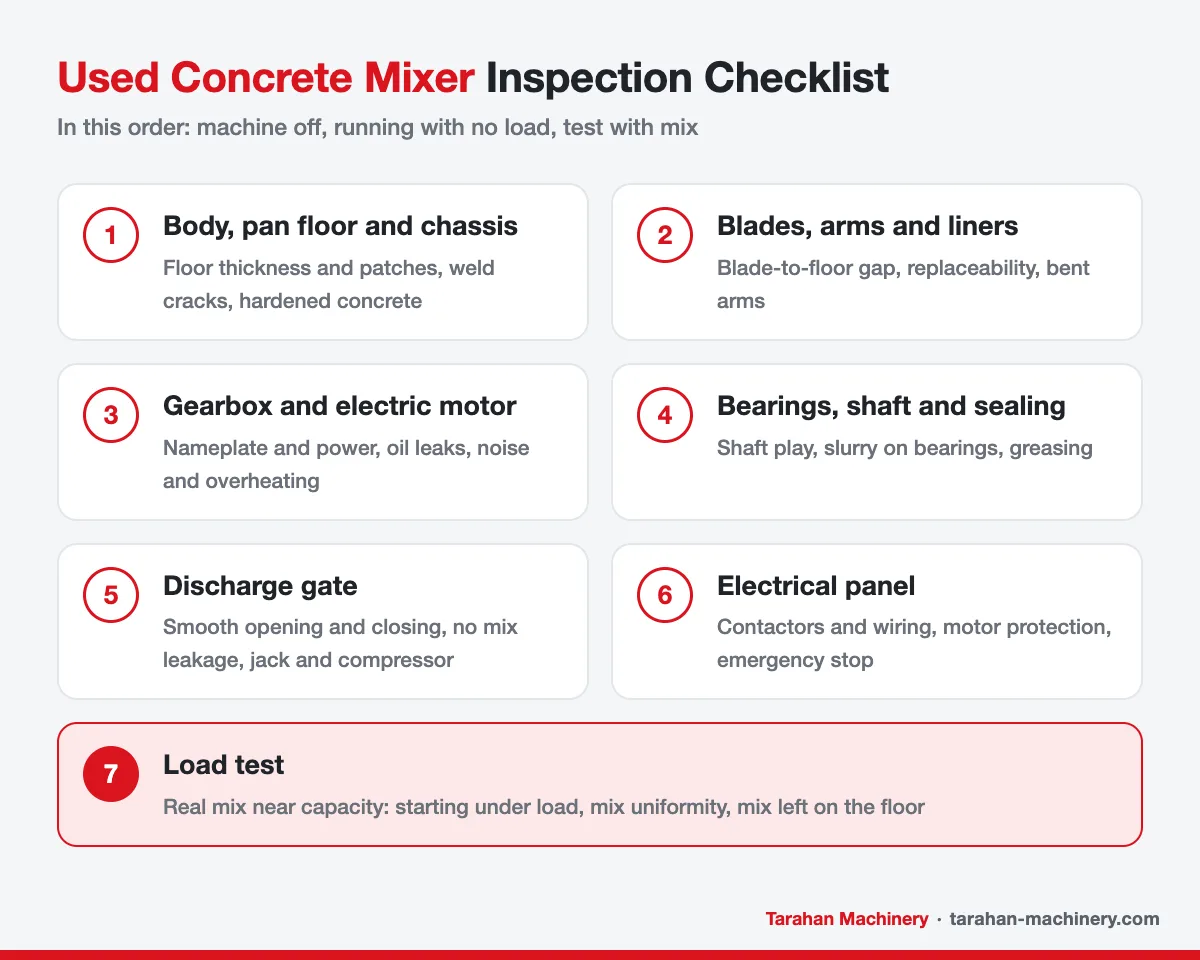
Inspect the machine in daylight, together with someone who knows industrial electrical systems and gearboxes. The order of this checklist is the order of the inspection: machine off, running with no load, and finally a test with mix.
1. Body, tub floor and frame
- Floor and wall thickness: The tub floor takes the most wear. If the floor plate is thin, wavy or holed, or several layers of patches have been welded onto it, deduct the cost of a new floor from the price. On mixers with replaceable floor and side plates, this repair is simpler.
- Cracks at the welds: Look closely around the gearbox mount and the legs. A crack that starts at a weld grows under vibration.
- Hardened concrete in the tub: A thick layer of dried concrete means the machine hasn’t been washed properly, and there may be hidden corrosion underneath.
2. Blades, arms and liners
- Blade-to-floor clearance: As blades wear, a gap opens between the blade edge and the floor, and a layer of mix stays under the blades without mixing well. The result can be uneven mix and blocks with crumbling edges.
- Adjustment and replacement: Ask whether the blade-to-floor clearance is adjustable, whether the blades themselves can be replaced, and where the spare parts come from.
- Arms and springs: A bent or re-welded arm shows that coarse aggregate got stuck under a blade and caused an impact; those impacts may have reached the gearbox too, so inspect the gearbox more closely.
- Wear liners: In pan mixers and shaft mixers, measure the remaining thickness of the liners and the cast-iron parts inside the body, and ask when they were last replaced.
3. Gearbox and electric motor
- Nameplate and power: Read the motor power and gearbox specifications from the nameplate and compare them with the tub capacity. A nameplate that has been removed, or a motor that was replaced later and doesn’t match the machine, is a red flag.
- Oil leaks: Check around and below the gearbox output oil seal. An old oil stain on the frame or ground usually means the leak has been there for some time.
- Noise and vibration: With no load, a whine, a rattle or a knock at startup can be a sign of worn gears, ball bearings or the coupling and should be investigated.
- Operating temperature: After a few minutes of running, carefully feel the heat of the motor and gearbox housings (with the back of your hand, not the palm). Quick heating with no load gets worse under real working conditions.
4. Bearings, shaft and sealing
- Shaft play: With the machine off and locked out, rock the shaft or arm by hand. Noticeable radial or axial play usually comes from a worn bearing or bushing; a little rotational play at the gearbox output is normal and shouldn’t be mistaken for it.
- Shaft-end sealing: On horizontal and shaft mixers, if cement slurry has escaped where the shaft passes through and settled on the bearing, early bearing failure is likely.
- Lubrication: Check the grease fittings. If they are dry and clogged, the machine has probably gone a long time without service. On mixers with automatic lubrication, ask whether the system still works or has been taken out of service.
5. Discharge gate
- Open and close the gate several times. It should move smoothly, close completely and not leak mix from its edge.
- If the gate has a pneumatic cylinder, also check the compressor, solenoid valve and hoses, and ask whether the compressor is included in the deal.
6. Electrical panel
- Open the panel (with the power off). A burnt contactor, spliced wires and a bypassed relay are warning signs.
- Motor protection (a bimetal or thermal relay) must be present and working; it opens the circuit on overload and abnormal current (for example, the loss of one phase) and keeps the motor from burning out.
- Test the emergency stop switch and the tub door safety interlock (if fitted).
7. Load test
An empty mixer only shows that the motor turns; gearbox, blade and gate faults reveal themselves under load.
- Ask the seller to fill the mixer close to its rated capacity with the same type of mix you use.
- As it starts moving under load, pay attention to the sound and any drop in speed. If the motor struggles to start under load or the panel protection trips, establish the cause (motor, gearbox, relay setting or site power supply) before you buy.
- After the usual mixing time, discharge the mix and see whether it is uniform or still has lumps of cement and dry sand.
- After discharge, look inside the tub: how much mix has stuck to the floor and walls, and how much has stayed under the blades?
- If a block making machine is also on site, run a few pallets of blocks with the same mix and check the edges and surface of the blocks.
To learn what good block mix looks like, our article on how to prepare concrete block mix will help.
What determines the value of a used mixer?
A used mixer has no fixed price, and even two mixers of the same size can differ widely in price. Instead of comparing listed figures with each other, weigh these factors together:
- Type and capacity: Larger mixers such as twin-shaft or industrial pan mixers usually cost more than smaller models.
- Manufacturer and parts availability: A machine with a known manufacturer and parts still on the market has a higher resale value; a no-name machine should be bought for less.
- Degree of wear: Floor thickness, condition of the blades and liners, health of the gearbox and motor. The cost of any part that must be replaced right away comes off the fair price.
- Length and intensity of service: A mixer that spent a few months in a low-use plant isn’t worth the same as one that ran for years on two shifts, even if they look alike.
- Included equipment: A dedicated electrical panel, pneumatic gate cylinder, skip or feed conveyor and legs raise the machine’s value; ask exactly which of these are part of the deal.
- Sold alone or as a package: When a mixer is sold with a block making machine and mold, the price covers the whole package and the mixer’s share isn’t clear. If you only want the mixer, ask for a separate price.
- Machine location: The distance to your plant adds to the transport cost.
Put several listings of the same type and capacity side by side and subtract the cost of the necessary repairs from each one. The listed price is the seller’s offer, and the current price of a new machine also changes; get the figure from the seller or manufacturer, not from old listings.
Hidden costs not included in the listed price
Until the day it makes its first batch of mix in your plant, a used mixer carries other costs too:
- Dismantling and transport: Detaching the mixer from its foundation and production line, a crane at origin and destination, and truck haulage.
- Immediate repairs: Replacing the floor or liners, blades, oil seal and bearings, plus gearbox service and an oil change. Even a sound mixer usually needs a full service after being moved.
- Spare parts: For a mixer whose manufacturer is no longer in business, you may have to have blades and liners custom-made, which costs more and takes time.
- Installation and foundation: Building a base or platform, leveling, and matching the gate height to the skip, conveyor or block making machine hopper.
- Electrical: If your plant’s power doesn’t match the machine or the mixer has no dedicated panel, the cost of a panel and cable, and sometimes of upgrading your power connection.
- Production downtime: Every day the mixer sits idle, the whole line sits idle, a cost that appears on no invoice.
A simple rule: before signing the sales agreement, add up “listed price + transport + immediate repairs + installation” and compare that figure, not just the listed price, with the current price of a new mixer.
Used or new mixer?
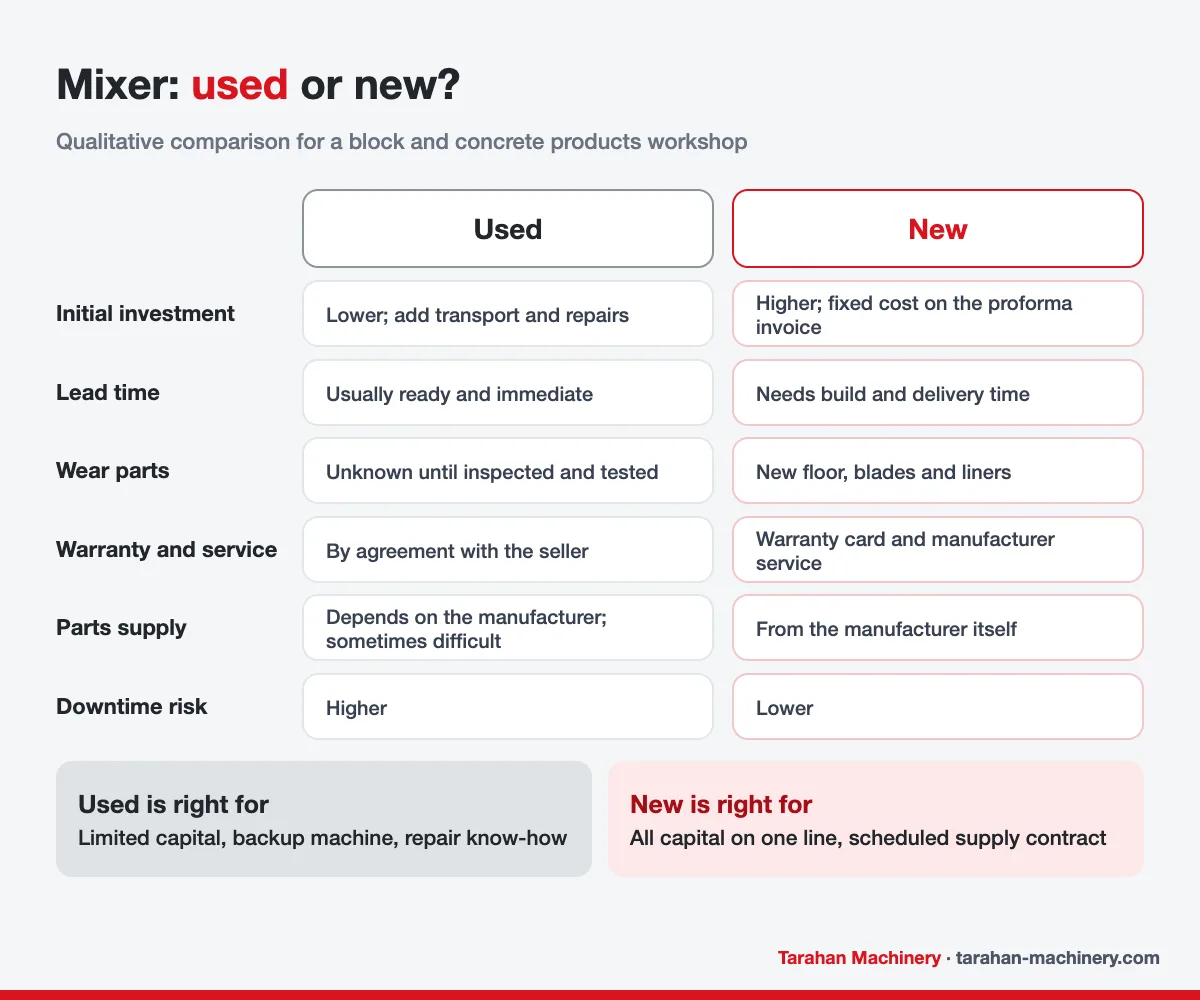
A used mixer makes sense for someone with limited capital, someone who wants a backup machine, or someone who can handle mechanical and electrical repairs themselves. But if you are putting all your capital into one line or you have a supply contract with a fixed schedule, mixer downtime gets expensive and a new mixer is the lower-risk choice.
| Criterion | Used mixer | New mixer |
|---|---|---|
| Initial capital | Lower, but transport and repair costs must be added | Higher, with a known cost from the proforma invoice |
| Availability | Usually available right away | Requires manufacturing and delivery time |
| Capacity and specifications | Limited to available listings | Choice of capacity, number of gates and power supply to suit your plant |
| Condition of wear parts | Unknown; only an inspection and test will show | New floor, blades and liners |
| Warranty and service | Depends on agreement with the seller | Warranty card and manufacturer’s after-sales service |
| Parts supply | Depends on the manufacturer; sometimes difficult | From the manufacturer itself |
| Installation and training | Up to the buyer | Installation, commissioning and operator training available from the manufacturer |
| Risk of production downtime | Higher | Lower |
If you haven’t found a reliable option after a few visits, also take a look at Tarahan’s new concrete mixers. The DM.V vertical mixer is built in 300-, 500- and 800-liter capacities. Its blades are replaceable and their clearance to the floor is adjustable, its floor and side plates are double-layered, and these plates can be replaced for repair. Its electrical panel also uses LG/LS components from Korea.
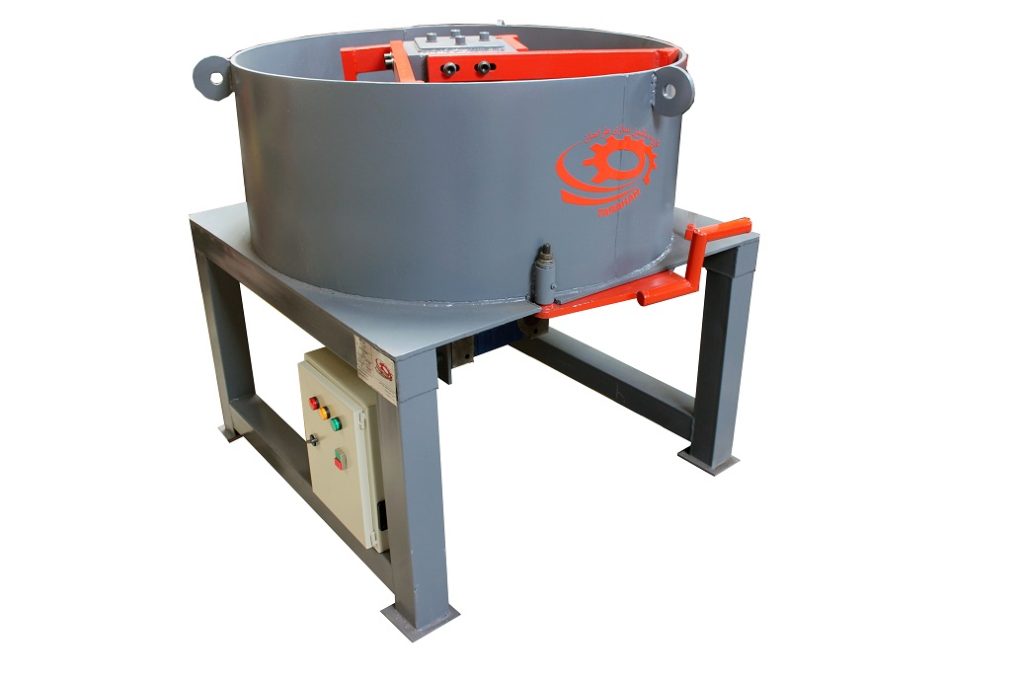
For more continuous production lines, the DM.H horizontal mixer is built in 800-, 1000-, 1200- and 2000-liter capacities, with replaceable cast-iron blades, wear-resistant plate up to 20 mm thick in the body and floor, and an electrical panel with Hyundai and LS components. If you produce stiff, low-water mix or colored pavers, the Tarahan pan mixer is another option, at 500 to 2000 liters, with replaceable wear liners and discharge through one or two gates. For batching plants and high-capacity factories, the twin-shaft mixer is built with automatic shaft lubrication and two discharge gates.
Buying safely from used mixer listings
The Tarahan Machinery used machines section gathers sale listings for used equipment across various categories, from block and curbstone making machines to batching plants and conveyors. To see only mixers, go to the used mixer listings page. Each listing shows a code, a city and an asking price or “negotiable.” According to the site’s own statement, Tarahan Machinery takes no responsibility for the information about, or the performance of, the advertised machines; in other words, as with any used purchase, checking the machine is up to the buyer. Follow these steps:
- Call first, travel later: Ask the questions from the “Before the visit” section by phone, and request photos and video of the machine running.
- In-person inspection with a technician: Bring the checklist above and take photos of the nameplates, the inside of the tub and the welds.
- On-site load test: Before agreeing on a price, run the mixer with real mix. If the seller won’t allow a test, factor that risk into the price or walk away.
- Ownership and documents: Ask to see the original purchase invoice, the previous sales agreement or any document showing that the seller owns the machine. If the machine is installed in someone else’s plant, make sure that person also agrees to the sale.
- Written sales agreement: Record the machine’s specifications (manufacturer, capacity, motor power), included equipment, the condition you saw in the test, the amount, the time and terms of payment, and who is responsible for dismantling and loading.
- Staged payment: Pay the bulk of the amount after the final test and at loading, not before you have seen the machine.
New listings are added from time to time; if there’s no suitable machine now, check back later.
Frequently asked questions
How can I tell whether the listed price of a used mixer is fair?
There is no fixed price; it depends on type and capacity, manufacturer, degree of wear, the health of the gearbox and motor, and included equipment. Compare the sellers’ asking prices on the used concrete mixer page and add transport and repair costs to each.
How many liters is a mixer with a “120 opening”?
It depends on the manufacturer. In Tarahan’s DM.V vertical mixers, the 120 cm opening belongs to the 500-liter model, but other manufacturers may use different sizes. Ask the seller for the capacity and check it on the machine’s nameplate.
Which used mixer is best for a block plant?
For a small or medium plant, a sound vertical (round) mixer is usually the simplest and cheapest option. If you have stiffer mix or colored pavers, look at a pan mixer, and if you have a continuous production line, look at a horizontal mixer. The mixer’s capacity should match the mix consumption of the block making machine.
Does a used mixer come with a warranty?
Any warranty or commitment on a used machine depends on your agreement with the seller. If the seller has made a promise about the machine’s condition, write it into the sales agreement.
Can I find a used single-phase mixer for block making?
Block plant mixers are usually three-phase, and only small models may be single-phase; for example, in Tarahan’s DM.V series only the 300-liter model is built with a 3 hp single-phase electric motor. If your plant doesn’t have three-phase power, settle this point before you buy.
Can a used mixer be refurbished?
Yes. On many mixers the floor, blades, liners, oil seal and bearings can be replaced, and the gearbox can be repaired or replaced as well. Just estimate the cost of this work before you buy; sometimes the machine price plus refurbishment comes close to the price of a new mixer.
Can I buy a used mixer from video alone, without an inspection?
That is not recommended. Video is good for ruling out unsuitable listings, but floor thickness, shaft play and how the machine behaves under load can only be judged in person.
Summary
A used concrete mixer can lower the cost of setting up a plant, provided its type suits your mix and your block making machine, and provided that before paying you have checked the floor and blades, gearbox and motor, bearings, gate and electrical panel and tested the machine with real mix. Always add transport, repair and installation to the listed price before comparing it with a new mixer. To see the listings, visit the used mixer category page; and if you need the current price and specifications of new Tarahan mixers for comparison, call +98 914 584 1914 and a sales specialist will advise you according to your machine and your plant’s capacity.





Submit Comment: