


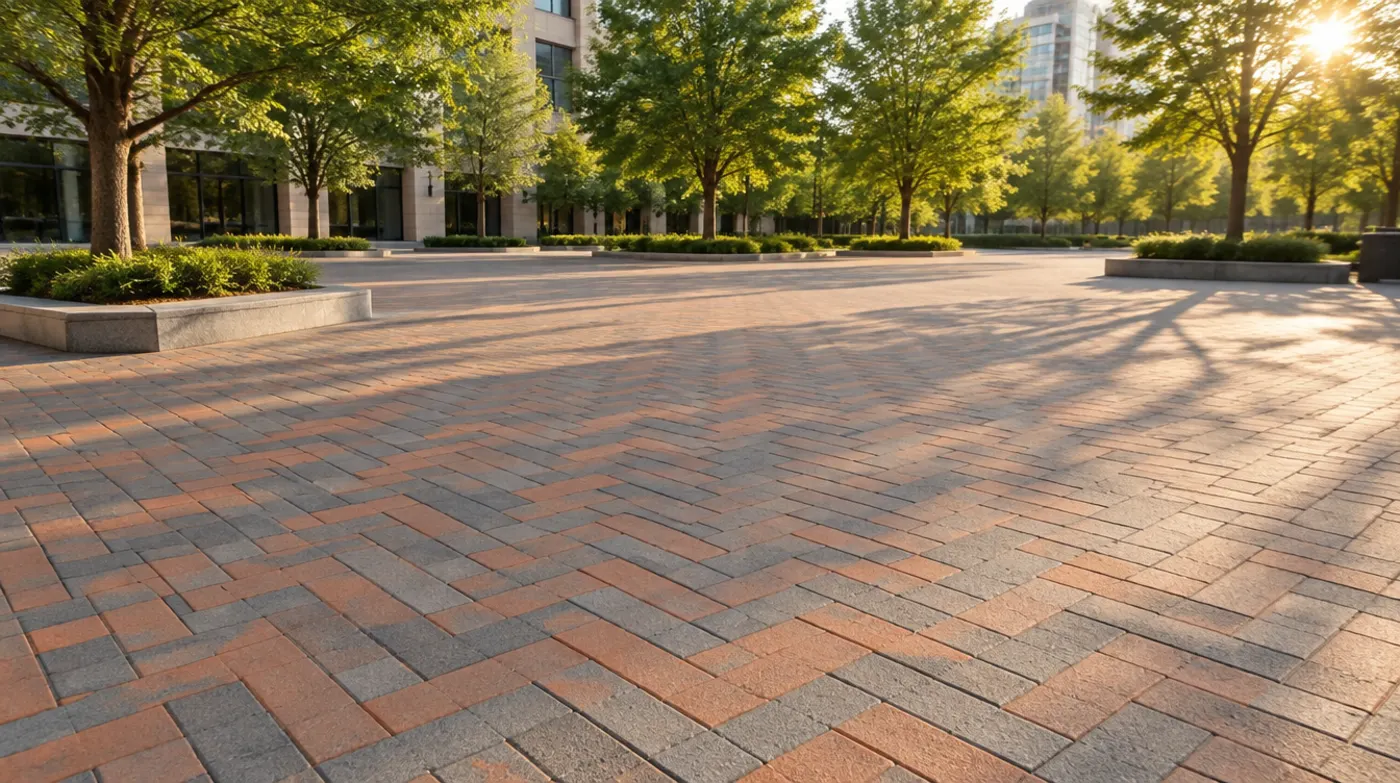
“Paving” comes from the English word for laying a surface of stone or slabs, and it has passed into trade usage in Iran. In the Iranian concrete machinery market, a “paving” machine, also widely called a “pavising” machine, is what English-speaking buyers would call a paving block machine: a stationary vibro-press that fills a steel mold with semi-dry concrete, compacts it with vibration and hydraulic pressure, and delivers cement blocks, concrete curbstones, and concrete pavers on a pallet. On Iranian construction sites, however, “paving” sometimes also refers to concrete floor finishing with a power trowel, which is a separate subject.
If you came here for the job-site meaning of the word, the next section explains it briefly. The rest of this guide is about the paving block machine: how it works, how single-hopper and double-hopper models differ, what equipment you need alongside it, and how to choose the right model for your capacity and budget.
What Is “Paving”? The Two Common Meanings of the Word
When people in Iran talk about “paving,” they usually mean one of two things:
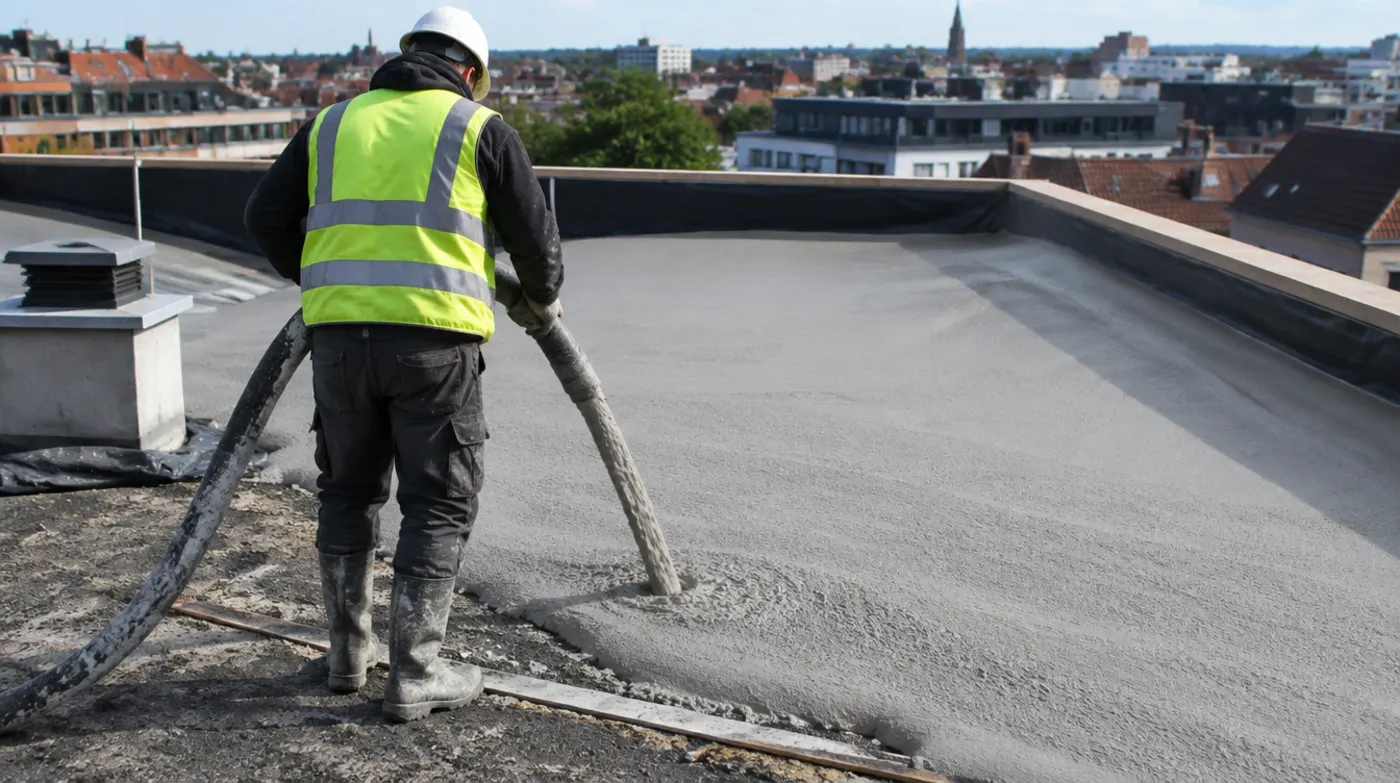
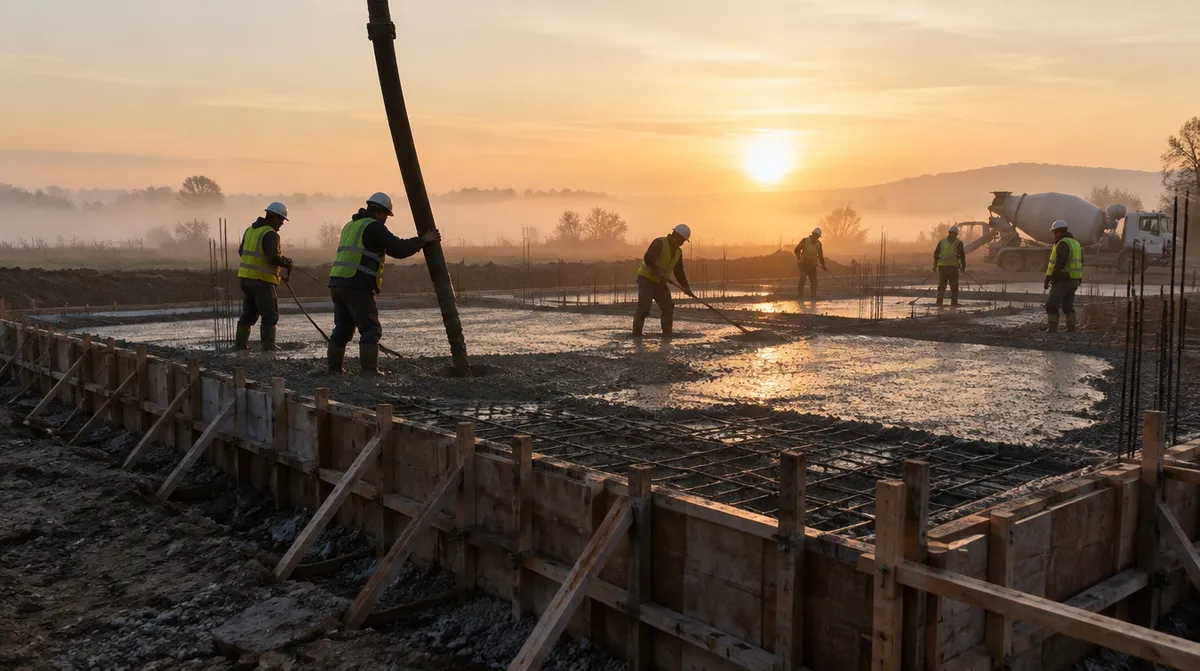
- Paving in building construction: Some contractors use “paving” or “paving floor” for a concrete floor in an industrial building, parking garage, or warehouse whose surface is leveled and finished after the pour with a power trowel (helicopter trowel). This is a floor construction method, not the production of precast units.
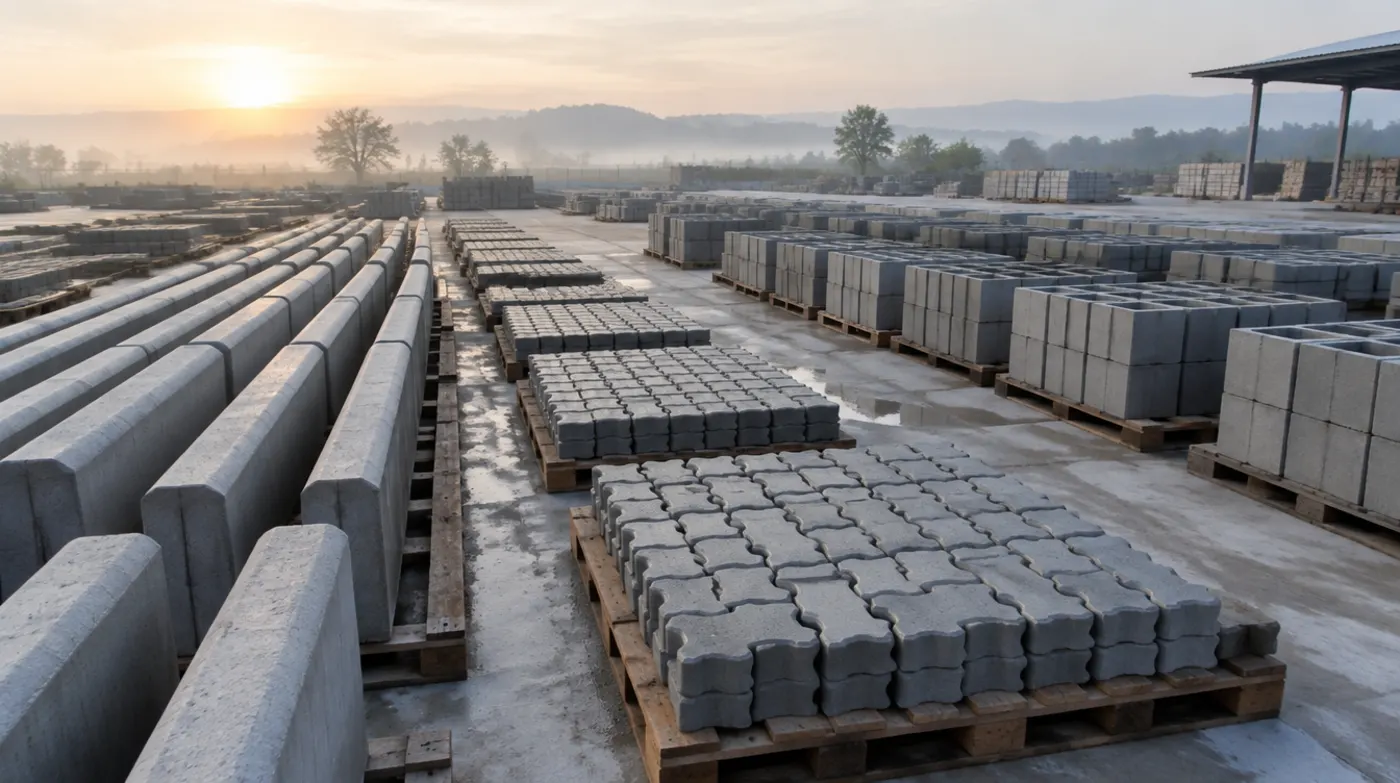
- Paving machine in the concrete products industry: A stationary machine that produces precast concrete units such as pavers, paving stones, curbstones, and blocks in a factory. These units later go into sidewalks, parks, yards, and outdoor areas.
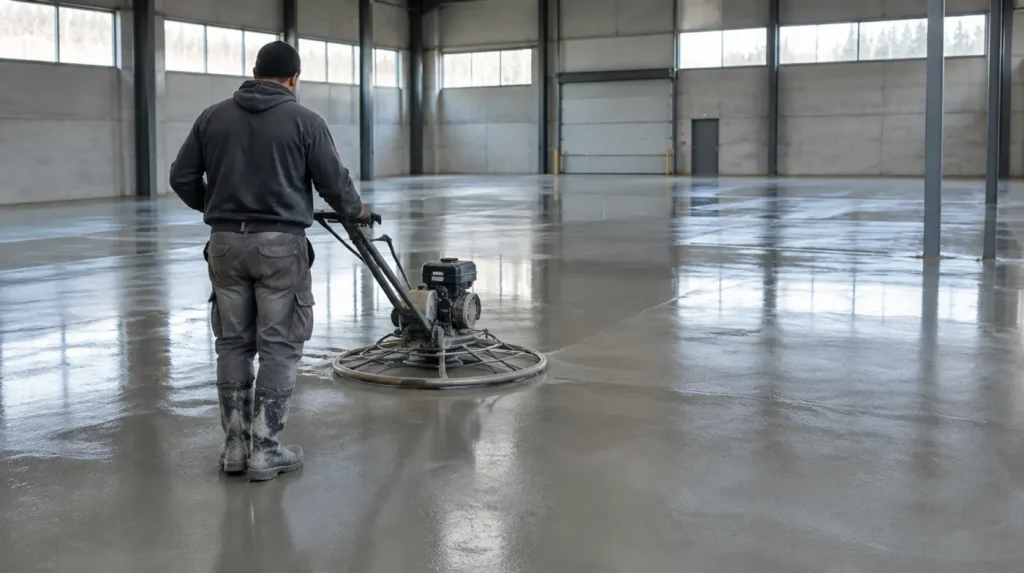
What the two have in common is the idea of paving and flooring. But if you plan to set up a paver production workshop or buy a machine, you mean the second one, and the rest of this article is for you.
Paving or Pavising: What Is the Difference?
There is none. In Iran, a “pavising machine” is the same thing as a “paving machine,” and the only difference is the pronunciation common in the market. “Paving” is the more correct form because it comes from the English word. In ads and in conversations with sellers there, you will hear other names for the same machine as well: stationary machine, press machine, paving stone machine, paver machine, or “stationary block machine.” All of these point to one family of machines, which Tarahan Machinery classifies under stationary concrete product machines.
The phrase “pavising block machine,” which buyers in Iran search for often, reflects this: a paving block machine does more than make pavers, and with a block mold it becomes a high-output stationary block machine.
What Is a Paving Block Machine and How Does It Work?
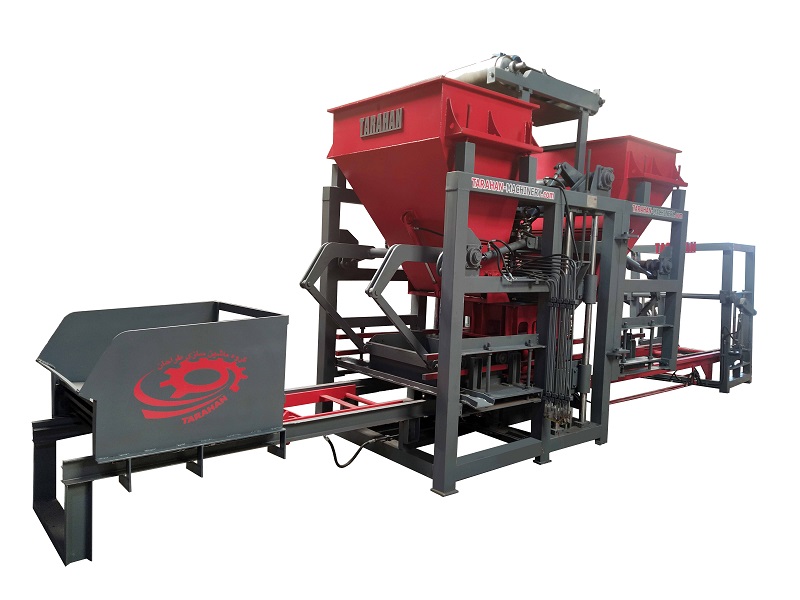
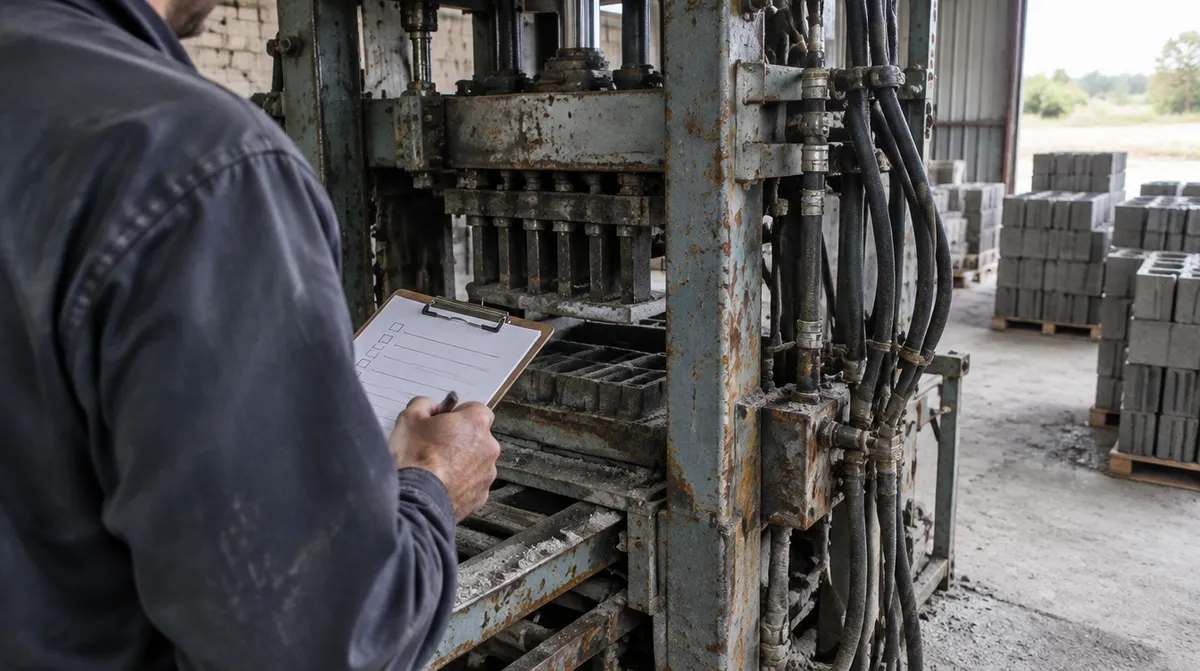
A paving block machine is a stationary press that is installed on a foundation and forms each unit on a pallet, not on the ground. A typical work cycle runs roughly like this:
- An empty pallet (wood, steel, or PVC) moves into position under the mold.
- The feed drawer takes semi-dry concrete from the hopper at the top of the machine and spreads it into the mold.
- The vibrators start, and at the same time the upper tamper head comes down on the concrete under hydraulic pressure to drive out air and compact the mix.
- The mold lifts, the formed units stay on the pallet, and the pallet leaves the machine for stacking and curing.
The quality of what a paving block machine produces depends on this combination of vibration and pressing more than on anything else. If the concrete is poorly compacted, the unit has voids, absorbs water, and scales sooner in freezing weather. This matters most for pavers, which spend years under traffic and moisture.
Main Components of a Paving Block Machine
- Hopper: The bin at the top of the machine that receives the mixed concrete from the conveyor belt. Single-hopper machines have one bin and double-hopper machines have two separate bins.
- Steel mold: Sets the shape and dimensions of the product. By changing the mold, the same machine switches from blocks to curbstones or pavers. The TM series steel molds are designed specifically for these machines. See examples on the concrete paving mold page.
- Vibration system: Lower vibrators under the mold table and, on some models, upper vibrators on the tamper head. This is why the machine needs a pit underneath it, to give access to the vibrators.
- Hydraulic press: The pump, cylinders, and hydraulic valves that generate the pressure needed for compaction. On Tarahan models, hydraulic pressure ranges from about 120 bar on the small model to 200 bar on the large models.
- Pallet: The surface on which the unit is formed and moved. The number of pallets you need depends on machine capacity and curing time.
- Electrical and control panel: Sets vibration time, press pressure, and the sequence of movements. On automatic lines, this control is handled by a PLC.
What Can a Paving Block Machine Produce?
The biggest advantage of a paving block machine is that one machine and a few molds let you produce several best-selling products. By changing the mold, Tarahan TM series models make these units:
- Concrete pavers and paving stones: For sidewalks, parks, yards, parking areas, and industrial yards, in a range of patterns and thicknesses.
- Concrete curbstones: Street curbs and garden edging curbs. If you are not familiar with the common types and sizes of curb, read our article what is a concrete curbstone.
- Cement and pumice blocks: 10, 15, and 20 cm wall blocks.
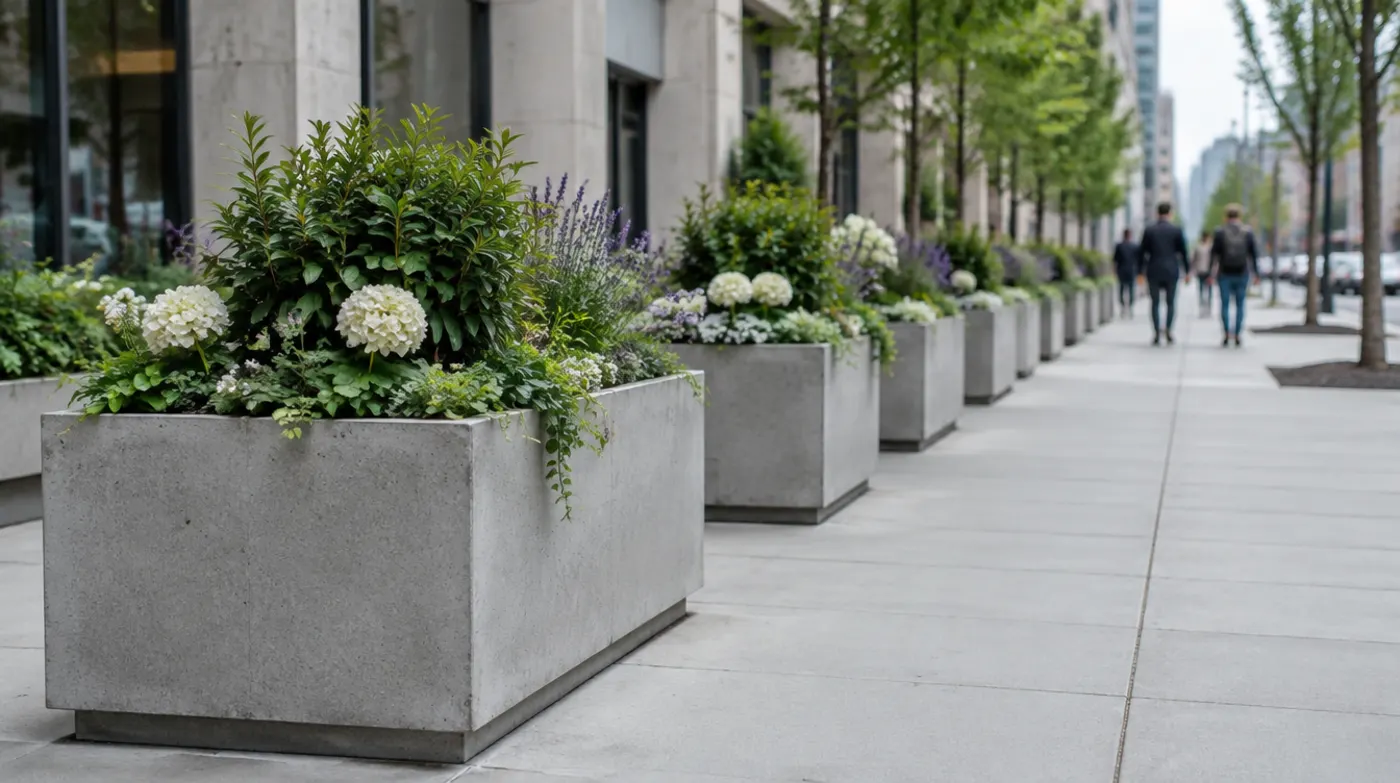
- Special units: With a custom mold, the machine can also produce units such as concrete flower boxes and landscape elements.
On most Tarahan models, the production height ranges from 50 to 300 mm, so both thin pavers and tall blocks and curbstones fall within the machine’s working range. To see the models recommended specifically for pavers, visit the paving block making machine page.
Single-Hopper or Double-Hopper Machine?
This is the most important technical decision when buying a paving block machine, and the answer depends on the product you want to sell.
Single-Hopper Paving Block Machine
It has one hopper and makes each unit from one type of concrete mix. It is fully adequate for blocks, curbstones, and single-color pavers, and it is simpler and cheaper. Models TM-104, TM-108, TM-110, TM-112, and TM-118 belong to Tarahan’s group of single-hopper stationary machines.
Double-Hopper Paving Block Machine
It has two separate hoppers: one for the base layer (the main, load-bearing body of the unit) and one for the face layer, which is usually colored and made with finer aggregate. The machine first places the base layer in the mold and compacts it slightly, then spreads the face layer over it, and the final pressing and vibration bond the two layers into one piece. The result is a two-layer or two-color paver.
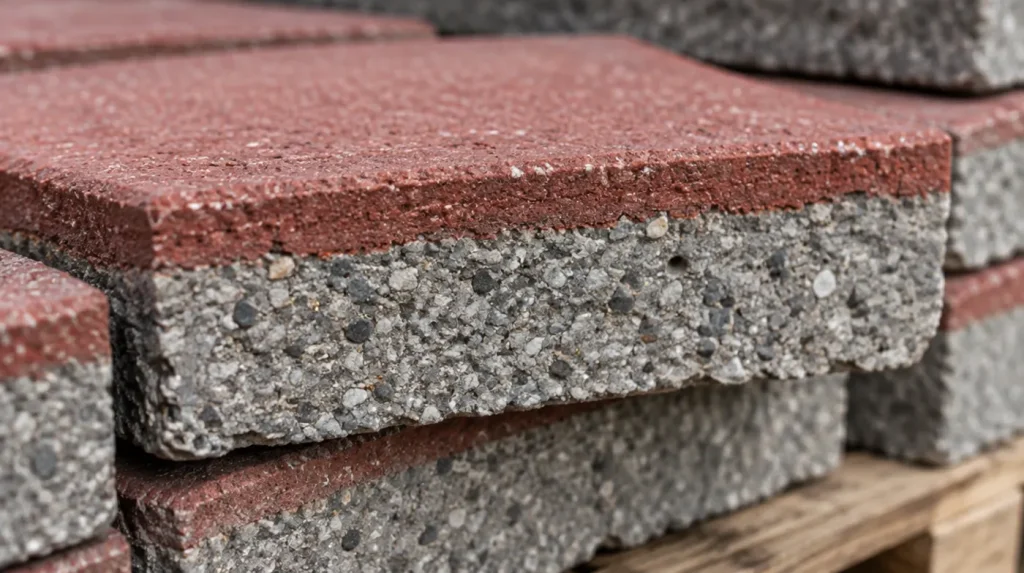
Why is two-layer production more economical? Pigment and face-layer materials cost more than base-layer materials. When pigment goes only into the thin face layer, pigment cost falls while the finished look stays the same. You can also adjust the face-layer mix design separately for better abrasion resistance. Models TM-208, TM-210, and TM-218 belong to the group of double-hopper stationary machines.
One important point: the number of hoppers does not determine a machine’s capacity. Capacity comes down to pallet size, vibration power, and hydraulic pressure. That is why every Tarahan double-hopper model has a single-hopper counterpart with the same pallet dimensions (TM-108 and TM-208, TM-110 and TM-210, TM-118 and TM-218). If the market in your region buys only gray pavers and curbstones, you do not need a double-hopper machine. If you plan to make colored pavers for urban landscaping, villas, or decorative projects, buy a double-hopper machine from the start, since adding a second hopper to a single-hopper machine is usually not a simple job.
For the different paver production methods (dry pressing, wet pressing, and the vibration table) and the effect of each on product durability, read our article on concrete paver and paving stone production methods. The paving block machine falls under dry pressing, whose advantages are fast forming and high output.
Paving Block Machine vs. Mobile (Egg-Laying) Block Machine
Mobile machines, known in the market as “egg-laying” machines, form units directly on a flat, level concrete slab and then move forward on their own. A paving block machine, by contrast, is stationary and produces on pallets. This difference has several practical consequences:
- Pavers: Because of their limited vibration and pressing power, mobile machines are not recommended for producing pavers and paving stones. If pavers are your main product, you need a stationary machine.
- Land: A mobile machine needs a large concrete slab so the units can dry on the ground. With a paving block machine, units stay on pallets, and the pallets are stacked and taken to the curing area, so the land is used more efficiently.
- Quality and dimensional accuracy: A flat pallet and stronger pressing give units with more uniform dimensions and a cleaner surface, which matters for pavers and for export.
- Initial investment: A mobile machine requires less capital and suits a small start or block production at the project site.
We give a full comparison of the two in terms of land, labor, capacity, and investment in our article mobile vs. stationary block machines. For a general introduction to all the machine groups, see our overview of concrete product machines.
What Equipment Does a Paver Production Line Need?
A paving block machine does not work alone; it is the heart of a production line. In a typical line, materials follow this path:
- Feeder or batching plant: A loader dumps gravel, sand, or pumice into the feeder, where it is weighed. In simple lines, a two-compartment feeder with digital weighing does this job, and in larger lines a concrete batching plant does it.
- Cement silo and screw conveyor: Cement travels from the silo to the mixer by screw conveyor.
- Conveyor belts: One belt carries materials from the feeder to the mixer, and another carries the finished mix from the mixer to the machine’s hopper.
- Mixer: Blends the cement, aggregate, and water. For the semi-dry concrete these machines use, horizontal mixers or pan mixers are common.
- Paving block machine: Molding, vibration, and pressing on the pallet.
- Pallet lifter, lowerer, and stacking robot: On semi-automatic lines, full pallets are stacked on top of one another. On automatic lines, a stacking robot picks the dried units off the production pallet and arranges them on a shipping pallet.
- Curing: A forklift takes the pallets to the curing area or dryer. Proper curing, meaning keeping units adequately moist and away from sun and strong wind during the first days, affects the final strength of the paver as much as the machine itself does.
Tarahan arranges this line at four levels: manual, semi-automatic, automatic, and fully automatic. They differ in the number of workers, how pallets are handled, and the degree of PLC control. See the full equipment list for each level on the concrete products plant page.

Comparison of Tarahan Paving Block Machine Models
The table below sets the TM series models side by side, based on the specifications published on each product page. Capacity figures are approximate and vary with mold type, mix design, operator skill, and line coordination.
| Model | Hoppers | Pallet size (cm) | 20×40×20 blocks per pallet | 50×30 curbstones per pallet | Pavers per pallet (m²) |
|---|---|---|---|---|---|
| TM-104 | Single-hopper | 46×87 | 4 pcs | Not recommended | 0.3 |
| TM-108 | Single-hopper | 99×92 | 8 pcs | 3 pcs | 0.8 |
| TM-208 | Double-hopper | 99×92 | 8 pcs | 3 pcs | 0.8 |
| TM-110 | Single-hopper | 110×115 | 10 pcs | 6 pcs | 1 |
| TM-210 | Double-hopper | 110×115 | 10 pcs | 6 pcs | 1 |
| TM-112 | Single-hopper | On request | 12 pcs | 8 pcs | 1.4 |
| TM-118 | Single-hopper | 135×150 | 18 pcs | 8 pcs | 1.8 |
| TM-218 | Double-hopper | 135×150 | 18 pcs | 8 pcs | 1.8 |
To estimate daily paver output, multiply the “Pavers per pallet” figure by the number of pallets your line actually produces per hour. The nominal speed of these models is about 80 to 140 pallets per hour, but in practice line speed is usually set by the slowest link (the mixer, batching, or pallet handling), not by the machine itself.
Which Model Suits Which Buyer?
- TM-104: Has a small pallet and suits a workshop with limited space that mainly makes blocks. If pavers and curbstones are your main products, choose a larger model.
- TM-108 and TM-208: A logical starting point for a workshop that wants to make all three products. If colored pavers are part of your sales plan, take a look at the TM-208 double-hopper machine.
- TM-110 and TM-210: A larger pallet and 180 bar of hydraulic pressure, for semi-industrial production and urban landscaping orders. The TM-210 model is the double-hopper version in this group.
- TM-112: A single-hopper machine with a longer pallet, for higher output of single-color blocks and curbstones.
- TM-118 and TM-218: The largest pallet and 200 bar of pressure, for industrial plants and contractors with bulk orders.
What to Check Before Buying a Paving Block Machine
Most problems at new workshops do not come from the machine itself. They come from decisions that were not made before the purchase. Go over this list with a sales specialist:
- Product and market: First know what you are selling and to whom. Single-color pavers, colored pavers, curbstones, or blocks? The choice of single or double hopper and of pallet size follows from this.
- Land: The land you need is not just about the machine. Space for the mixer and batching plant, material stockpiles, pallet curing, and product storage takes up more room, and it grows with the model size, automation level, and output. Get the exact area from a sales specialist based on your line layout.
- Foundation and pit: The machine is installed on a concrete foundation and needs a pit underneath for access to the vibrators. Include this in your building plan from the start.
- Power: The electric motor driving the hydraulics, the vibrators, the mixer, and the batching plant all run together. Check your power supply capacity against the line specifications before ordering.
- Labor: The machine itself usually needs only 2 to 3 trained workers. The total headcount for the line depends on the automation level.
- Pallets: The number of pallets must match capacity and curing time. Wood pallets are the most common, steel pallets cost less and have resale value, and PVC pallets are light but expensive.
- Molds: You need one mold for each product and each paver pattern. Align your initial mold list with your sales plan.
- Materials: Access to graded gravel and sand and to cement of consistent quality directly affects product uniformity.
- Support: Tarahan stationary machines come with a 12-month warranty and 10 years of after-sales service. Specify spare parts access and technician dispatch in the contract.
- Delivery time: For models such as TM-108 and TM-208, delivery usually takes about 60 to 70 working days, depending on any custom molds. Plan your building preparation around this timeframe.
Frequently Asked Questions
What does “paving” mean?
“Paving” comes from the English word for laying stone or slab surfaces. In the concrete products industry in Iran, it refers to the stationary machine that produces pavers, curbstones, and blocks on pallets. In building construction there, concrete floor finishing with a power trowel is also sometimes called paving.
Is a pavising machine different from a paving machine?
No. Both are names for the same machine, and only the pronunciation differs. “Paving” is the more correct form.
Can a paving block machine also make blocks?
Yes. By changing the mold, Tarahan TM series models produce 10, 15, and 20 cm blocks, curbstones, and pavers.
Do you need a double-hopper machine to make colored pavers?
For two-layer pavers with a colored face, yes. A single-hopper machine can also make colored pavers, but the pigment then goes through the entire body of the unit and the cost rises.
Is an egg-laying machine suitable for making pavers?
It is not recommended. Mobile machines work for blocks and curbstones, but their vibration and pressing are not sufficient for quality pavers.
How much land do you need to set up a paving block machine?
It depends on the model, the line’s automation level, and output. Besides the machine itself, you need space for the mixer and batching plant, material stockpiles, pallet curing, and product storage. Ask our sales specialists for the exact area based on your line layout.
How much does a paving block machine cost?
The price depends on the model, the number of hoppers, the molds, and the auxiliary line equipment, and it changes with the market. For a current price and a proforma invoice, contact our sales specialists.
Conclusion
A “paving” or “pavising” machine is the stationary vibro-press known in English as a paving block machine, which produces concrete pavers, curbstones, and blocks on pallets by changing the mold. If you make single-color pavers and blocks, a single-hopper machine is enough. If colored, two-layer pavers are in your plans, buy a double-hopper machine from the start. Choose the pallet size to match the volume your market actually buys. Compare the models on the stationary paver and paving stone machines page, and for model selection, line layout, and current prices, call the Tarahan Machinery specialists at +98 914 584 1914.
To learn about the patterns, sizes, and thicknesses of the products these machines make, see our article on types of concrete pavers and paving stones.

Submit Comment: