


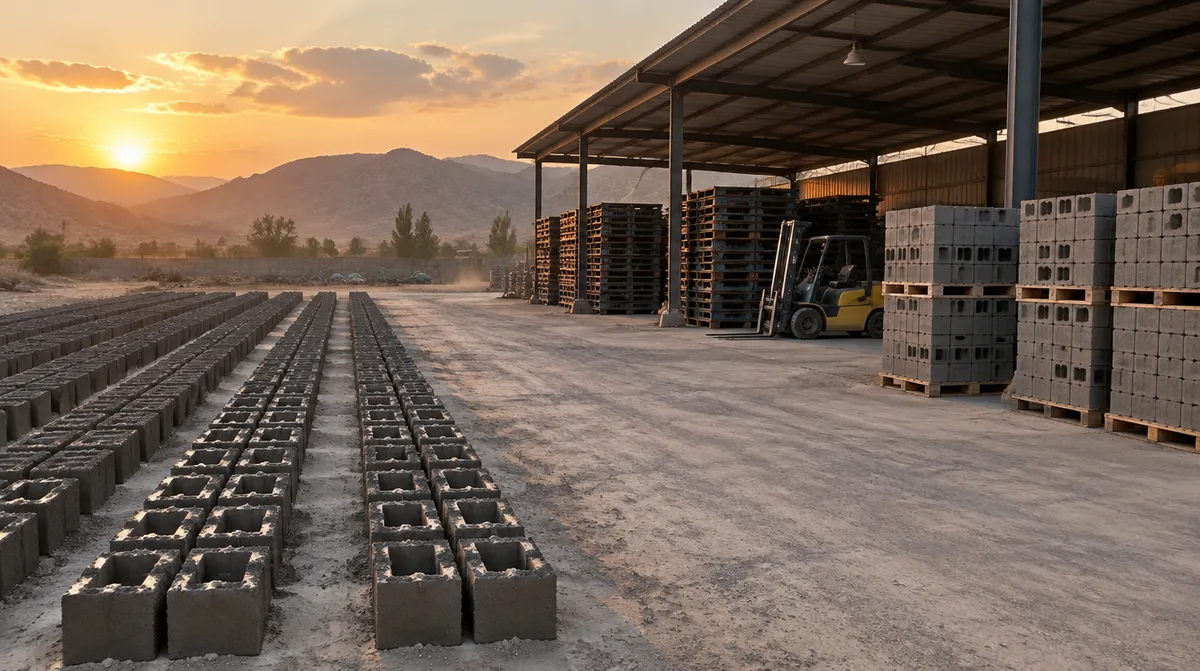
If you have a large, flat concrete yard, your main products are wall and ceiling blocks, and you want to start with less capital, a mobile block making machine (also called an egg-laying or movable machine) is usually the more logical choice. But if you want to make precisely sized concrete pavers and curbstones alongside blocks, consistent quality is a priority, and you are thinking about a production line that can grow, a stationary block making machine (a pallet-type or “pavesing” machine) is usually the better fit.
This article compares these two types of block making machine by production method, land, labor, product range and initial investment, and sets Tarahan Machinery’s mobile and stationary models side by side using the figures from their product pages, to make your decision easier.
The Main Difference Between Mobile and Stationary Block Machines at a Glance
The fundamental difference between these two machines comes down to one question: where does the block go after molding?
- A mobile block machine travels over a flat concrete surface and “lays” the blocks directly on the ground: the machine moves and the product stays where it is. That behavior is where the name “egg-laying” comes from.
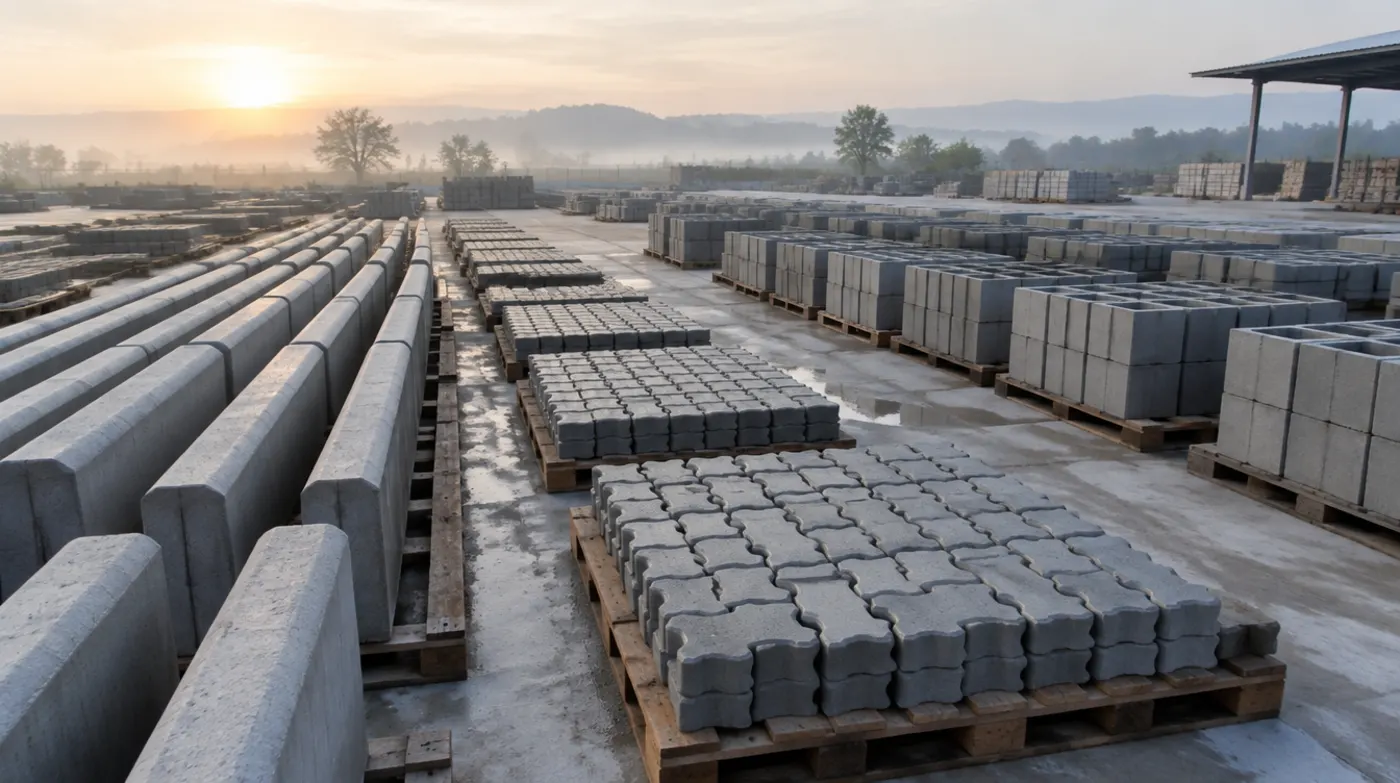
- A stationary block machine sits on a fixed foundation and the product is formed on a metal or wooden pallet, which then goes with the product to the curing area. In other words, the machine stays put and the product moves.
This simple difference affects almost every other factor: the size and type of land, the amount and type of auxiliary equipment, the dimensional accuracy of the product, the range of units you can make, and how much capital you must spend before the first block. To learn about other machines as well, see our article on types of concrete product making machines.
How Does a Mobile (Egg-Laying) Block Machine Work?
In mobile machines, concrete mix is poured into the mold, vibration and pressing compact it, then the mold lifts and a row of blocks remains on the concrete surface. The machine moves forward one step and repeats the cycle. The blocks stay right there on the concrete slab until they harden, and are then collected and bundled. For this stage, a block collecting machine lifts the dry blocks off the ground in bundles and loads them straight onto a truck.
A few important consequences of this method:
- No production pallets are needed: the cost of buying pallets and pallet-handling equipment disappears.
- A flat, level concrete slab is part of the production line: since the blocks stay on this slab until they harden, the higher your daily output, the larger the slab you need.
- The mix has to reach the machine: by wheelbarrow on simpler models, and by silo plus a loader or lift on hopper-equipped models.
- The machine is easy to relocate: this makes it suitable for making blocks on the project site or in workshops without extensive infrastructure.
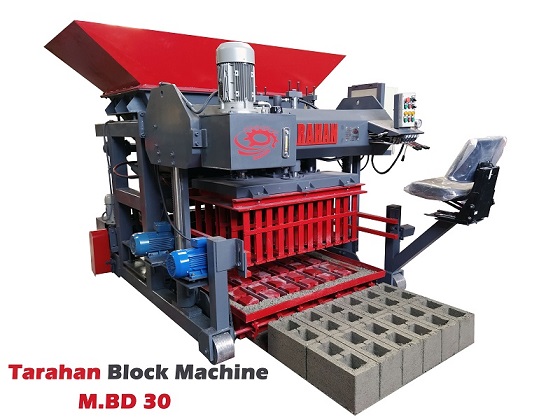
On the market, these machines also go by the names “movable block machine,” “mobile block making machine” and “egg-laying block machine,” all of which refer to the same concept. For the full list of models, see the Tarahan mobile block making machines category.
How Does a Stationary (Pavesing) Block Machine Work?
In a stationary machine, an empty pallet is positioned under the mold, the mix drops from the hopper (the feed bin on the machine) into the mold, and the lower and upper vibrators, together with hydraulic pressure, compact the concrete. The mold then lifts, the pallet carrying the product comes out, and the next pallet takes its place. On the Iranian market these machines are also called “pavesing” or “paving” machines.
The product is moved on its pallet to the curing area. Depending on how advanced the production line is, this transfer can be manual (with a special barrow or wheeled racks), semi-automatic (with pallet elevator and lowerator robots and a forklift) or, on automatic lines, handled by a stacking robot. After drying, the product is collected from the pallet and the pallet returns to the production cycle.
The most important advantages of this method:
- Product range: by changing the mold, the same machine can make blocks, curbstones and pavers. That is why, on Tarahan’s product pages, most TM models are presented as “block, curbstone and paver making machines.”
- Dimensional accuracy and an even surface: the combination of vibration, hydraulic pressure and product height adjustment is essential for units such as pavers that must fit together precisely.
- Two-layer production: on double-hopper models, one hopper supplies the structural layer and the second supplies the colored surface layer. The result is two-layer, colored pavers and curbstones.
- Room to expand: a stationary machine can gradually be built up into a complete production line with a batching plant, conveyors and pallet robots.
On the other hand, these machines need pallets, a foundation, a mixer and mix delivery system, and a dedicated curing space, and they demand more initial capital. See the models in the stationary concrete product machines category.

Mobile vs Stationary Block Machine Comparison Table
The table below summarizes the differences. Figures for Tarahan models are taken from the product pages and, as those pages themselves state, capacities are approximate and depend on many factors.
| Criterion | Mobile (egg-laying) block machine | Stationary (pavesing) block machine |
|---|---|---|
| Production method | The machine moves and lays blocks directly on the concrete surface | The machine is fixed; the product is formed on a pallet and goes to the curing area |
| Pallets required | No | Yes; the number of pallets depends on production volume and curing time |
| Land | Flat, level concrete slab; on Tarahan’s product pages, from a minimum of 500 m² (M.KB) to a minimum of 1,500 m² (M.BD) | Space for the machine, auxiliary equipment and curing; for example, at least 500 m² for TM-104 and TM-108, and at least 400 m² for TM-208 (including installation, production, storage and curing) |
| Product range | Specializes in wall and ceiling blocks; curbstones are possible with a mold change, but a dedicated machine is recommended for professional curbstone production; pavers do not appear in the capacity table of any Tarahan mobile model | Blocks, curbstones and pavers with a mold change; two-layer, colored pavers and curbstones on double-hopper models |
| Capacity | By number of blocks per cycle: from 4 to 5 blocks (20 cm) on manual models up to 12 blocks on the M.BD | By pallet: from 4 to 18 blocks (20 cm) per pallet and a nominal capacity of 80 to 140 pallets per hour, depending on the model |
| Labor | According to the product pages, 3 people for M.KB and M.KH and at least 3 to 4 people for M.BD | 2 to 3 operators for the machine itself according to the product pages; labor for pallet handling and curing depends on the line’s level of automation |
| Initial investment | Lower; simpler auxiliary equipment and no pallets | Higher; machine, pallets, foundation, mixer and mix delivery system |
| Best for | Starting on a limited budget, making blocks on the project site, workshops without extensive infrastructure | Professional concrete product manufacturers, the paver and curbstone market, an expandable production line |
Tarahan Mobile Block Making Machine Models
Tarahan’s mobile models range from manual machines to hopper-and-silo models. The key difference between them is whether or not they have a hopper: on hopper-equipped models the mix reaches the mold automatically from the silo and a PLC can be installed; hopperless models are simpler and, according to the M.KB page, the hopperless model cannot be upgraded with a PLC.
M.BD: Two-Row, 12-Cavity Mobile Machine
The M.BD 12-cavity automatic block making machine is mobile, two-row and hopper-equipped. According to the capacity table on its product page, it makes 12 blocks of 20×40×20, 16 blocks of 15 cm or 22 blocks of 10 cm per stroke. Its specifications include a 1,000-liter silo, a 5-ton press force and the option to add a PLC. To set it up you need at least 1,500 m² of flat concrete slab, 50 A three-phase power, access to a 1,200-liter mixer and a loader or Bobcat, and at least 3 to 4 operators.
M.BS: 6-Cavity Mobile Machine with Silo
The M.BS automatic mobile block making machine belongs to the hopper-and-silo series. It has a 6-cavity mold, a silo of about 1 m³, a hydraulic press with pressure adjustable up to 160 bar, and the option to install a PLC or winch. For standard operation, the product page lists a level concrete yard of about 1,000 to 2,000 m², 50 A three-phase power and at least 3 people per shift.
M.KB (Cadona): Semi-Hydraulic and Economical
The M.KB Cadona mobile block making machine is semi-hydraulic and hopperless, and it cannot be fitted with a PLC. According to the capacity table, it makes six 20 cm blocks per cycle. To run it you need at least 500 m² of flat concrete ground, 3 people (one operator and two helpers), a 500-liter mixer, two high-leg wheelbarrows and 25 A power. Delivery time is usually 20 to 30 working days.
M.KH: Semi-Hydraulic with Hydraulic Mix Feed
The M.KH semi-hydraulic block making machine is also mobile and hopperless, with hydraulic mix feed, a press of up to 160 bar and a 32 A three-phase electrical panel. Its capacity is six 20 cm blocks per cycle, and it requires at least 600 m² of flat concrete ground and a team of 3. The product page states explicitly that this model does not make pavers.
Manual Block Machine: The Lowest Cost to Start
The manual block making machine comes in single-motor and twin-motor versions and runs on single-phase or three-phase power. According to the product page, 8-hour capacity is 500 to 700 blocks on the single-motor version and 900 to 1,200 blocks on the twin-motor version. This model suits someone who wants to test the local market with the least capital.
Tarahan Stationary Block Making Machine Models
According to their product pages, all eight stationary TM series models covered in this article are electro-hydraulic, make blocks, curbstones and pavers with a mold change, and have a product height adjustable between 50 and 300 mm. In this list, the 100 series models are single-hopper and the 200 series models are double-hopper. The table below summarizes the main specifications from the product pages:
| Model | Hopper | Pallet size (mm) | 20×40×20 blocks per pallet | Pavers per pallet | Capacity (pallets per hour) | Hydraulic pressure |
|---|---|---|---|---|---|---|
| TM-104 | Single-hopper | 460 × 870 | 4 units | 0.3 m² | 80 to 140 | 120 bar |
| TM-108 | Single-hopper | 980 × 920 | 8 units | 0.8 m² | 80 to 130 | 160 bar |
| TM-110 | Single-hopper | 1150 × 1100 | 10 units | 1 m² | 80 to 120 | 180 bar |
| TM-112 | Single-hopper | 1460 × 920 | 12 units | 1.4 m² | 80 to 110 | 180 bar |
| TM-118 | Single-hopper | 1500 × 1350 | 18 units | 1.8 m² | 80 to 100 | 200 bar |
| TM-208 | Double-hopper | 990 × 920 | 8 units | 0.8 m² | 80 to 130 | 160 bar |
| TM-210 | Double-hopper | 1150 × 1100 | 10 units | 1 m² | 80 to 120 | 180 bar |
| TM-218 | Double-hopper | 1500 × 1350 | 18 units | 1.8 m² | 80 to 100 | 200 bar |
Single-Hopper Models: TM-104 to TM-118
The TM-104 stationary block machine is the smallest stationary model in this list (by pallet size). According to its product page, it needs at least 500 m² of space and 3 skilled workers, and it is aimed at small and newly established workshops. The same page points out that this model’s pallet is smaller, and if making curbstones or pavers alongside blocks matters to you, you are better off choosing a larger model.
The TM-108 model, with a 22 kW hydraulic pump motor and at least 500 m² of space, runs with at least 3 trained operators and can also make pavers and flower boxes with a mold change. The TM-110 (2 operators), TM-112 (usually 3 operators) and TM-118 (2 to 3 operators, with a 37 kW hydraulic pump motor) have larger pallets and more units per cycle, and are designed for higher output and larger construction projects.
Double-Hopper Models: TM-208, TM-210 and TM-218
Double-hopper models suit a manufacturer whose target market is two-layer, colored pavers and curbstones. According to its product page, the TM-210 double-hopper machine makes two-color, two-layer paving stones, curbstones, blocks and flower boxes, and needs at least 2 skilled workers to operate. For the TM-208, the minimum space for installation, production, storage and curing is given as 400 m², with 3 people required. The TM-218 is the largest double-hopper model and needs 3 people to operate, including an operator, a person in charge of material supply and a quality controller. If your main focus is pavers, also see the paver making machine page, and for street curbs the curbstone making machine page.
According to the product pages, all the stationary and mobile models presented in this article come with a 12-month warranty and 10 years of after-sales service or parts supply. Delivery time on the TM-208 and TM-118 pages is given as usually 60 to 70 working days.
How to Choose Between a Mobile and a Stationary Block Machine
Before comparing models, give clear answers to these five questions. These answers usually determine the type of machine:
- Land: Do you have, or can you build, a flat, level concrete slab of sufficient size? A mobile machine practically cannot work without it. If land is limited but you have a shed or covered space for racking pallets, a stationary machine makes more sense.
- Budget: Don’t look only at the machine price; also account for pallets, mixer, loader, pouring the floor and bringing in power. If your budget does not cover a new machine, look at a used block making machine or start with a simple mobile model.
- Product mix: If you sell only wall and ceiling blocks, a mobile machine is enough. If you plan to make quality pavers or curbstones for sale, you need a stationary machine, and for two-layer, colored products, a double-hopper model.
- Market and mobility: If you make blocks for your own projects or on the project site, the mobility of a mobile machine is a real advantage. If you are building a permanent workshop to sell to the local market, a fixed machine is no limitation.
- Labor and power: Assess how many reliable workers you have and what type of power is available. Manual models also run on single-phase power, but the hopper-equipped mobile models (M.BD and M.BS) need 50 A three-phase power, and the stationary models have hydraulic pump motors of 5.5 to 37 kW. The TM-118 and TM-218 pages mention industrial and three-phase power, so ask a sales specialist about the power type and amperage for the model you want.
For a closer look at costs and equipment, also read the block making machine buying guide and the article on setting up a block making workshop.
Common Mistakes When Choosing a Mobile or Stationary Block Machine
- Comparing machine prices only: A mobile machine needs no pallets but requires a large concrete slab; a stationary machine does not depend on a large production slab but needs pallets and auxiliary equipment. The real cost is the machine plus the infrastructure.
- Underestimating the land for a mobile machine: Blocks stay on the slab until they harden. If the slab is small, the machine has to stop before reaching its capacity.
- Buying a mobile machine with plans to make pavers: Pavers need dimensional accuracy, pallets and suitable vibration. According to the M.KH page, this model does not make pavers, and for curbstones, the mobile model pages recommend a dedicated curbstone making machine.
- Ignoring mix delivery: The capacity of any machine depends on how fast the mix reaches the mold. A large machine with a small mixer effectively runs at the mixer’s capacity.
- Choosing more capacity than the market needs: High nominal capacity without sales is just idle capital. Match capacity to real, predictable sales.
- Ignoring the upgrade path: If you intend to automate, buy a hopper-equipped model from the start (see the differences between levels in our comparison of manual and automatic block making machines). On hopperless models such as the M.KB, the product page says a PLC cannot be installed.
Frequently Asked Questions
Is an egg-laying block machine the same as a mobile block machine?
Yes. “Egg-laying,” “movable” and “mobile” are different names for one type of machine, which lays blocks directly on the concrete surface and moves itself forward. Tarahan also presents this machine as “mobile or egg-laying” on the M.KH model page.
What does “pavesing machine” mean?
Pavesing (or paving) is the market name for stationary pallet-type machines: machines that make the product on a pallet and produce blocks, curbstones and pavers with a mold change. Tarahan’s TM series models fall into this category.
Can a mobile block machine make pavers and curbstones?
For pavers, you need a stationary machine, and the M.KH page states explicitly that this model does not make pavers. Some mobile models, such as the M.BD, M.BS, M.KB and M.KH, can also make curbstones with a mold change, but the product pages recommend a dedicated curbstone making machine for professional curbstone production.
Which type of machine needs less land?
On Tarahan’s product pages, the land required for mobile models ranges from a minimum of 500 m² (M.KB) to a minimum of 1,500 m² of concrete slab (M.BD). For stationary models, for example, a minimum of 500 m² is given for TM-104 and TM-108 and a minimum of 400 m² including curing for TM-208. That said, the actual land you need depends on your daily output and curing method.
Can a mobile block machine be automated later?
Only hopper-equipped models. According to the product pages, the M.BD and M.BS can be fitted with a PLC, but the M.KB is hopperless and cannot; the M.KH is also hopperless. If an upgrade is in your plans, choose a hopper-equipped model from the start.
What are the warranty and delivery times for these machines?
According to the product pages, the models presented here come with a 12-month warranty and 10 years of after-sales service or parts supply. Delivery time is stated as usually 20 to 30 working days for the M.KB, about 45 to 60 working days for the M.BD, and usually 60 to 70 working days for the M.BS, TM-208 and TM-118.
Conclusion
Choosing between a mobile block machine and a stationary block making machine has less to do with the machine itself than with your business. If you have a large concrete yard, your product is blocks, and you want to produce with less capital or on the project site, a mobile machine is the logical choice. If your product mix also includes pavers and curbstones, dimensional accuracy and surface quality matter to you, and you are thinking about an expandable production line, choose a stationary pallet-type machine.
The price of each model depends on options, molds and auxiliary equipment, and is quoted after reviewing your needs. For advice and a price quote, contact Tarahan’s sales specialists at +98 41 3630 4464 or +98 914 584 1914.

Submit Comment: