


To set up a concrete block manufacturing workshop, start by sizing up the local market, then secure land with water, three-phase power and truck access, and divide it into zones for materials, mixing, production and curing. Next, choose your block making machine based on output, land and power, and match the mixer, crew and permits to that same scale.
Most people who get into block making start with the machine, when it is really the land, the power supply, the type of customer and the curing space that determine which machine makes sense. Below we walk through the setup process and, for each workshop size, put the actual specifications of Tarahan Machinery’s machines side by side. This guide gives no cost or revenue figures, because they change from city to city and from month to month.
How many steps does it take to set up a block making workshop?
A block plant, whether small or semi-industrial, almost always follows this same path. Sticking to the order keeps you clear of two costly mistakes: a machine your land or power supply can’t support, and a block nobody in your area wants to buy.
- Market assessment: which block, what thickness, and for which customer?
- Land and workshop layout: area, concrete floor, entry and exit routes, and division into zones.
- Water and power: three-phase power with enough amperage, and clean water for the mix and for curing.
- Raw materials: cement, sand or pumice, and how to store them.
- Labor: an operator and helpers to suit the machine.
- Permits: the provincial and county paperwork required before official production begins.
- Machine and mixer selection: based on the three previous steps, not the other way around.
- Curing and quality control: where the final quality of the block takes shape.
- Sales and delivery: loading, transport and keeping customers.

How do you assess the local market before buying anything?
The block market is a local market. Blocks are heavy and the cost of hauling them over long distances climbs quickly, so your main customers are usually within a short radius of the workshop. Before you rent land, visit construction projects, building-material dealers and existing workshops, and answer these questions:
- Does your area mostly use heavy (sand) blocks or lightweight pumice blocks?
- Which thickness sells best: 10 and 15 cm blocks for partition walls, or 20 cm blocks for walls? Is there demand for ceiling blocks as well?
- Who is the main customer: the single-project builder, the volume housing contractor or the building-material dealer?
- Are customers satisfied with the quality or delivery times of the workshops already operating in the area?
- How many months of the year does the construction season last in your area? In cold regions, winter effectively slows both production and sales.
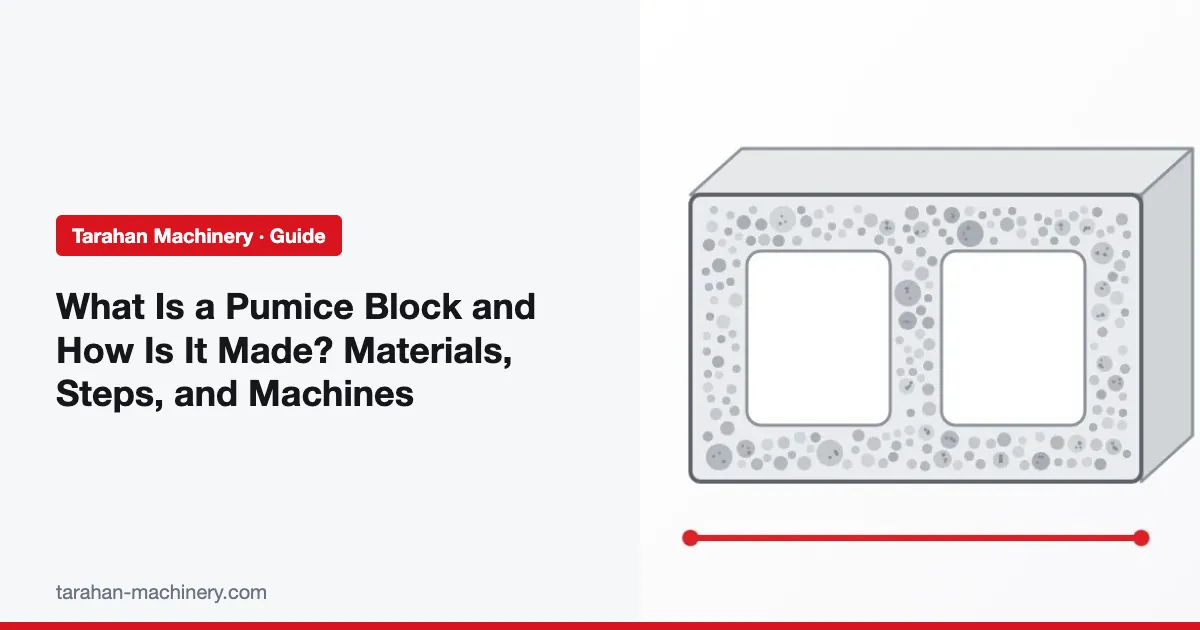
This assessment should give you two answers that every other decision depends on: your main block type, and the daily output you can realistically sell, not the output the machine can produce. If you plan to make lightweight blocks, read the pumice block production guide first, because a supply of good pumice near the workshop is a siting requirement in its own right.
How much land does a block making workshop need, and how should it be laid out?
The machine and the output determine the land area. Tarahan Machinery’s product pages list a minimum of about 500 m² for the manual machine, M.KB and TM-104, about 1,000 m² and up for M.BS, and about 1,500 m² of smooth concrete slab for M.BD. These figures are the minimum working space for the machine; if you plan to stockpile a lot of material or hold finished product for several days, you will need more room.
When choosing land, also check the following: truck and loader access without passing through narrow alleys, distance from residential areas because of vibration noise, proximity to a sand or pumice quarry, and a gentle slope for surface water drainage. A level concrete floor, especially for mobile machines, is part of the production line and is not the place to cut costs.
Block making workshop layout: five zones that must be kept separate
A good layout keeps the flow one-way: materials come in from one side and finished blocks are loaded out from the other, without the loader passing beside fresh blocks.
- Material storage zone: next to the entrance gate, with a dividing wall between sand and pumice so the materials don’t mix. Keep bagged cement under a roof and on pallets, away from ground moisture, or use a cement silo for bulk cement.
- Mixing zone: place the mixer close to both the material storage and the machine, so wheelbarrow or loader trips stay short. The water tap and a scale or fixed measuring container belong here too.
- Production zone: for a stationary machine, the machine platform with its foundation; for a mobile machine, the starting end of the concrete slab.
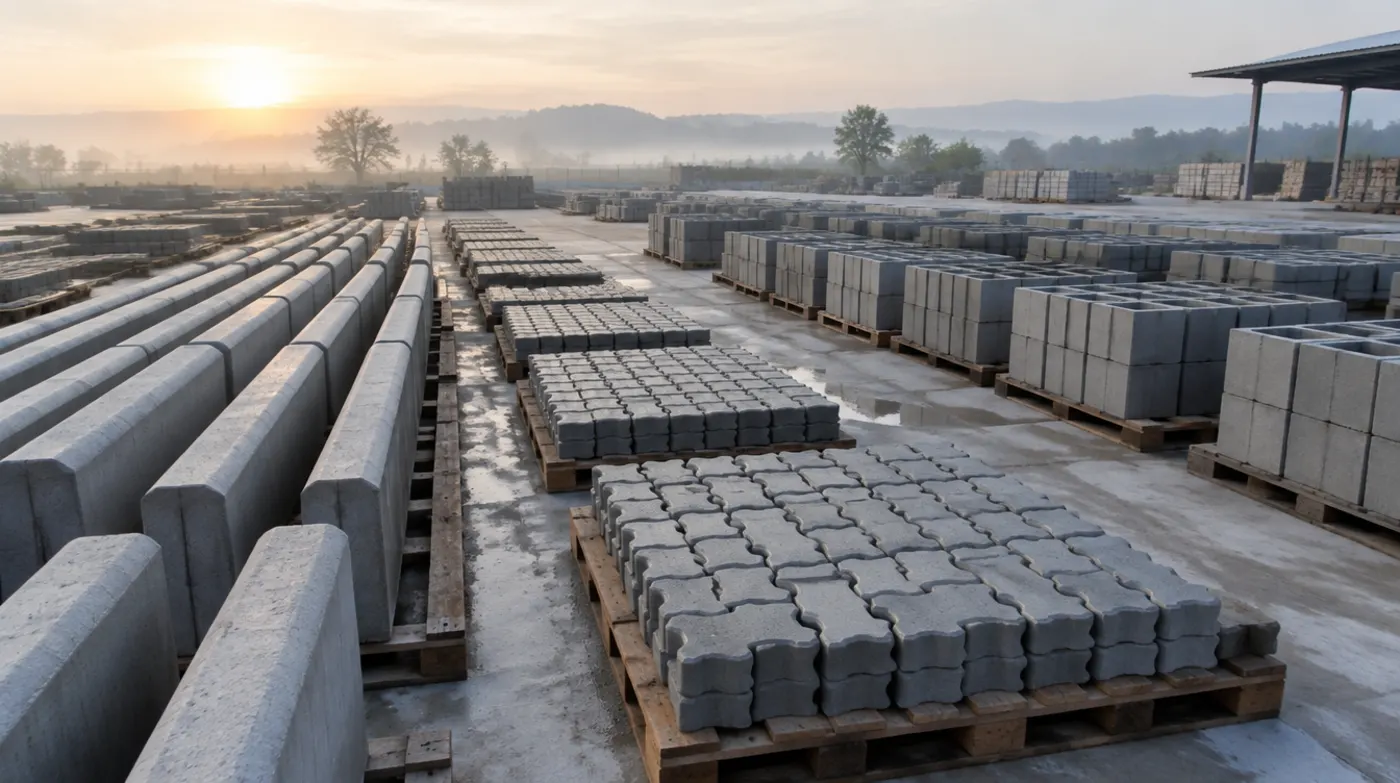
- Curing zone: in a mobile workshop, the concrete slab itself is the curing area; in a stationary workshop, racks or a yard for loaded pallets. Shade and access to a water sprayer are required.
- Finished product storage and loading zone: near the exit gate, with room for trucks to maneuver.
The main layout difference between the two machine types is this: with a mobile block machine, the machine moves and the blocks stay on the ground, so the higher the daily output, the larger the concrete slab you need. With a stationary block machine, the product is formed on a pallet and carried to the curing area, so you need pallets, a foundation and a pallet handling system. We cover this comparison in detail in our article on mobile vs. stationary block machines.
An industrial shed is recommended for the machine and the mixing zone. Producing in the open is possible, but rain, direct sun and wind affect both the quality of the mix and the life of the machine’s electrical parts.
Workshop water and power: what to check before signing a lease
Power is the most common bottleneck, and it is often discovered only after the machine has been bought. Before signing for the land, ask whether the existing supply is single-phase or three-phase, how many amps it provides, and what procedure the local power utility follows if you need more amperage. According to the product pages, Tarahan Machinery’s machines have these power requirements:
| Machine | Power required | Rated power or main motors |
|---|---|---|
| Single-motor manual block machine | Single-phase or three-phase | 1.5 hp vibration motor |
| Two-motor manual block machine | Single-phase or three-phase | 2 hp vibration motor + travel motor |
| M.KB (mobile semi-hydraulic) | 25 A electrical panel | 3 kW press motor, 1.5 kW travel motor |
| M.KH (mobile semi-hydraulic) | Three-phase, 32 A | 3 electric motors, 9.5 hp in total |
| M.BS (mobile hydraulic) | Three-phase, 50 A | Hydraulic, PLC can be installed |
| M.BD (mobile automatic, 12-mold) | Three-phase, 50 A | 5-ton press, 1,000-liter silo |
| TM-104 (stationary, single-hopper) | Industrial power for the motors listed | 5.5 kW hydraulic motor + two 3 kW vibrators |
The mixer needs power too. Tarahan Machinery’s vertical mixers run on three-phase power, and only the 300-liter model can be ordered for single-phase. So if the land has only single-phase power, the safe options are a manual machine and a 300-liter mixer; for larger machines, confirm the power type with a specialist before ordering, or plan for a generator and an upgraded connection.
Water is used in two places: making the mix and curing. It must be clean, without excessive dissolved salts, mud or silt. A storage tank for days when the water is cut off helps keep production and the spraying of fresh blocks from stopping.
Where and how do you source raw materials for block making?
Cement: Type II Portland cement is commonly used for blocks. Cement is sold bagged and in bulk; in a small workshop bagged cement is simpler, and as production grows a cement silo and bulk purchasing make more sense. Never store bagged cement directly on the ground or exposed to moisture; lumpy cement lowers block quality.
Aggregate: heavy blocks use sand and fine gravel, while lightweight blocks use pumice. Aggregate must be clean, free of roots and organic matter, and low in clay. Consistent grading from one specific quarry matters, because any change in material throws off your mix and vibration settings.
Mix design: settle the ratio of cement, aggregate and water once through controlled trial and error, then repeat it with a fixed measure. Block mix should be low in water and semi-dry; a mix that is too wet makes the block slump after the mold lifts, and one that is too dry causes chipped edges. We explain curing principles and quality points in more detail in our article on the principles of concrete block production.
How many workers do you need, and what skills should they have?
Tarahan Machinery’s product pages specify a crew of three for the manual machine, M.KB, M.KH, M.BS and TM-104. The usual lineup on mobile semi-hydraulic machines is one operator and two helpers. For M.BD, allow at least 3 people for loading materials, operating the machine and collecting the product.
These figures cover only the work at the machine; someone also has to order materials, handle loading and make sales, and in a small workshop that is usually the owner. If you have a loader, count its driver as well.
The most important skill is adjusting the mix and vibration, and it comes with practice. Block making training is usually given while the machine is being installed; Tarahan Machinery provides operator training and a Persian-language manual for its machines, and according to the M.BD page, installation and initial setup of that model usually take 1 to 3 days. Treat the first few weeks as a learning period, and don’t commit your output to wholesale buyers until quality is consistent.
What permits does a block making workshop need?
In Iran, the paperwork varies by province and type of land, but you will usually deal with the following:
- Land use: the land must be zoned for industrial or workshop use, or be located in an industrial park or zone. Agricultural land without a change of use usually causes problems.
- Establishment permit and operating license: usually obtained from the provincial Department of Industry, Mine and Trade.
- Environmental clearance: usually required because of dust and noise, and it affects site selection.
- Industrial power and water connections: ask the county offices about the procedure and timing.
- Product quality: if you intend to sell to government projects or volume builders, take the product quality and laboratory requirements seriously from the start.
Before buying or renting land, consult the county Department of Industry, Mine and Trade; some plots effectively cannot get a permit, and you need to know this before building the concrete slab.
Which machine suits which workshop scale?
Now that the market, land, power and labor are clear, choosing the machine gets simpler. The table below puts the models of Tarahan Machinery block making machines side by side, using the figures from their product pages. For a fair comparison, it shows the number of blocks per pallet or cycle instead of per-shift capacity; actual capacity depends on operator skill, the mix and working speed.
| Workshop scale | Machine | Type | Land (minimum) | Crew | Power | 20 / 15 / 10 cm blocks per pallet or cycle |
|---|---|---|---|---|---|---|
| Small start, limited power | Single-motor manual | Manual | 500 m² | 3 people | Single-phase or three-phase | 4 / 5 / 7 |
| Small and growing | Two-motor manual | Manual with motorized travel | 500 m² | 3 people | Single-phase or three-phase | 5 / 6 / 9 |
| Small to medium, mobile | M.KB | Semi-hydraulic, no hopper | 500 m² | 3 people | 25 A | 6 / 8 / 11 |
| Medium, mobile | M.KH | Semi-hydraulic, no hopper | Flat concrete ground (depends on output) | 3 people | Three-phase, 32 A | 6 / 8 / 11 |
| Medium to large, mobile | M.BS | Hydraulic, PLC-capable | About 1,000 m² | 3 people | Three-phase, 50 A | 6 / 8 / 11 |
| High output, mobile | M.BD | Automatic, two-row, with silo | 1,500 m² | At least 3 people | Three-phase, 50 A | 12 / 16 / 22 |
| Stationary, varied products | TM-104 | Stationary single-hopper, electro-hydraulic | 500 m² | 3 people | 5.5 kW motor and two 3 kW vibrators | 4 / 5 / 7 |
Small start: manual machine
If your capital is limited, the land has single-phase power, or you want to test the market before a large investment, a manual block making machine is the logical starting point. The single-motor version has only a vibration motor and is moved by hand; the two-motor version has a separate travel motor that raises speed and efficiency. The main limitations of these machines are output and a greater dependence on labor.
Small to medium workshop: mobile semi-hydraulic M.KB and M.KH
Once your market is established and you want denser, more uniform blocks, mobile semi-hydraulic machines are the next step. The Cadona M.KB block making machine weighs 1,800 kg, has a semi-hydraulic press and vibration system and a hydraulic mix feed, and runs with one 500-liter mixer and two high-leg wheelbarrows. The M.KH semi-hydraulic machine is heavier (2,500 kg), its press works at up to 160 bar, and it has three electric motors. Neither has a hopper, and both produce the same number of blocks per pallet; the M.KB page states explicitly that it cannot be fitted with a PLC.
High-output mobile workshop: M.BS and M.BD
If you have contracts with contractors or volume builders and need continuous production, mobile hydraulic and automatic machines come into play. The M.BD 12-mold automatic block machine lays two rows of blocks at once, has a 1,000-liter silo so it doesn’t stop to take on mix, and can be fitted with a PLC. On the other hand, it requires a 1,200-liter mixer, a loader or Bobcat, and a larger concrete slab. M.BS is also hydraulic and can be upgraded by installing a PLC or a winch.
Stationary workshop with varied products: TM-104 and larger models
If you are also thinking about producing pavers and curbstones in addition to blocks, or dimensional accuracy is your priority, look at a stationary pallet machine. The TM-104 stationary machine is single-hopper, has a 46×87 cm pallet, works at 120 bar hydraulic pressure, and makes products 50 to 300 mm high. Each pallet yields one 30×50 curbstone or about 0.3 m² of pavers; even so, because its pallet is small, curbstone making machines are recommended for serious curbstone and paver production. A stationary machine needs pallets, a foundation and curing space for the pallets.
For more on selection criteria, see our guide to choosing a block making machine by budget and space. If your starting capital is limited and you are considering a used machine, go through our used block making machine buying checklist before you buy.
What equipment does a block making workshop need besides the machine?
A block making machine can’t produce without supporting equipment. The minimum equipment list for a block making workshop is:
- Mixer: its capacity must match the machine. The product pages specify a 500-liter mixer for M.KB and M.KH and a 1,200-liter mixer for M.BD. The DM.V vertical mixer is built in 300, 500 and 800-liter capacities and suits the dry mix used for blocks and curbstones. For larger lines and low-slump concrete, a pan mixer is also an option. We explain the selection criteria in our guide to choosing a block making mixer.
- Molds: each block thickness, and each ceiling or partition block, needs its own mold. At the start, buy only the molds for the blocks that sell best in your area.
- Mix and product handling: high-leg wheelbarrows for simple machines; a loader, Bobcat or tractor with a bucket for machines with a silo.
- Collecting and loading: gathering dried blocks off the slab is hard, time-consuming work in mobile workshops. The block collecting machine is designed for this job and for loading blocks onto the delivery truck, and it can be ordered for single-phase or three-phase power.
- Pallets: for stationary machines only; the number needed depends on curing time and daily output.
- Curing equipment: water sprayer, hose, plastic sheeting or wet burlap, and shade.
How is block curing done, and why does it matter so much?
A fresh block is at its most vulnerable in the first few days. If the water in the mix evaporates too soon, the cement doesn’t have time to react fully and the block turns brittle and powdery, a problem the customer notices right at loading.
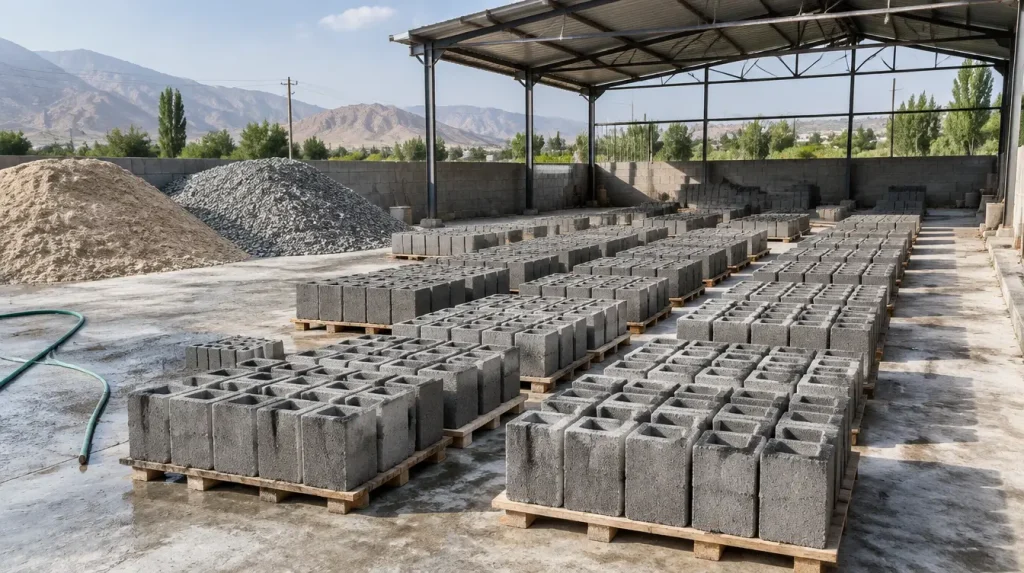
In small workshops, the most common method is water curing: the blocks are kept wet with a sprayer so their moisture level doesn’t drop. This usually takes about a week. A few practical points:
- On the first day, keep blocks out of strong sun and direct wind; a shade structure or plastic cover helps a lot.
- Spray at low pressure so the edges of fresh blocks don’t break.
- Don’t move or stack blocks before they have hardened enough; chipped edges and fine cracks usually come from this kind of haste.
- In cold weather, shift production to the warm hours of the day and protect fresh blocks from freezing; small workshops sometimes use a stove or heater in a covered space.
How do you check block quality every day?
Consistent quality is a workshop’s most effective sales tool. A short daily checklist is enough:
- At the start of each shift, check the moisture of the materials by hand and adjust the water in the mix accordingly.
- Measure the dimensions and height of a few blocks from each batch with a tape measure; uneven height means a problem with vibration or mold filling.
- Look at the edges and corners; chipped edges usually come from a dry mix or a worn mold.
- Each day, break or drop a few blocks from previous days and compare how they behave; if they suddenly turn brittle, check the cement, the materials or the curing.
- Inspect the mold, bolts and vibration dampers regularly. Ask about service intervals and parts supply before you buy, too; Tarahan Machinery states a 12-month warranty and 10 years of spare parts supply for its machines.
Who do you sell blocks to, and how?
Selling blocks depends more on trust and on-time delivery than on advertising:
- Local builders and contractors: visit projects under construction with a few cured sample blocks; the customer will test the block by hand.
- Building-material dealers: wholesale at a lower margin, but with regular turnover.
- Project contracts: for volume builders, steady production capacity and regular delivery matter more than the price per block.
There is no fixed figure for the profitability of concrete block production. Profit comes from the gap between the local selling price and the cost of cement, aggregate, power, labor and transport, and all of these are local and variable. The right approach is to build a simple spreadsheet using current prices in your own city: the material cost per block, the monthly fixed costs, and the output you can actually sell.
Frequently asked questions
Is a block making workshop profitable?
It can be, provided the local market, output and costs line up. Because material and selling prices differ from city to city, calculate profit using current prices in your own area, not general figures.
Which machine should a small block making workshop start with?
With limited power and little capital, a single-motor or two-motor manual machine; with adequate power and a more certain market, the M.KB mobile semi-hydraulic machine. All three work with about 500 m² of land and a crew of 3.
What is the minimum land for a block making workshop?
About 500 m² for the manual machine, M.KB and TM-104; about 1,000 m² and up for M.BS; and about 1,500 m² of concrete slab for M.BD. Allow for material and finished product storage separately.
Can you run a block making workshop on single-phase power?
Yes, but with limits. The manual machine and the 300-liter vertical mixer can also be ordered for single-phase power. Hydraulic and automatic machines such as M.KH, M.BS and M.BD need three-phase power.
How long does block making training take?
Operator training is usually given during installation, but mastering the mix and vibration settings usually takes a few weeks of practice.
What sections should a block making workshop layout include?
Material storage, the mixing zone, the production zone, the curing yard, and finished product storage and loading, arranged so that materials enter through one gate and blocks leave through another.
Does a block making workshop need an industrial shed?
It isn’t mandatory, but the machine, electrical panel, mixer and cement store should have a roof so that mix quality and curing stay consistent in sun and rain.
Conclusion
Setting up a block making workshop starts with answering three questions: which block and for whom, on what land, and with what power. Once these are clear, the choice between a manual, mobile semi-hydraulic, mobile automatic or stationary machine nearly makes itself. To match the workshop scale and the right machine to your own land and power conditions, or to get current machine prices, call the specialists at Tarahan Machinery at +98 914 584 1914.


Submit Comment: