


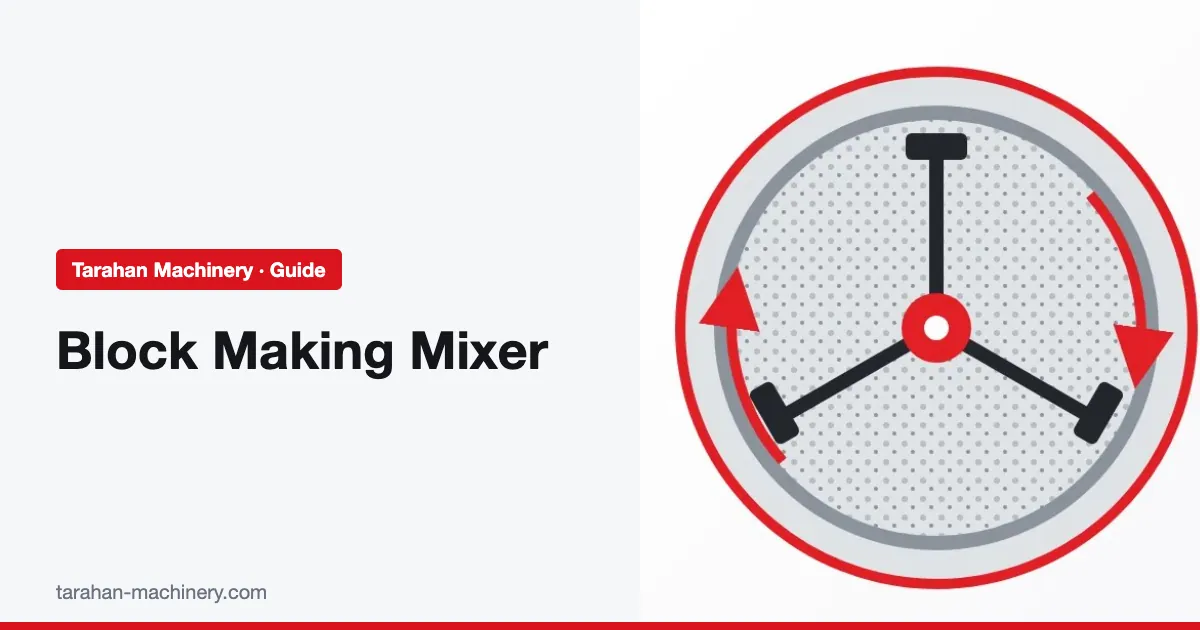
When choosing a block making mixer, the rule is to buy a machine that homogenizes a dry, low-water mix (zero or near-zero slump) through pressure and the forced movement of its blades, not one that merely tumbles the materials. For a mobile block machine or a small plant, a vertical (round) mixer is usually enough. For a stationary line making blocks, curbstones, and colored pavers, a pan mixer or horizontal mixer is the more logical choice. Save the twin shaft mixer for batching plants and very high output. Drum mixers and betonieres are built for fluid concrete and are not the first choice for block mix.
How Does a Block Making Mixer Differ from a Fluid Concrete Mixer?
Concrete for slabs and columns is fluid, and it can be mixed in a rotating drum as it falls from top to bottom. Block, curbstone, and paver mix is different. It is semi-dry, or “damp” in plant-floor language: it holds enough water to activate the cement, but so little that the block can leave the mold right after vibration and pressing and stand on its pallet.
This dryness is what makes mixing hard. In a low-water mix, cement balls up instead of coating the sand and gravel particles. If the mixer lacks power or its blades do not force the mix to move, the result is a block whose edges crumble as it leaves the mold, whose color is blotchy, or whose strength varies from one pallet to the next. In our article on how to prepare concrete block mix, we explain that even the most expensive additives form clumps in a weak mixer and fail to deliver results.
That is why mixers for concrete products use “forced mixing”: a blade turns inside a stationary tank, pushing the materials and lifting them off the floor. In a betoniere or drum mixer, the drum itself turns and the materials fall under their own weight. For a closer look at how site mixers, betonieres, and truck mixers compare with industrial mixers, see the article on the difference between site mixers, betonieres, and truck mixers. For a general introduction to all mixer families, the guide to types of concrete mixers is a good starting point. Here we focus only on choosing a mixer for blocks and concrete products.
Which Tarahan Mixers Suit Blocks and Concrete Products?
All models are listed on the concrete mixer category page. For block mix, the first five types matter; the last three serve other purposes.
DM.V Vertical Mixer: The Classic for Block and Curbstone Making
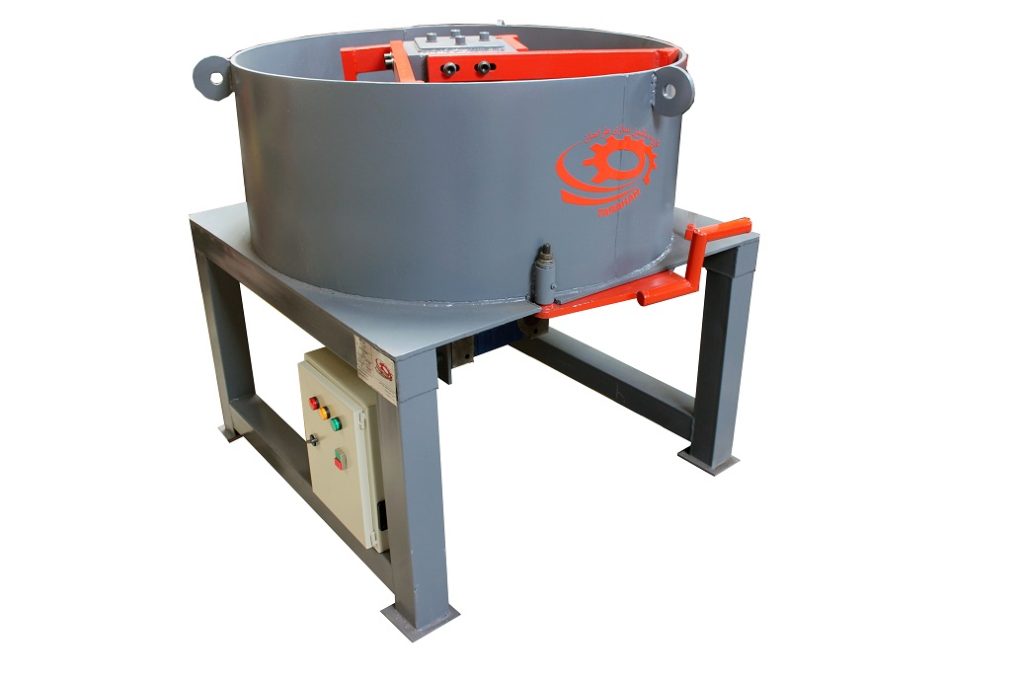
The DM.V vertical mixer is what the market calls a “block making mixer” or “curbstone machine mixer.” Its main shaft is vertical and its tank is round and pot-shaped. Paddles drive the materials around the tank, and discharge is from the bottom. Tarahan builds this model specifically for dry mix used to produce concrete products and artificial stone.
- Capacities: 300, 500, and 800 liters.
- Electric motor: 3 hp (single-phase 300-liter version), 5.5 hp for the three-phase 300-liter, 10 hp for the 500-liter, and 15 hp for the 800-liter.
- Opening diameter: 90 cm for the 300-liter models, 120 cm for the 500-liter, and 150 cm for the 800-liter.
- Power supply: three-phase; only the 300-liter model can be built for single-phase power.
- Double-layer floor and wall plate (20 mm), replaceable plate, replaceable blades with adjustable clearance, mechanical cleaner inside the tank, optional pneumatic cylinder for the gate, and an electrical panel with Korean LG/LS components.
The DM.V is simple and compact, and it usually does the job for a plant with one mobile block machine or one single-hopper stationary machine. The single-phase 300-liter version is also a practical advantage for a plant that does not yet have three-phase power.
Heavy-Duty Round (Pan) Mixer: Forced Mixing for Zero-Slump Concrete
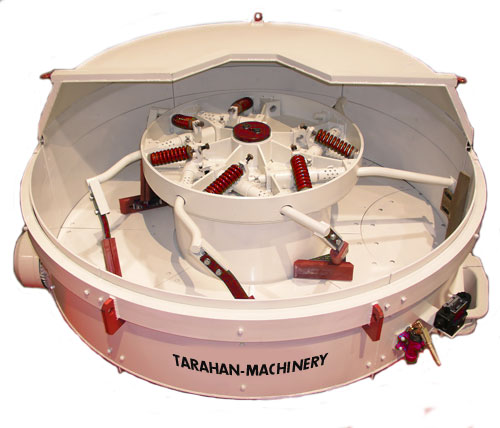
The pan mixer also has a round, stationary tank, but it is designed for heavier work. In the Tarahan pan mixer, the arms sit at the center of the tank and move the concrete with a rotating motion and pressure from the floor upward. This mixer breaks up cement lumps and quickly coats the sand and gravel particles with cement paste.
- Mixing capacity: available in several sizes, ordered according to the line’s output.
- High-power worm gearbox and a high-torque Motogen electric motor that makes starting under full load possible.
- Replaceable anti-wear liners on the wall and floor, with a two-piece body that allows liners to be changed with nuts and bolts alone, without any cutting.
- Anti-wear paddles with protective springs: if a large piece of aggregate jams, the spring absorbs the impact so the arm does not break and the gearbox is not damaged.
- Single or double discharge gate; the two-gate version can feed two lines at the same time (for example, a block machine and a curbstone machine).
- Automatic washing with internal nozzles, available as a custom option.
The pan mixer’s strength lies in products where uniformity is visible: streak-free colored pavers and pumice blocks in which cement does not settle out. For block and curbstone lines, the smaller pan mixer models are usually enough, while the larger ones are recommended for bigger products or a high number of batches.
A pan mixer of about 1000 liters is between 2 and 2.5 m in diameter and close to 2.3 m high, and it needs clear space roughly 3.5 to 4 m in diameter for service and discharge. Pan mixers are usually three-phase.
DM.H Horizontal Mixer: For Continuous Lines and Heavy Work
The DM.H horizontal mixer has a U-shaped tank and a horizontal shaft. In this mixer, materials move in two directions at once: radially (from the center to the wall) and axially (along the shaft). The goal is to eliminate dead spots in the tank during continuous work with block and curbstone mix. The color, moisture, and consistency of the mix in each batch are more uniform than in a round vertical mixer.
- Capacities: 800, 1000, 1200, and 2000 liters.
- 20 mm anti-wear plate on the body and floor, modular and replaceable.
- Replaceable cast iron blades and a shaft of torsion-resistant alloy steel.
- Electrical panel with Korean Hyundai and LS components and a thermal relay; charging and discharge gates with pneumatic cylinders that can take commands from the line’s PLC.
- Mechanical cleaning system inside the tank to prevent mix buildup.
We recommend the 800- and 1000-liter capacities for block and curbstone lines with medium production, and the 1200- and 2000-liter capacities for high production, long shifts, or several presses running at once.
Single Shaft Mixer: One Shaft for Batching and Medium Output
The single shaft mixer has one shaft with angled blades that mix concrete in three dimensions with a back-and-forth flow. Built for batching plants and medium-sized projects, it comes in stationary and mobile versions and has replaceable anti-wear paddles, automatic shaft lubrication, and a Russian or Italian integrated gearmotor. On the mixer category page, the single shaft mixer is presented alongside the pan mixer as a cost-effective option for the dry and semi-dry concrete used in blocks, curbstones, and paving stones, and it can connect directly to a block machine, curbstone machine, or paving stone machine.
Twin Shaft Mixer: Two Shafts for Very High Output
The twin shaft mixer has two parallel shafts that turn in opposite directions, with blades that mix concrete in three dimensions. It is built for high capacities (up to 3000 liters) and for large, demanding projects. It has two discharge gates, automatic shaft lubrication, and a two-piece body with replaceable anti-wear cast iron parts. The twin shaft mixer handles everything from dry and semi-dry to fluid concrete, which is why its main place is in batching plants and automatic lines that produce both ready-mix concrete and concrete products.
Drum Mixer, Perlite Mixer, and Grout Mixer
- Drum mixer: it mixes by tumbling; the drum turns and internal blades lift the materials and release them. The Tarahan model has a 20 hp gearmotor and a drum made of 6 mm plate. It is economical for fluid and semi-fluid concrete and for ready-mix production in small plants, and Tarahan also considers it suitable for blocks and simple products in medium-capacity factories. For very dry mix, however, forced-action mixers are more reliable.
- Vertical (perlite) mixer: for lightweight materials such as perlite and pumice and for materials used in refractory products; its mixing is gentle so the grains do not break.
- Grout mixer: for injected cement grout (micropiles, anchoring, tunnels); it has nothing to do with block mix.
Mixing Differences Between Round and Shaft Mixers
In a round mixer (DM.V and pan mixer), materials circle a vertical shaft in a stationary tank. In the DM.V, paddles drive the materials around the tank; in the pan mixer, the central arms also lift the materials off the floor and press them against the wall. Discharge is through a gate in the floor or side of the tank.
In shaft mixers (single shaft, twin shaft, and DM.H horizontal), the shaft is horizontal and the tank is elongated. The blades turn the materials across the width of the tank and also carry them back and forth along its length. In a twin shaft mixer, the two shafts rotate in opposite directions and the flows from each side collide in the middle of the tank. A shaft mixer is built for large volumes and continuous work.

Which Mixer for Which Job? Comparison Table
This table is based on the specifications and recommendations on Tarahan’s product pages.
| Mixer type | Capacity (liters) | Suitable mix | Best fit | Key point |
|---|---|---|---|---|
| DM.V vertical | 300, 500, 800 | Dry and semi-dry | Mobile block machine, single-hopper stationary machine, small plants and first-time producers | Only the 300-liter model is available in single-phase |
| Pan mixer | Several capacities, made to order | Zero-slump, colored, pumice | Stationary block, curbstone, and colored paver lines; feeding two lines at once | Single or double discharge gate; usually three-phase |
| DM.H horizontal | 800, 1000, 1200, 2000 | Dry and semi-dry, with pigment and additives | Continuous line, long shifts, several presses at once | Pneumatic gate controllable from a PLC |
| Single shaft | Several capacities, from 500 liters | Dry and semi-dry, ready-mix concrete | Batching and medium output, direct connection to a block machine | Available in stationary and mobile versions |
| Twin shaft | Up to 3000 | Dry to fluid | Batching plant, automatic line with very high output | Two discharge gates; usually too large for a single block machine |
| Drum mixer | Made to order | Fluid and semi-fluid | Ready-mix concrete in small plants and on civil projects | Not the first choice for very dry block mix |
| Vertical (perlite) | Made to order | Lightweight (perlite, pumice) | Lightweight blocks and panels, refractory products | Gentle mixing so grains do not break |
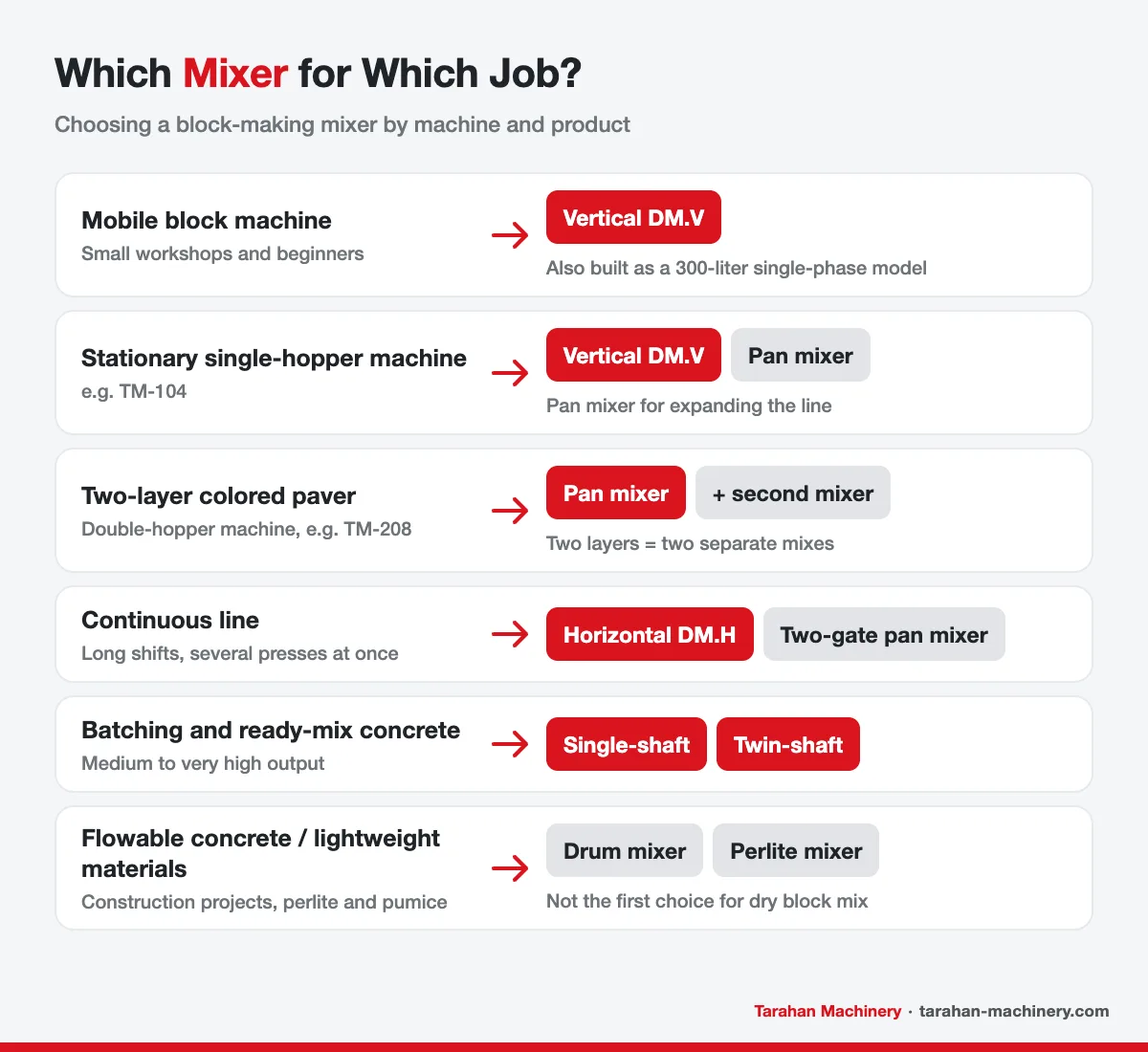
Some common scenarios:
- Mobile (egg-laying) block machine: the mixer should be simple, rugged, and low-cost to maintain; the DM.V is the common choice. Larger mobile machines need more capacity. For example, the page for the M.BD 12-mold mobile block machine lists access to a 1200-liter concrete mixer among the startup requirements.
- Single-hopper stationary machine: for a machine like the TM-104 stationary block machine, with a stated output of about 4000 blocks in an 8-hour shift, a DM.V or small pan mixer is usually enough. If you plan to expand the line, a pan mixer leaves more room to grow.
- Two-layer pavers and double-hopper lines: on the TM-208 double-hopper machine, the strong base layer and the colored face layer are pressed at the same time. The two layers need separate mixes, so a continuous line usually runs two separate mixers: a larger one for the base layer and a smaller one for the colored layer. Small plants sometimes work with one mixer and alternating batches, but the line runs slower. Because it spreads pigment evenly, a pan mixer is a good option for the colored layer. If you have not yet chosen a paver design, the guide to types of concrete pavers can help.
- Batching plant and ready-mix concrete: if you sell ready-mix concrete as well as concrete products, consider a twin shaft or single shaft mixer. Each makes both types of concrete and connects to the weighing system.
Matching Mixer Capacity to the Block Machine
Do not buy a mixer on liters alone. What matters is how many batches of mix it delivers per hour and whether that keeps up with what the block machine consumes. If it falls short, the block machine waits. If it is far too large, the prepared mix may sit for a long time and lose moisture and workability before it reaches the mold.
Tarahan’s mixer category page gives a rule of thumb for this:
Daily output ≈ net capacity per batch × (60 ÷ batch time in minutes) × effective working hours
Effective hours means the actual working time in a shift after deducting loading, unloading, and stoppages, usually 5.5 to 6.5 hours. Batch time includes loading and discharge, not just mixing. Compare the result with your own block machine’s mix consumption.
Some practical rules:
- If you have production peaks, buy one size larger or run two smaller mixers at the same time; with two mixers, servicing one does not shut down the whole line.
- A mixer that always runs at maximum capacity and under strain wears out its gearbox and motor sooner. For pan mixers, too, we recommend choosing a slightly higher capacity so the gearbox and motor last longer.
- Match the discharge height and direction to the feed point of the block machine, feed car, or conveyor belt. On Tarahan’s pan mixer, DM.H, and drum mixer, the discharge height and direction are set to suit your layout.
- If two machines (for example, a block machine and a curbstone machine) will be fed from one mixer, look at the two-gate pan mixer.
Block Making Mixer Maintenance: Blades, Liners, and Discharge
The sand and gravel in the mix act like sandpaper on the blades and walls. Wear is normal; what matters is replacing worn parts quickly so the main body is not damaged.
Blades and Their Clearance from the Floor
As blades wear, the clearance between blade, floor, and wall grows, and a layer of mix stays on the floor unmixed and gradually hardens. On the DM.V, blade clearance is adjustable: inspect and adjust it periodically, and replace any blade that is excessively worn. On the pan mixer, the paddles are mounted on springs so the arm does not break if a large stone jams; even so, control the grading of your materials so these springs are not under constant impact.
Liners and Anti-Wear Plates
The heaviest wear occurs inside the tank and on the paddle edges. In Tarahan mixers the inner plating is replaceable: the DM.V has double-layer floor and wall plate, the DM.H has 20 mm modular anti-wear plate, the pan mixer has bolted liners, and the single shaft and twin shaft mixers have replaceable cast iron parts. When buying, ask how readily available spare liners and blades are and how many hours of downtime replacing them takes.
Discharge and Washing
Mix left to harden in the tank spoils the next batch and increases wear. Empty the tank completely and clean it at the end of every shift. The mechanical cleaning system (on the DM.V and DM.H) and automatic nozzle washing (a custom option on the pan mixer) make this job easier. Inspect the discharge gate as well; a gate that does not close fully lets cement slurry leak out.
Gearbox, Shaft, and Electrical System
Check the gearbox oil and shaft sealing as the manual specifies. On single shaft and twin shaft mixers, shaft lubrication is automatic, but its reservoir must stay full. Do not start the mixer with hardened mix in the tank, and if the panel’s thermal relay keeps tripping, find the cause rather than raising its setting.
If you plan to buy a used mixer, these same points (blades, liners, gearbox, shaft, and gate) are the most important things to inspect. Our guide to buying a used concrete mixer walks through the inspection step by step.
Block Making Mixer Selection Guide, Step by Step
- Define the type of mix. Dry and semi-dry mix for blocks, curbstones, and pavers needs a forced-action mixer (DM.V, pan, DM.H, single shaft, or twin shaft). Fluid concrete can be made in a drum or twin shaft mixer. Lightweight perlite-based materials need a vertical perlite mixer.
- Write down the block machine and the product. Mobile or stationary, single-hopper or double-hopper, blocks only or two-layer colored pavers too. Two-layer pavers mean two separate mixes.
- Convert output into batches per hour. Use the formula above to work out what mixer capacity and how many batches will supply the block machine with mix. Leave margin for production peaks.
- Assess power and space. Do you have single-phase or three-phase power? Only the 300-liter DM.V is available in single-phase. Draw the mixer’s dimensions, the service space around it, the discharge height, and the loader or conveyor route on your plant layout.
- Decide the level of automation. If the line runs on a PLC or will connect to a batching and weighing system, the DM.H, pan mixer, single shaft, and twin shaft mixers can all be connected.
- Ask about wear parts and service. Clarify the availability of spare blades and liners, the warranty, and the delivery time, and get the technical specifications in writing.
- See a trial mix. Watch a video of the machine at work and, if possible, run a trial batch with your own materials.
Frequently Asked Questions
What is the best block making mixer for a small plant?
For a plant starting out with one mobile block machine or one single-hopper stationary machine, the DM.V vertical mixer is usually enough; its 300-liter model is also available in single-phase.
How does the DM.V vertical mixer differ from a pan mixer?
Both have a round tank and a vertical shaft. The DM.V is simpler (300 to 800 liters). The pan mixer is built for heavier work and larger capacities, with bolted liners, spring-mounted paddles, and an optional two-gate discharge.
Can you make blocks with a drum mixer or rotating drum?
With a very dry mix, a rotating drum does not spread cement well, and the risk of cement balling up is high. For regular block production, a forced-action mixer is more reliable.
Isn’t a twin shaft mixer overkill for block making?
For a plant with one block machine, usually yes. The twin shaft mixer is built for high capacities up to 3000 liters and for batching plants that produce both ready-mix concrete and concrete products. It starts to make sense when you have very high output or produce ready-mix concrete at the same time.
How many mixers do two-layer pavers need?
The base layer and the colored face layer use separate mixes, so a continuous line usually runs two mixers: a larger one for the base layer and a smaller one for the colored layer. You can also work with one mixer and alternating batches, but line speed drops. Because it spreads pigment evenly, a pan mixer is well suited to the colored layer.
For a stationary line, is the DM.H horizontal mixer or a pan mixer better?
Both suit a stationary line. The DM.H (800 to 2000 liters) is designed for continuous work and several presses at once. The pan mixer is strong at spreading pigment and on pumice blocks, and with two gates it can feed two lines. The choice depends on your layout and product.
Conclusion
Choose your block making mixer by the type of mix and your block machine, not by liters alone: the DM.V for a mobile block machine and small plant, a pan mixer or DM.H for a stationary line and colored pavers, and a single shaft or twin shaft mixer for batching and very high output. Tell us your machine type, product, and daily output, and Tarahan’s specialists will recommend the right capacity and model. For advice and current prices, call +98 914 584 1914 or see the models on each mixer’s page.

Submit Comment: