


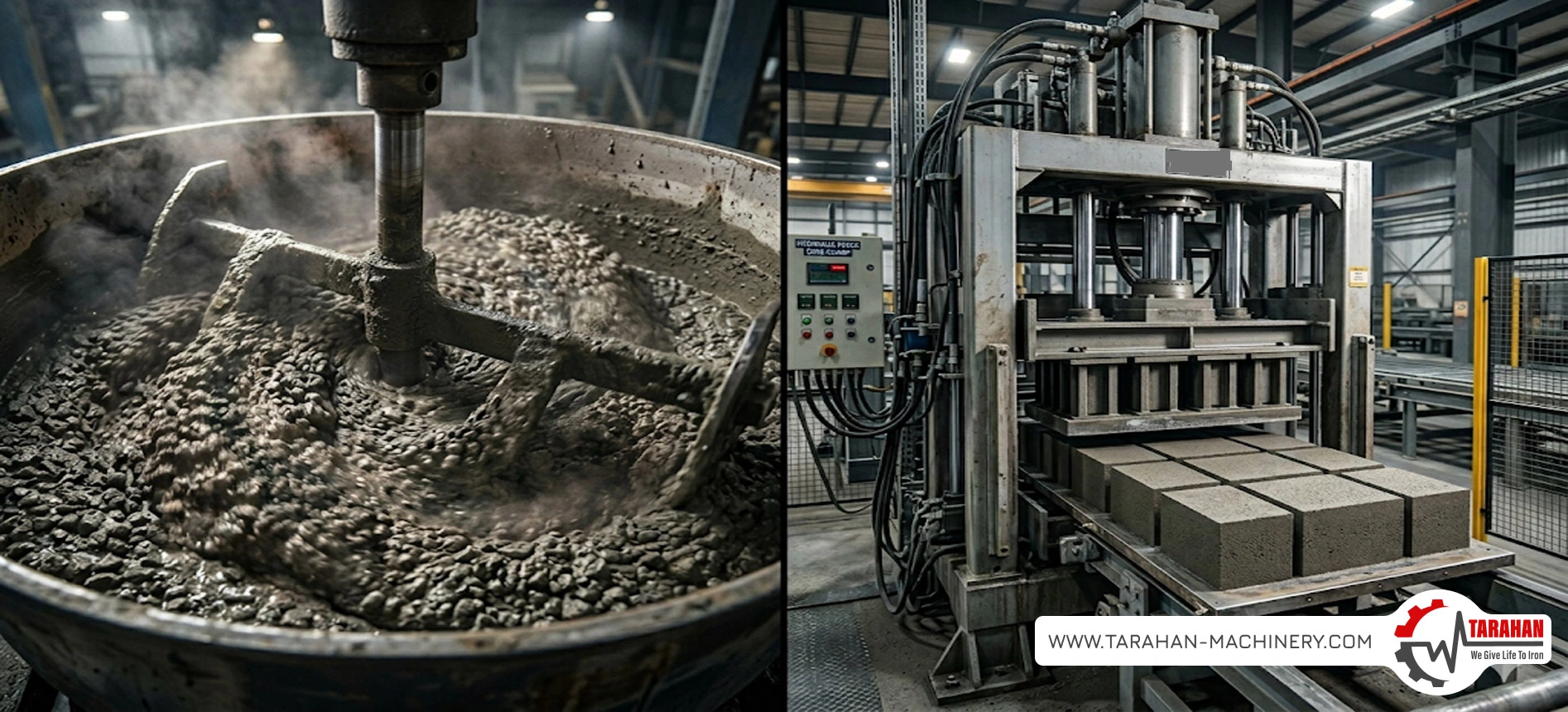
Block edges that crumble as they leave the mold, along with breakage and low strength, are the biggest drain on capital in block plants. What plant managers most want to know is how to make the mix firm up faster, so the production cycle speeds up and pallets are freed sooner, without having to use more cement. The root of the problem is the inherently dry nature of a concrete block mix, which never becomes uniform in ordinary, traditional mixers.
Many producers try to make up for this weakness by buying hardening agents, microsilica gel, or fibers. In reality, even the most expensive additives only form lumps and waste your money if they are blended in a weak mixer and pressed on a machine with irregular vibration. This article addresses exactly that concern and shows that replacing worn-out equipment with powerful machinery and mixers is the only practical way to prepare a standard mix, reach the highest compaction, bring waste down to zero, and protect your plant’s profit.
Breaking Down the Raw Materials: From Aggregate to Finished Concrete Block
Hydration of Portland Cement
Cement acts as the binder (the main adhesive) in concrete. When cement combines with water, hydration (the chemical reaction between water and cement) begins and produces a substance called C-S-H gel (the strong paste that gives the block its hardness and integrity). Setting the cement content (the amount of cement used per cubic meter of mix) accurately matters a great deal: there must be enough cement to coat every sand particle in a thin layer.
Aggregates (Gravel and Sand)
Aggregates form the main skeleton of the block. Sand must be washed and free of clay so that it does not stop the cement from bonding. For gravel, there is an important engineering rule called D_max (the largest gravel particle size). Under this rule, the largest gravel particle must be no more than half the wall thickness of your mold; otherwise, gravel particles jam at the mold edges and leave holes and voids on the block surface.
Water Management and Porosity Control
The W/C ratio (the weight ratio of water to cement) in a block mix must be kept precisely between 0.4 and 0.5. If you add more water, the excess evaporates as the block dries and leaves capillary pores behind (very fine holes and empty spaces within the block’s structure). These pores are exactly the points that destroy block strength.
Lightweight Aggregates (Pumice and Similar Materials)
To reduce the structure’s dead load (the weight imposed on the building frame), natural lightweight aggregates (such as scoria) or manufactured ones (such as LECA) are used. Their main challenge is very high water absorption: if they are not properly moistened before mixing, they soak up all the water in the mix and leave the block dry and brittle.
Fillers
Ground silica is an excellent filler (a material made of microscopic particles) that fills the voids between sand particles and gives your block a perfectly smooth, polished surface.
Iran’s National Standards for Concrete Products at a Glance
Sound production requires meeting legal requirements. The Iranian National Standards Organization defines two main frameworks for blocks, and the table below summarizes how they differ:
| Feature | Standard 70-1 (Load-Bearing Blocks) | Standard 70-2 (Non-Load-Bearing and Wall Blocks) |
| Main use | Carrying direct pressure and the weight of the structure | Partitioning (dividing walls) and weight reduction |
| Base raw materials | Washed sand, pea gravel, Portland cement | Natural or manufactured lightweight aggregate, cement, some stone powder |
| Testing focus | High compressive strength, low water absorption | Low density (lightness), thermal and sound insulation |
| Mix structure | Heavy, solid, and fully compacted mix | Lightweight mix with a porous texture |
Proportioning Materials Correctly: The Golden Formula for a Standard Mix
A mix design means finding the most accurate and cost-effective proportions of materials to reach the highest strength.
- Mix design for sand blocks (heavy): In a standard, sound mix, use 3.5 parts graded gravel and 2.5 parts washed sand for every 1 part cement. Water must also be added to this blend in a fully controlled way.
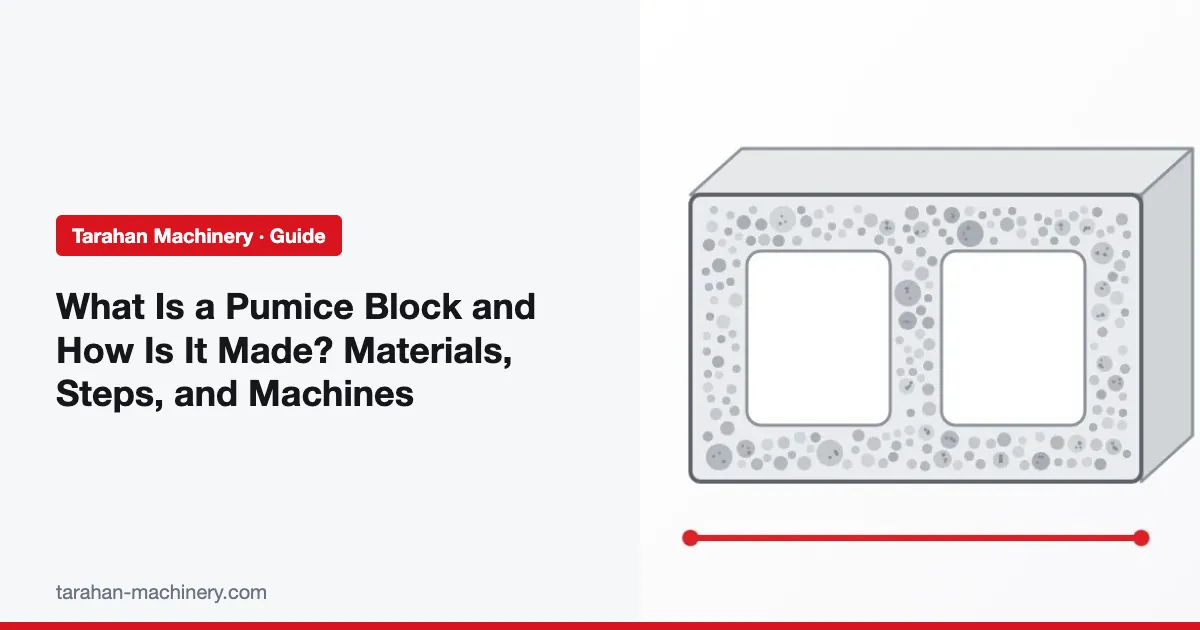
- Mix design for pumice blocks (lightweight): The golden formula for lightweight blocks usually consists of 30 percent cement, 60 percent pumice (a blend of fine and coarse), and 10 percent water. The key point here is mixing sequence and time: blend the dry materials thoroughly first, then add the water gradually.
A Practical Guide to Hardening Agents and Additives
Chemical additives are one way to speed up production, provided they are used correctly:
- Chemical accelerators: Materials such as calcium chloride sharply increase the rate of the cement reaction. They shorten the setting time (the initial firming of the mix) so you can move pallets sooner.
Warning: Chloride-based accelerators must not be used in concrete containing rebar because they cause the steel to rust.
- Microsilica gel: This material does two important jobs. First, it acts as a microfiller (filling very fine pores). Second, through the pozzolanic reaction (which converts the weak free lime in cement into a strong binder), it dramatically increases the density and hardness of the block.
- Polypropylene (PP) fibers: These polymer fibers spread through the mix like a mesh and prevent plastic shrinkage (cracking of the mix in the first hours caused by water evaporation). They also keep block edges from crumbling as the block leaves the machine.
- Superplasticizers: Through electrostatic repulsion (a repulsive force between cement particles that keeps them from sliding over one another and spreads them apart), these polymer materials let your mix form easily and compact under the press without a single extra drop of water.
Why Don’t Ordinary Mixers Work for Block Production?
The best formulas and additives are worthless if they are blended in the wrong machine. Because block mix is so dry, it is highly prone to lumping. Old rotating-drum mixers lack shear force (the force needed to pull the materials apart and break them up). As a result, additives and fibers do not disperse properly in these machines and ball up instead, producing blocks with powdery edges. To achieve complete uniformity, you need an industrial concrete mixer. Tarahan Machinery offers specialized solutions depending on your type of mix:
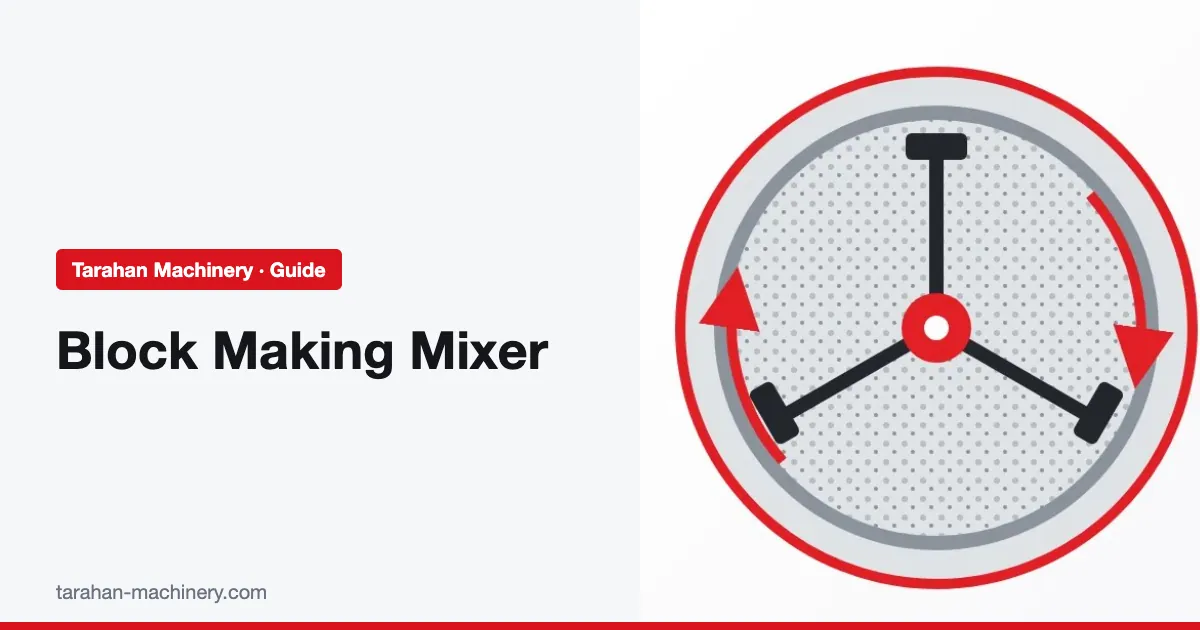
- Twin-shaft mixers: With two horizontal shafts whose mixing paths intersect, these machines create three-dimensional mixing that breaks up the toughest cement lumps and distributes fibers or microsilica gel in a fraction of the time.
- Pan mixers or vertical mixers: With blades that scrape the floor of the pan, these mixers suit plants producing pumice (lightweight) blocks or pavers. They drive moisture deep into the mix without crushing the delicate pumice grains.
Pressing and Compaction: Forming the Product with Vibration and Pressure
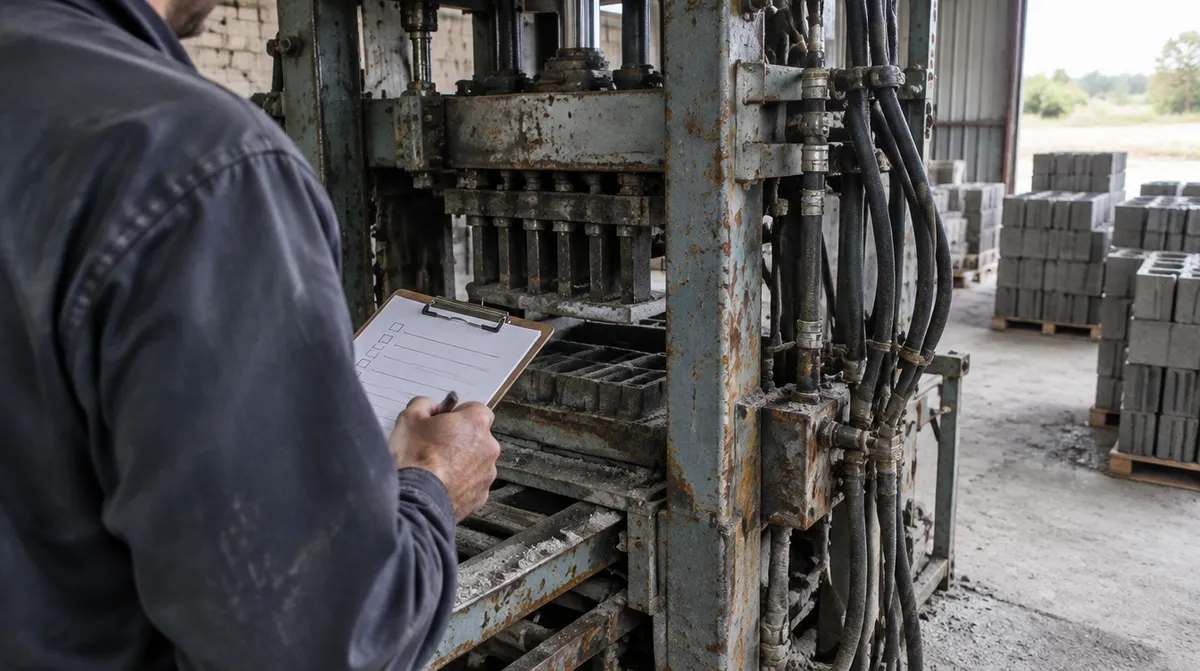
A dry mix (with zero slump) does not take the shape of the mold on its own. To remove air and form the product, the machine must be able to create localized liquefaction (vibration that temporarily makes the mix particles slippery so they fill the mold corners). This requires a precise combination of vibration (high-frequency oscillation) and hydraulic pressure (pressing force from above).
Turning Formulas on Paper into a Real Production Line
To keep the best mix designs and most expensive additives from going to waste, you need an advanced concrete block making machine alongside your concrete mixer. Together they turn these theories into a profitable production line by delivering the highest physical compaction and the lowest waste.
Stationary Block Machines: Reliable, Fully Automatic Industrial Production
With a detailed understanding of the mechanical behavior described above, Tarahan Machinery designed its specialized machinery to eliminate human error and minimize waste. Take, for example, the single-hopper models in its range of stationary machines:
TM-104 and TM-108 (Exceptional Block Production Speed)
These two models are the beating heart of concrete product plants. An advanced electro-hydraulic system with 180 bar of hydraulic pressure and industrial electric motors (5.5 to 22 kW) gives the blocks the highest level of compaction. Thanks to the compact design of the chassis and mechanical parts, the TM-104, built mainly for block production, delivers especially high production speed (80 to 130 pallets per hour).
- Air-bubble removal and surface uniformity: Powerful, distributed vibration systems (2 vibration motors at the bottom) fully expel air bubbles trapped in the mix and create a smooth, even surface.
- Industrial output: With its larger pallet size (99 by 92 cm), the TM-108 produces 60 to 80 pallets per hour, equal to 6,000 standard blocks (or 800 curbstones and 450 square meters of pavers) in an 8-hour shift.
TM-110 Industrial Model (High Precision at Medium Output)
This single-hopper machine is a multipurpose production system (blocks, curbstones, pavers) whose quick mold changes greatly expand a plant’s product range. Hydraulic pressure of 160 bar from two separate pumps (with a 13 kW electric motor), together with 8 powerful industrial vibrators, ensures uniform concrete compaction at every point in the mold. With a pallet size of 110 by 115 cm, the machine can produce 8,000 blocks per day, or 650 square meters of high-quality double-layer pavers, in one 8-hour shift.
TM-112 Extra-Heavy-Duty Model (The Mass-Production Giant)
For plants with major municipal contracts or export goals, the TM-112 is the best choice. With an enlarged pallet size (145 by 110 cm) and hydraulic pressure raised to 180 bar (driven by a 30 kW main electric motor), this machine offers exceptional output. Daily production of 10,000 blocks or 750 square meters of pavers in one work shift makes it a true money-maker in the concrete products industry.
The strategic advantage of Tarahan’s TM series is its full integration with batching systems (automatic weighing), conveyor belts, industrial mixers, and stacking robots. This automation ensures the mold is charged accurately and the finished product lands on the pallets without the slightest deformation (change of shape or sagging edges).
Mobile (Egg-Laying) Block Machines: A Smart Way to Eliminate Pallet Costs
Besides stationary machines, Tarahan Machinery also builds mobile (egg-laying) machines with outstanding chassis stability and movement free of damaging vibration. They are made for sites that have a large concrete-paved yard (projects with a concrete slab) and want to produce blocks with moving machines without spending money on thousands of pallets:
- Automatic hopper-equipped mobile block machines (M.BD and M.BS): These machines are the flagships of mobile production. The powerful 12-mold M.BD has a 1,000-liter hopper (silo), so it does not need to stop to be recharged with mix. With an optional smart PLC system (an industrial computer that fully automates the process), it keeps labor involvement to a minimum and can produce between 3,000 and 10,000 standard blocks in one work shift.
- Semi-hydraulic series (M.KH and Cadona M.KB): This series was developed for mid-sized plants that want hydraulic compaction quality on a more affordable budget. The M.KH, with its hydraulic mix-feeding system and operator seat, reduces operator fatigue by up to 50 percent and has a capacity of 3,000 blocks. The Cadona (M.KB) is an economical, very easy-to-use version and an excellent replacement for older machines.
All of these machines are engineered to keep parts wear to a minimum, and all are backed by support and a 12-month warranty on main components.
Moistening and Curing: The Final Step to Ensure Strength
Block production does not end when the block leaves the machine; cement needs moisture to continue reacting.
- Water curing: With this method, after initial hardening, blocks must be sprayed with water continuously for at least 7 days and kept out of direct sunlight so the moisture inside them does not evaporate.
- Steam curing (industrial curing): In well-equipped plants, blocks enter steam chambers (at high temperature or under autoclave pressure). The combination of heat and moisture multiplies the speed of the cement reaction and makes the block ready for market in less than 24 hours.
Conclusion: How to Protect Plant Profit Through Smart Equipment Choices
A short-term view of equipment and the use of cheap, workshop-grade machines directly raise a plant’s operating expenses (OPEX). A mix prepared and compacted in weak machines needs more cement to make up for its weaknesses and sharply increases the waste rate (broken and irregular blocks).
Upgrading your production line with batching systems, powerful mixers, and automatic press machines from reputable manufacturers such as Tarahan Machinery is not a cost. It is a reliable strategy that distributes additives completely, minimizes cement consumption, and brings waste down to zero, lowering the production cost of every block that leaves the block mold and ensuring a fast return on investment.
Frequently Asked Questions About Concrete Block Mix
Why do concrete block edges crumble or turn to powder when leaving the machine?
This problem usually has three main causes. First, the mix is too dry (the water-to-cement ratio is below 0.4). Second, traditional mixers do not distribute the cement properly throughout the mix. Third, the block making machine is too weak to apply hydraulic pressure and vibration simultaneously and lock the aggregate particles together.
Can ordinary drum mixers be used to prepare block mix?
From an engineering and quality standpoint, no. Drum mixers are designed for fluid, water-rich concrete. Block mix is dry and needs high “shear force” to blend, which only industrial mixers (such as twin-shaft or pan mixers) can provide. Using a drum mixer will increase waste and make the mix inconsistent.
What is the best mixing time for pumice block mix?
Because natural and manufactured lightweight aggregates absorb so much water, the dry materials (aggregate and cement) must be blended first. After the water is added gradually, the mix should be blended for 6 to 8 minutes so the water penetrates the pores of the aggregate and the mix “settles,” as producers say.
Is microsilica gel alone enough to increase strength?
Microsilica gel greatly increases the strength of the cement matrix. But if a powerful mixer does not distribute the gel evenly through the mix, or the press does not fully compact it, it will act as localized weak spots inside the block instead of adding strength. Standard equipment is the necessary complement to chemical additives.
See the production, curing, and quality control steps in the concrete block making guide.




Submit Comment: