


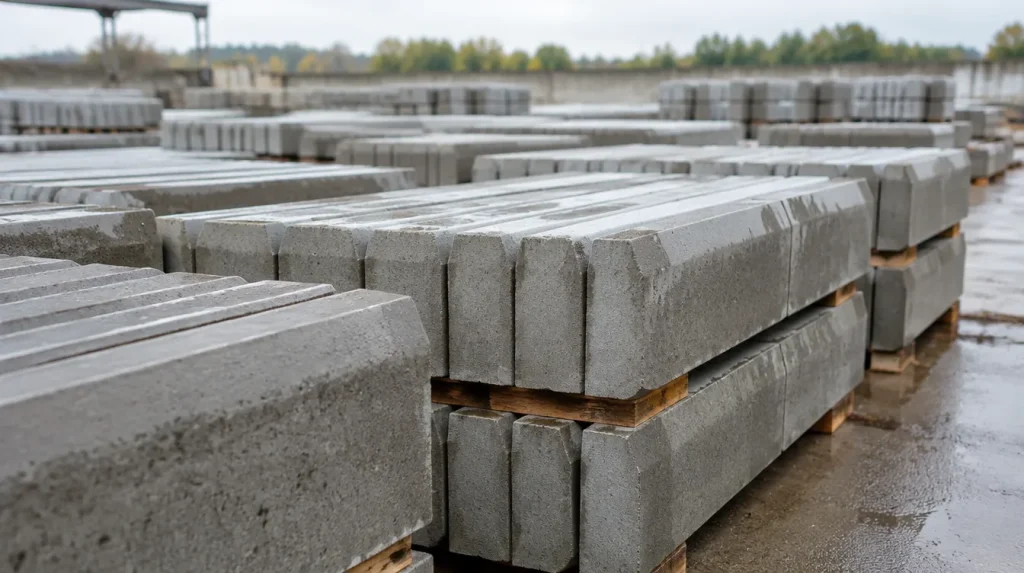
Concrete curbstone production usually follows one of three methods: dry pressing (press and vibration), wet pressing (fluid concrete, heavy pressing and water extraction by suction) and traditional casting in molds. In workshops in Iran, dry pressing is the more common choice, and curb quality depends above all on a low-water mix design, uniform compaction in the mold and moist curing during the first days.
A concrete curb looks like a simple part, but it works in harsh conditions: surface water runs along it, it freezes and thaws repeatedly in winter, and now and then a car wheel strikes its edge. A curb that starts scaling a few years after installation hands the project owner the replacement bill all over again, which is why following sound technical practice at every production stage can noticeably extend its service life.
What Methods Are Used to Produce Concrete Curbstones?
Each method has its own equipment, speed and surface quality, and the choice between them depends on order volume, capital and workshop space.
1. Dry Pressing (Press and Vibration)
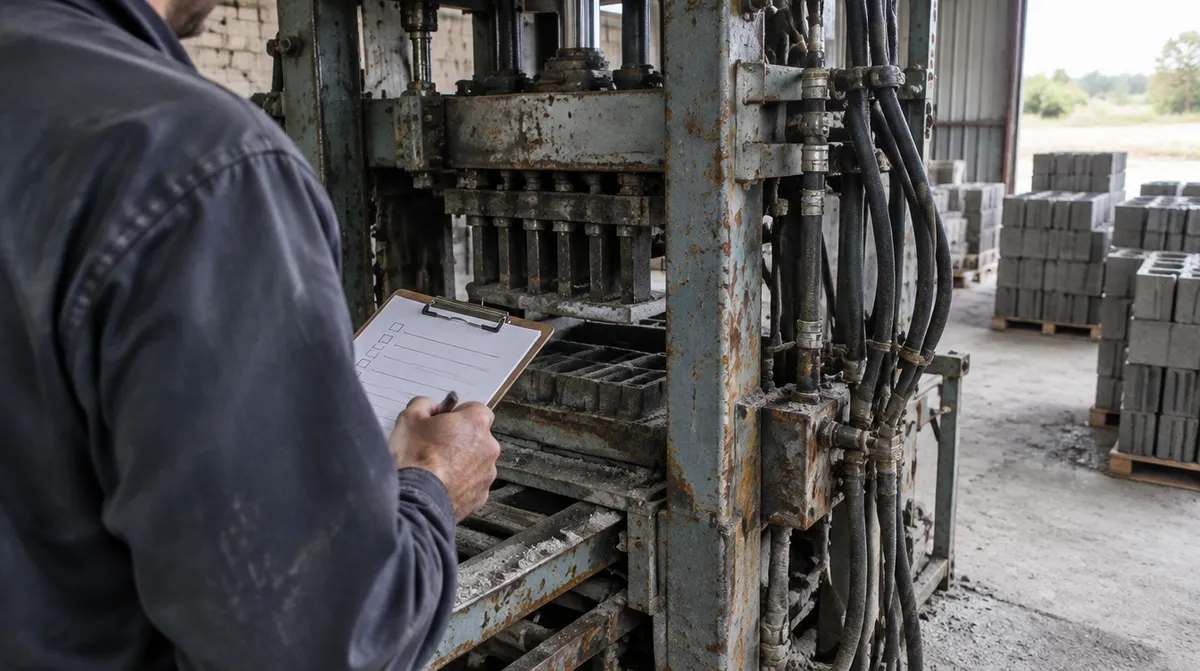
In this method, the materials are prepared as a dry mix with a slump close to zero and compacted in a steel mold by a curbstone making machine that provides both vibration and pressing. The general process is as follows:
- Aggregate, cement and water are combined in set proportions in the mixer to produce a damp, uniform mix.
- The mix is transferred to the machine’s tray or hopper, and the mold is filled.
- Vibration runs while the mold fills, so that the materials settle and trapped air and voids are driven out.
- The press head then bears down on the material, bringing the curb to its final density.
- The mold lifts, the formed curb stays on the ground or on a pallet, and it is set aside for curing.
The main advantage of this method is immediate demolding: you produce one curb after another with a single mold and do not need dozens of casting molds, so output is high. The low water-cement ratio of the dry mix also helps concrete durability. Dry-press machines fall into two groups:
- Mobile (egg-laying) machines: The machine travels over a flat concrete floor and lays curbs on the ground row by row. The two common types are the semi-hydraulic machine without a hopper (also known in the market as the Cadona) and the fully hydraulic machine with a hopper. If you are not familiar with this group, see how the Cadona curbstone machine works.
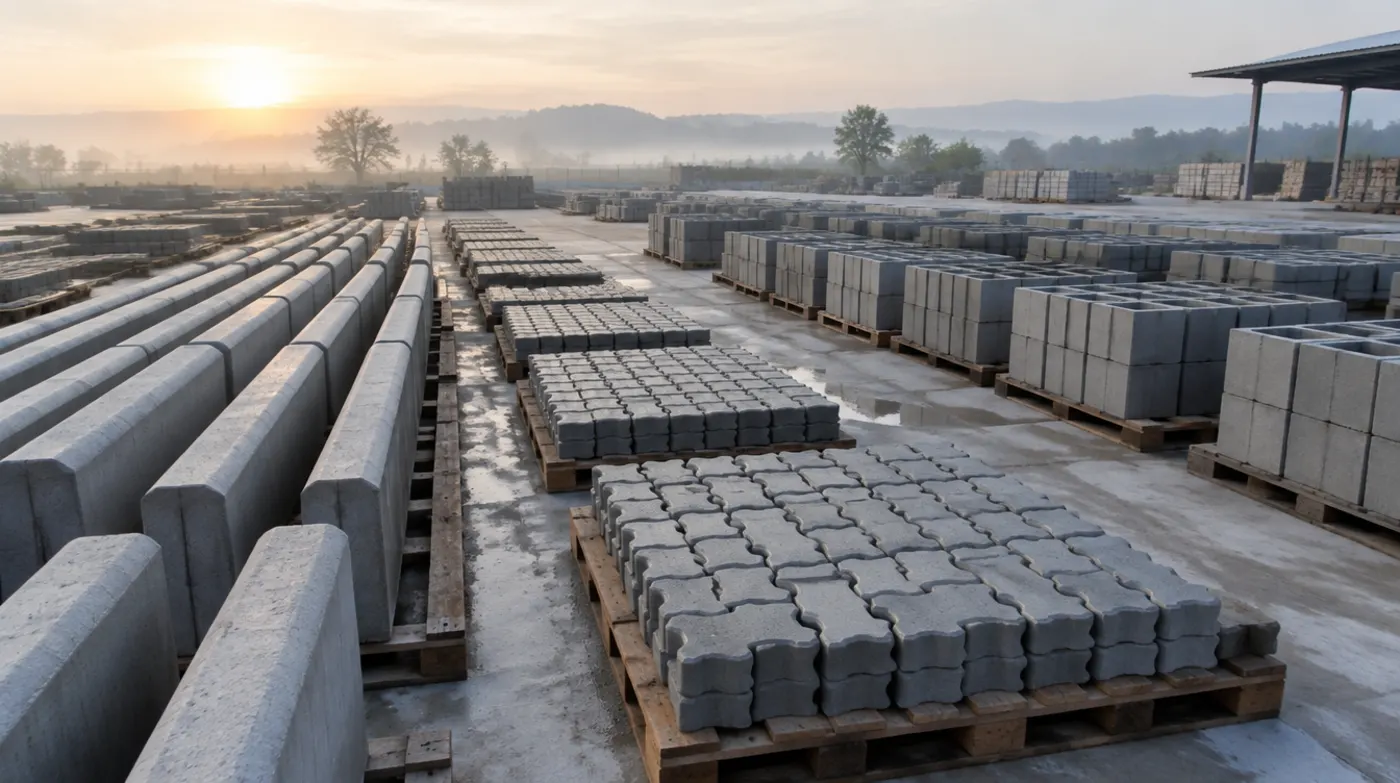
- Stationary machines (production on pallets): The machine is installed at one spot, and curbs are produced on pallets and carried to the curing area by a transfer system. These machines usually have stronger pressing and vibration, and they are also known in the market as paving block machines.
2. Wet Pressing (Wet Press)
In wet pressing, fluid concrete is poured into the mold, the machine presses it under very high pressure, and a vacuum system simultaneously draws out much of the excess water; vibration is usually not involved. The cement slurry of the fluid concrete forms a uniform layer on the surface and seals the pores, giving a smooth surface that resists freeze-thaw. On the other hand, the equipment for this method is heavy and expensive and is found mostly in large factories. For a similar comparison on pavers, see the article on concrete paver and paving stone production methods.
3. Traditional Method (Mold Casting and Vibration)
In the traditional method, plastic concrete is poured into individual molds, usually compacted on a vibration table, and removed from the mold once it has partially hardened. For better durability, the water content is kept low, a water-reducing admixture is used and, in cold regions, an air-entraining agent is added. Cast curbs look smooth, but with too much water or poor vibration they lack sufficient durability, and because each curb occupies its mold until it hardens, high output requires many molds and a lot of space. In this method, the vibration table is a basic piece of workshop equipment.
Comparison of Concrete Curbstone Production Methods
The table below gives a brief, qualitative summary of the differences between the three methods. Exact output figures depend on machine model, curb dimensions and how well the workshop is run.
| Criterion | Dry pressing (press and vibration) | Wet pressing (wet press) | Traditional casting |
|---|---|---|---|
| Main equipment | Mixer + mobile or stationary curbstone making machine + one mold per cross-section | Heavy press with vacuum system + special mold | Mixer + vibration table + a large number of molds |
| Concrete consistency | Dry and earth-moist, slump close to zero | Fluid; excess water removed by vacuum | Plastic to fluid, higher slump |
| Demolding | Immediately after pressing | Immediately after pressing and suction | After partial hardening, usually the next day |
| Production speed | High | High, at factory scale | Low; depends on the number of molds |
| Surface quality | Good; more uniform with finer grading and proper machine adjustment | Very smooth and dense | Smooth, but shows voids or bleeding if vibration is poor |
| Frost durability | Good, provided compaction is sufficient and curing is correct | Very good | Variable; depends on water ratio and admixtures |
| Initial capital | Medium | High | Low |
| Typical use | Curb workshops, contractors, precast concrete factories | Large factories with high-volume orders | Limited production, special and custom pieces, small workshops |
Pressed Concrete Curbstone Production, Step by Step
Whether you work with a mobile or a stationary machine, the overall sequence is the same. Each stage has a common error that will show up in the finished curb if it is not controlled.

- Material preparation: Sand and gravel must be clean, free of soil and clay, and of a defined grading. For pressed curbs, the maximum aggregate size is usually kept small (about 9 to 12 mm). Check the moisture of stockpiled materials every day; wet sand after rain raises the water in the mix without you noticing.
- Weighing and mixing: Cement and aggregates are better measured by weight than by wheelbarrow and shovel. Mixing time in the mixer is usually about one and a half minutes, or until the mix is completely homogeneous. Add the water slowly and at the end; a correct mix holds its shape when squeezed in the fist, but no water comes out of it.
- Mold filling and vibration: The mix must spread evenly throughout the mold. At this stage, vibration drives out trapped air. Vibration that is too short leaves voids, and vibration that is too long causes slurry separation in wetter mixes.
- Pressing: The press head settles onto the material under pressure until the curb reaches its final height and density. If pressing is not equal at both ends of the mold, one end of the curb will be denser and the other weaker.
- Demolding: The mold lifts and the curb stays on the concrete floor or pallet. The floor must be clean and level; any unevenness transfers directly to the bottom of the curb.
- Curing: A fresh curb must be protected from direct sun, wind, heavy rain and frost, and kept moist for several days. This stage is critical in the dry-press method.
- Quality control and stockpiling: Once the curbs have gained sufficient strength, they are checked for dimensions, appearance, chipped edges and, where needed, water absorption and strength, and then stockpiled and loaded.
What Determines the Quality of a Concrete Curbstone?
Except in special cases, a concrete curb does not carry heavy compressive or bending loads, so the deciding factor in its design is durability against water, abrasion and the freeze-thaw cycle more than strength, especially in regions with large day-night temperature swings, such as northwestern Iran and the country’s mountain regions.
Water-Cement Ratio
The water-cement ratio is the most important number in the mix design: the lower it is, the lower the porosity and water absorption and the higher the frost resistance. The dry mix of the press method allows this ratio to stay very low, with compaction provided by pressing and vibration. Adding water to “make the machine run easier” directly shortens the life of the curb.
Initial Concrete Temperature During Production
Warm concrete gains strength faster in the first days, but over the long term the cement paste does not distribute evenly, porosity rises, ultimate strength is lower and water absorption is higher. Cooler concrete gains strength later but reaches a higher ultimate strength.
In one Iranian study that tested concrete at initial temperatures of 17, 25, 29 and 39°C, the highest compressive strength came at an initial temperature of 25°C and the highest flexural strength at 29°C; the lowest compressive and flexural strength and the greatest water penetration depth were recorded at 39°C. The practical takeaway for a workshop is simple: in summer, move production to the cool hours of morning and evening, keep materials and water in the shade, and avoid placing a hot mix in the mold.
Aggregates: Size, Crushing and Type
Aggregates make up the bulk of concrete (usually about 60 to 75 percent of its volume) and play a large role in its properties. Three points matter for pressed curb aggregate:
- Smaller maximum size: Coarse aggregate creates more empty space. Reducing the maximum size increases the bond surface between cement paste and aggregate and lowers stress concentration in the transition zone; studies comparing maximum sizes of about 6 and 12.5 mm confirm this.
- High percentage of crushed particles: In dry pressing, crushed aggregate produces a better-interlocked, more uniform mix, although it needs more water. In casting, rounded sand offers better workability.
- Aggregate type: High-strength aggregates such as granite have a strong positive effect on the abrasion resistance and durability of the curb. They cost more, but for curbs exposed to traffic and severe abrasion they can be the more economical choice over the service life.
Alternative Materials: Recycled Aggregate and Glass
Recycled aggregate from demolished concrete structures and ground glass (as a partial replacement for cement or aggregate) can also be used in curbs, provided the dosage is determined by testing and, in the case of glass, the risk of alkali-silica reaction and the chloride and sulfate content are checked in the laboratory.
Cement, Admixtures and Air-Entraining Agent
The compressive strength and abrasion resistance of a curb rise above all by lowering the water-cement ratio, which usually calls for a higher cement content; the higher the compressive strength, the lower the abrasion loss. A water-reducing admixture also helps durability.
The fine, regular bubbles created by an air-entraining agent give freezing water room to expand and improve curb durability in cold regions. Air content is usually capped at about 7 percent, and each 1 percent of air usually takes away about 5 percent of compressive strength; compensate for this loss in the mix design.
Sample Concrete Curbstone Mix Designs
A mix design must be adjusted to the materials of each region and to each machine through testing and trial samples. The two examples below are given only to show the logic of the calculation and the order of magnitude of the numbers; they do not replace a laboratory mix design.
Dry-Press Curbstone Mix Design by the ABA Method
In a research mix design for dry-pressed curbs following the Iranian Concrete Code (ABA), the initial assumptions were a minimum compressive strength of 30 MPa, 7 percent air and a maximum crushed aggregate size of 9.5 mm. The calculation steps are as follows:
- Setting the water-cement ratio: The ratio is read from the code chart for the target strength and cement type, then corrected for the air percentage. In this design, with grade 525 cement, the final ratio came to 0.29.
- Choosing the grading: For a maximum size of 9.5 mm, the code grading curve was used, and for a more uniform finish a finer grading between envelopes B and C was selected. The fineness modulus (the sum of cumulative percentages retained on the sieves divided by 100) was calculated at about 4.57.
- Setting the free water: With aggregate more than 90 percent crushed and a required slump of less than 1 cm, the initial free water was read as about 145 kg per cubic meter. This value was corrected for air and cement content, giving a final water content of 132 kg. In very dry mixes, stable air bubbles are hard to create, and the actual air percentage must be measured on a sample.
- Setting the cement: With 132 kg of water and a ratio of 0.29, the cement content came to about 455 kg per cubic meter.
- Setting the aggregate: Using the absolute volume relationship, the total aggregate weight in the saturated surface-dry condition came to about 1672 kg, which, split into 60 percent sand and 40 percent gravel, is about 1003 kg of sand and 669 kg of gravel.
| Component (per cubic meter) | Approximate amount |
|---|---|
| Grade 525 cement | 455 kg |
| Free water | 132 kg |
| Sand | 1003 kg |
| Gravel (maximum 9.5 mm) | 669 kg |
| Target air | About 7 percent (with air-entraining agent) |
Sample Mix Design for the Casting Method
For curbs cast in molds with plastic concrete, the table below shows three strength levels with a constant water content. Because the water stays constant, the water-cement ratio falls from about 0.56 to about 0.4 as the cement content rises, and the target strength increases.
| Target compressive strength (kg/cm²) | Cement (kg) | Gravel (kg) | Sand (kg) | Water (liters) | Concrete unit weight (kg) |
|---|---|---|---|---|---|
| 200 | 363 | 1184 | 519 | 205 | 2271 |
| 250 | 446 | 1184 | 452 | 205 | 2286 |
| 300 | 513 | 1184 | 397 | 205 | 2298 |
The casting design uses far more water than the dry-press design, and this difference explains why a properly compacted pressed curb usually has lower water absorption and greater durability.
What Do International Standards Say About Concrete Curbstones?
Different countries have their own requirements for concrete curbs, and reviewing them shows where the main focus lies. Requirements in New Zealand and Australia for curbs placed in situ by machine emphasize the concrete compaction percentage rather than relying on compressive strength alone, and they also set a minimum cement content and a small maximum aggregate size (usually about 12.5 mm). US requirements call for a higher cement content, an air-entraining agent at about 5 to 8 percent, a maximum water-cement ratio of about 0.4 to 0.45 and a higher 28-day compressive strength, although the project owner or responsible agency can change these values.
For the dry-press method, slump is usually between zero and about 1 cm, and the recommended minimum compressive strength is 20 to 32 MPa. Before signing a contract, get the project’s technical requirements and the standard it cites from the client, and check your samples against them.
Curing Concrete Curbstones: The Weak Point of the Press Method and How to Offset It
The biggest drawback of the press method is how vulnerable the curb is in the first hours. Impact, early handling, sun, dry wind or overnight frost can permanently weaken the surface of a fresh curb. A dry mix contains little water, and if even that evaporates quickly, the surface cement does not fully hydrate and the curb later turns powdery. So in this method, curing is part of production itself.
- Cover quickly: Cover the rows of curbs as soon as possible with plastic sheeting, wet burlap or a suitable covering to retain moisture and keep direct wind off the surface.
- Water regularly and evenly: Manual watering must be continuous and uniform and done by a trained worker; patchy watering produces uneven color and quality.
- Curing period: The first days are the most sensitive period, and moist curing usually continues for at least several days to a week. In cold weather this time is longer.
- Protect from cold: On nights when frost is possible, protect fresh curbs with an insulating cover or stop production; water freezing inside young concrete causes irreversible damage.
- Delay handling: Do not lift or stack a curb until it has gained sufficient strength.
On stationary lines, pallets go to a curing room where humidity and temperature are better controlled; in a mobile workshop, the same control has to come from covering and regular watering.
Common Challenges in Concrete Curbstone Production and How to Solve Them
Most defects seen in curbs on the market, such as a non-uniform mix, poor appearance or chipped edges, have a specific cause in the production process. The table below lists the most common ones with their likely cause and solution.
| Observed defect | Likely cause | Solution |
|---|---|---|
| One end of the curb dense, the other weak or crumbling | Uneven mold filling, or machine out of adjustment and unequal pressing | Even spreading of the mix in the mold, periodic adjustment of pressing and vibration |
| Uneven bottom or curb rocking when laid | Uneven and dirty production floor or pallet | Cleaning the production strip before starting work and keeping the floor level |
| Rough, voided surface or crumbled edges | Mix too dry, short vibration or coarse grading | Adjusting mix moisture, increasing vibration time, using finer grading |
| Material sticking to the mold and torn edges | Dirty or unoiled mold, worn mold surface | Cleaning and oiling the mold every few cycles, inspecting for wear |
| Surface turning powdery or scaling after a few months | Insufficient curing, rapid water evaporation, frost damage to young concrete | Immediate covering, regular watering, protection on cold nights |
| Fine surface cracks | Rapid drying in sun and wind, or high mix temperature | Producing in cool hours, using a sunshade, keeping materials moist |
| Breakage during loading and transport | Early handling or insufficient compaction | Waiting until sufficient strength is reached, checking sample weight and density |
| Different color and appearance between batches | Volumetric batching, change of cement or aggregate source, varying water | Batching by weight, keeping the material source constant, checking sand moisture |
One maintenance point deserves serious attention: curbstone making machines wear quickly because of constant vibration and impact. Regular inspection of bolts, hydraulic cylinders, vibrators and the mold surface, along with oiling the mold after a certain number of curbs, extends machine life and keeps the curbs consistent in appearance.
Quality Control of Concrete Curbstones in the Workshop
Quality control does not have to be complicated; it only has to be regular. Use this simple checklist for each shift or each production batch:
- Dimensions: Measure the length, height and thickness of a few curbs at random and compare them with the project drawing. Squareness and a straight top edge matter for laying.
- Appearance: Check for chipped edges, cracks, voids and uneven color. Separate defective curbs right away.
- Weight: Weighing several curbs of the same size is a quick way to detect differences in density; a lighter curb has usually been compacted less.
- Water absorption: Water absorption is a good indicator of durability. Send samples to a laboratory, or at the very least compare dry and saturated weights in the workshop.
- Strength: Project orders usually require strength and durability tests on samples; keep a record of the results.
- Record keeping: Note the production date, cement and aggregate source, mix design and weather conditions for each batch so that the cause of any defect can be traced.
Concrete Curb Molds: Material, Fabrication and Selection
A concrete curb mold (also called a cement curb mold) determines the shape, dimensions and surface quality of the curb. A weak or misaligned mold will not produce a good curb, even with the right mix design. Curb mold design must be based on the project drawing and the curbstone making machine model, so that curbs are produced to exact dimensions with minimal material waste.
Curb Mold Material
The body of a curb mold is usually made from ST37 steel plate. In continuous, high-volume production, the inner surfaces that touch the concrete and take the most abrasion can be made from wear-resistant plate such as CK45 or Hardox to extend mold life. The top edge of the mold usually has a chamfer or controlled radius so that the curb chips less on impact.
How a Concrete Curb Mold Is Made
Making an industrial concrete curb mold involves several main stages:
- Design and drawing approval: The curb type, dimensions, edge shape and surface finish are defined, and fabrication drawings are prepared.
- Precision plate cutting: The steel plate is laser cut so that no waves or bends form along the edges.
- Welding and assembly: Parts are carefully welded and aligned to keep distortion to a minimum.
- Local machining: Sensitive areas such as the concrete contact surface and the top edge are machined for final accuracy.
- Quality control: Dimensional measurement, a test assembly on the machine and inspection of the inner surface quality before delivery.
A curb mold for a stationary machine is usually designed lying flat, and one for a mobile machine standing upright, so that pressing and demolding go faster. The vibration position and mold connection points must also be set specifically for that machine, so that vibration is uniform and the curb comes out of the mold cleanly. Molds are built with a single cavity (for limited production) or multiple cavities (for high output), and matching pieces such as corners, start and end pieces, and drain connections can also be ordered for them.
A homemade mold of ordinary plate soon warps under constant vibration and pressing. If you are ordering a mold, specify the curb dimensions, machine model, edge type, surface finish and production volume. Tarahan Machinery designs and builds custom concrete curb molds on this basis. For a broader look at steel molds for concrete products and how to maintain them, see also the guide to concrete mold types.
Which Machine Should You Choose for Concrete Curbstone Production?
Choosing a curbstone making machine comes down to four questions: how large is your order volume, do you need to produce at the project site or in a fixed workshop, do you want only curbs or also blocks and pavers, and how much capital and covered space for curing do you have? The table below sets out the main specifications of Tarahan Machinery curbstone making machines, based on the information on each product page.
| Model | Type | Press and vibration system | Curbs per cycle or pallet | Key points |
|---|---|---|---|---|
| M.KC | Mobile, semi-hydraulic, no hopper | Non-hammer hydraulic press; two adjustable vibrators at the front and rear of the mold | 6 curbs, 50×30 or 50×50 | Curb height up to 50 cm; 32 A three-phase power; recommended mixer 800 liters; flat concrete floor of about 500 square meters; no PLC option |
| M.CS | Mobile, fully hydraulic, with hopper | Dual hammer and press action rated at 4 tons; 7.5 kW vibration motor and 11 kW hydraulic motor | 6 curbs, 50×30 or 50×50 | Hopper capacity 1 cubic meter; curb length 30 to 100 cm; cycle time about 2 minutes; PLC or winch can be added |
| TM-208 | Stationary, double-hopper, on pallets | 160 bar hydraulic pressure; 4 lower and 2 upper vibrators | 3 curbs, 50×30, per pallet | Produces blocks, curbs and two-layer pavers by changing the mold |
| TM-110 | Stationary, single-hopper, on pallets | 180 bar hydraulic pressure; 30 kW hydraulic pump motor | 6 curbs, 50×30, per pallet | Product height 50 to 300 mm; also produces blocks and single-color pavers; 2 operators |
| TM-218 | Stationary, double-hopper, on pallets | 200 bar hydraulic pressure; 37 kW hydraulic pump motor | 8 curbs, 50×30, per pallet | Colored two-layer curbs and pavers; touch panel with program storage; suited to mass production |
According to the product pages, all of these machines come with a 12-month warranty and 10 years of after-sales service. Capacities are approximate and depend on curb dimensions, mix design and operator skill.
Which Machine for Which Workshop?
- Low-cost start or small municipal projects: The M.KC semi-hydraulic curbstone machine has a simple structure, low-cost maintenance and a small footprint, and with the right mold it also produces canyo channels and drains in addition to curbs. It is the logical option for a contractor who wants to start quickly with limited capital.
- Production at the project site with higher density and uniformity: The M.CS fully hydraulic curbstone machine, with its 1-cubic-meter hopper, dual pressing and optional PLC automation, suits landscaping contractors, municipalities and workshops that have to move around but want more uniform quality and fewer workers. In the PLC version, according to the product page, one operator is enough to control the machine.
- Stationary factory and a varied product range: If you make blocks and pavers as well as curbs, TM series stationary machines such as the TM-110 produce all three products by changing the mold. Production on pallets with transfer to the curing area gives better control over quality.
- Mass production and colored curbs: For large municipal orders and colored two-layer curbs or pavers, the double-hopper TM-218 with 8 curbs per pallet is suitable; this model should be planned as part of a complete line with a batching plant, conveyor belt and pallet handler.
If your initial budget is limited, the second-hand market is also worth considering; just have the hydraulic cylinders, vibrators and mold professionally inspected before buying. The list of used curbstone machines on the Tarahan website is kept up to date.
Can You Make a Concrete Curbstone at Home?
Yes, for a few meters of garden edging or yard border, you can make concrete curbs at home: a simple mold of boards or sheet metal, concrete with a low water ratio, tamping or tapping the mold to release air, and keeping the pieces moist for several days. However, a homemade curb does not have the density and durability of a pressed curb and is not suitable for a street edge or anywhere a car wheel will hit it. For details on the home method, curb types and common sizes, read the article what a concrete curbstone is and what dimensions it comes in.
Frequently Asked Questions
Which concrete curbstone production method is best?
For most workshops, dry pressing offers a good balance: high speed, one mold per cross-section and good durability thanks to the low water-cement ratio. Wet pressing gives a denser surface but needs heavy, expensive equipment and is used mostly in large factories.
What are concrete curb molds made of?
An industrial curb mold is usually made from ST37 steel plate, and for high-volume production the inner surfaces can be made from wear-resistant plate such as CK45 or Hardox to extend mold life. The mold must be designed to match the curbstone making machine model.
How is a concrete curb mold made?
The main stages are design and drawing approval, laser cutting of the plate, welding and aligned assembly, machining of sensitive areas, and dimensional inspection with a test assembly on the machine. A mobile machine mold is usually designed standing upright and a stationary machine mold lying flat.
How many days should concrete curbstones be cured?
The first days are the most sensitive period, and curbs should usually stay covered and moist for at least several days to a week; in cold weather this period is longer. Do not move or stack a curb until it has gained sufficient strength.
What is the mix design for pressed concrete curbstones?
The pressed curb mix is dry, with a slump close to zero. In one research mix design by the ABA method, the result per cubic meter was about 455 kg of grade 525 cement, 132 kg of water, 1003 kg of sand and 669 kg of gravel with a maximum size of 9.5 mm. Always adjust the final design using your own materials and sample testing.
Why do concrete curbstones turn powdery or scale after a while?
The most common causes are insufficient curing and rapid water evaporation, a high water-cement ratio, low compaction and freezing of young concrete. In cold regions, an air-entraining agent and finer grading also improve surface durability.
What equipment do you need to start concrete curbstone production?
At minimum: a mixer, a curbstone making machine with a mold for the desired cross-section, a flat and level concrete floor for production and curing, three-phase power, material handling equipment, and watering and covering supplies. Stationary lines also add a batching plant, conveyor belts and a pallet handling system.
Conclusion
A durable concrete curb is not the result of one decision but of a chain of correct decisions: a production method matched to the workload, fine, clean, suitably crushed aggregate, a low water-cement ratio, control of mix temperature, uniform compaction with a properly adjusted machine, an accurate mold and, most important of all, moist curing during the first days. When these links hold, a pressed curb suffers less damage during loading and transport and lasts for years at the roadside without scaling.
If you need advice on choosing a machine or mold to fit your order volume and workshop space, or want a current price, call the Tarahan Machinery specialists at +98 914 584 1914.



Submit Comment: