


As science and technology advance, industries have to transform and adopt new machines and equipment to keep pace, and this brings new risks and hazards for workers. Mechanized machinery may appear to have made construction projects less risky, but it has also exposed the workforce to emerging risks, and neglecting them can have far more serious consequences than the risks of traditional building methods.
Identifying hazards and assessing risks on these projects, and then putting the necessary control measures in place, is therefore unavoidable. Using different methods to identify and control the risks of each job process gives a project a sound basis for paying attention to safety.
This article identifies and assesses the risks of a concrete batching plant, reviews concrete batching plant safety issues, and covers control measures as far as possible.
Overview of the Concrete Batching Plant
A concrete batching plant is used to produce concrete in large volumes. It comes in a variety of models and capacities and is used on most civil engineering and building projects.
The raw materials a batching plant uses to make concrete are cement, washed sand, pea gravel, coarse gravel, water and concrete admixtures (microsilica powder, superplasticizer, gel, etc.).
The plant consists of the control room, dragline scraper, material mixer, hoist system and chassis, along with the chassis of the skip car, cement silo, water tank, aggregate retaining wall and screw conveyor.
Safety Tips for Installing a Concrete Batching Plant
As a first step, coordinate with the site HSE department on carrying out the work and obtaining the required permits.
Foundation
The various sections of the batching plant need a proper foundation and subgrade. After the area has been leveled and compacted, build concrete foundations sized to the structures to support the chassis, the silos and the columns of the aggregate storage walls.
Chassis
Most parts of the metal chassis are joined with nuts and bolts, so check the strength and tightness of these connections during assembly. Reinforce some parts with welding if needed. When setting the main legs on the base plates, make sure they are adjusted and level. The gussets connecting the main legs to the base plates must also sit at a 90-degree angle, and they should be joined using suitable welds and welding wire.
Control Room
The control room is the center that controls and directs all concrete production operations at the batching plant. Follow these safety requirements:
- Provide enough space for the operator to move around.
- Position the control panel so the operator cannot accidentally bump into it.
- Fit the control panel switches with suitable guards.
- Install an emergency power cutoff switch on the control panel.
- Use suitable relays and fuses in the panel’s electrical system.
- Provide adequate lighting for night work.
- Use ring-guarded control panel switches to prevent accidental operation.
- Design the control room so the operator has a clear view of the platform.
- A fire extinguisher, first aid kit and flashlight must be kept in the control room.
Dragline Scraper (Dragline-Type Batching Plant):
The scraper moves aggregate from the lower part of the stockpile to the gates at the upper part of the stockpile.
Safety Tips
- Provide a suitable access route for the operator.
- Fit safety guards on all moving parts, especially the scraper cab.
- Use standard wire rope on the scraper boom.
- An ergonomic operator seat is mandatory.
Material Mixing Drum (Mixer):
The mixing drum, or material mixer, sits on the batching platform, and this is where the concrete is made.
Safety Tips
- A microswitch must be installed on the mixer door so the machine stops automatically when the door opens.
- Keep the mixer door fully closed to prevent dust from escaping.
- Fit a suitable guard on the admixture inlet hatch so no one can reach into the mixer.
Hoist System and Skip Car
Aggregate is carried to the mixer in a special car that runs on the hoist rail.
Safety Tips
- Fit suitable fencing and guards along any part of the hoist path that people could reach.
- Choose the wire rope and cables carrying the car according to the weight of the skip hopper and materials.
Screw Conveyor
The screw conveyor is a tube with a helical flight inside, used to move cement from the silos to the mixer.
Safety Tips
- Keep the screw’s connections to the silos and the mixer inlet fully tight and sealed.
- Fit safety guards on the electric motors.
- Keep the hatches on the screw conveyor fully closed to prevent cement leaks.
Cement Silos
Silos hold and store cement and come in different sizes according to their capacity. A screw conveyor carries cement from the silo to the cement weighing scale, and after weighing it enters the mixer. Keeping this path clean and calibrating the scale periodically matters both for mix accuracy and for safe discharge.
Safety Tips
- Before installing the silos, confirm that the foundation is strong and the base plates are level.
- Place the bolts at the four corners of the base plate, at equal spacing.
- If the silo legs need to be made taller, choose strong, sturdy legs and observe the following:
- When welding large silos, use a rectifier or diesel welding machine to achieve uniform, strong welds, because of the heavy load on the legs.
- The silo legs must be exactly the same size and level, and the bottom edge of each leg must be perfectly even and flat.
- Reinforce the joint between the silo legs and the base plate with gussets of equal size set at 90 degrees to each other, so the load is carried evenly.
- Before installing the silos, fit the waist-high guardrail on top of the silos and the safety cage on the silo ladder.
- Prevent personnel from crowding or gathering unnecessarily during silo installation, and prohibit entry within a radius equal to the height of the silos.
- It is very important to follow all safety laws and regulations, including those on transporting and moving heavy loads, and to use experienced personnel for the installation.
- After the silos are in place, check that they are level using a surveying instrument.
- Because temperature matters in concrete production, a light silo color is recommended to reduce heat absorption and transfer.
Aggregate Storage
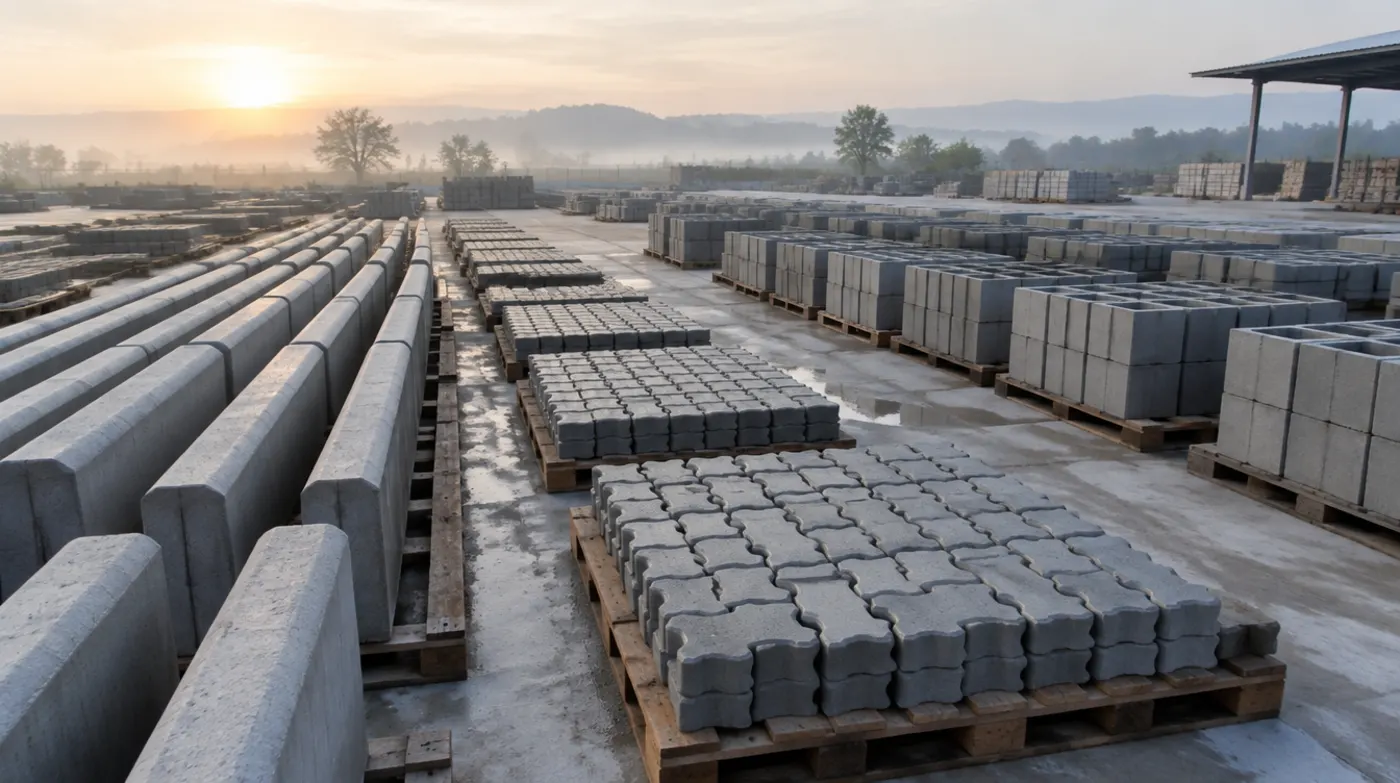
The aggregate needed for concrete production consists of washed sand, pea gravel and coarse gravel, which are kept separate from one another by retaining walls in the area next to the batching plant.
Safety Tips
When building a storage wall with precast concrete structures and timber planks, the vertical columns must be perfectly plumb and strengthened with suitable welds.
- Installing bracing arms behind the wall is essential. Select these arms according to the load on the wall, and make sure they have the required strength. If they are not strong enough, they may bow and the welds may break.
- Weld the wall bracing arms at a suitable amperage.
- For walls made of concrete block, use rebar in the wall materials and add concrete buttresses as well.
Recommended Measures for Eliminating Hazards
To reduce the hazards of using a concrete batching plant, the following measures are essential:
- A septic tank is required to take the batching plant’s wastewater.
- All batching plant systems and structures must be connected to a ground wire.
- All required safety signs must be installed on the batching plant.
- Only the batching plant operator may enter the control room.
- Personnel are strictly forbidden from walking on the aggregate stockpiles.
- After work ends, always cut power to the machine before cleaning.
- Strictly avoid unnecessary crowding on the batching platform and in the control room.
- Do not install electric motors under water connections, because of possible leaks.
- Before starting the batching plant, clean the windows of the scraper and the control room.
- Do not eat, drink or smoke while working.
- Personal protective equipment is mandatory, including work clothes, safety shoes, gloves, a mask and a hard hat.
- Inexperienced people are not allowed to enter the batching area.
- Do not throw any objects down to the lower level or the surrounding area.
- After work ends, and during repairs, keep the control panel’s safety guard closed.
- Never open the door of the concrete mixer while materials are being mixed.
- Before starting work, verify that all parts of the batching plant are sound and in good condition.
- Do not store materials on the stairs or batching platform where they block movement.
- Clutter in the control room and anything that restricts its space are strictly prohibited.
- Use the batching plant stairs with the utmost care, and do not rush.
- All batching plant cables and wiring must be tidy, up to standard and routed through ducts.
- A designated person must guide truck mixers under the batching plant.
- Before using the scraper, make sure no one is on the aggregate stockpiles.
- Never put your hands under the scraper seat, because of the chain there.
- When unloading cement, check how full the silos are so that they do not overflow.
- When clearing ice from the water tanks, stay out from under and around the tanks.
- When cleaning, do not spray water on the control room or the electric motors.
- Install all electric motors where they will not be exposed to dust.
- Never expose electrical panels to water ingress or dust, or place them in the truck mixer loading path.
- When building stairs and personnel walkways, follow all standards, including landings, permitted slope, and suitable length and width.
- If concrete admixture is needed, add it through the hatch provided on the mixer and follow safety procedures.
- If a screw conveyor clogs, never put your hand into its hatch. Use a rubber mallet instead.
- When climbing the silos, coordinate first and use a safety harness and other personal protective equipment.
- If the aggregate storage walls are made of planks and timber, a loader must never climb onto them.
- When stockpiling material behind a wall, keep the load weight balanced on both sides of the wall.
- During repairs, post an “Under Repair” sign and completely cut power to the machine.
- Do not stand under the hoist system or the material skip hopper without prior coordination.
- After repairs are finished, put all safety guards back in place.
Conclusion
Construction work is inherently dangerous and has traditionally had a high accident rate. Public concern over the frequency and scale of construction hazards and accidents has made it essential to pay attention to this industry in Iran. Since the batching plant is one of the main processes in construction work, its hazards deserve serious attention as well. In this article from Tarahan Machinery, we have covered some of these risks and hazards and assessed the relevant safety measures. We hope this experience makes a small contribution to reducing the countless accidents in this industry.
Before you buy, see our guide to choosing a concrete batching plant to compare types and capacities.








Submit Comment: