


An interlocking brick is made by compressing a moist mix of soil, sand, or stone powder with cement in a press. Instead of being fired in a kiln, it cures over time or in a steam room. The raised and recessed features on these bricks lock together like puzzle pieces, which is why they are also known in Iran as “Lego bricks” or “mortarless bricks.” The most common size is 25×12.5×6.5 cm.
This article covers the history, sizes, raw materials, pros and cons of interlocking bricks, the factors that affect their price, and the types of machines used to make them (manual and hydraulic). If you are considering larger interlocking concrete blocks and setting up industrial production, read our guide to the interlocking block production line.
What Is an Interlocking Brick?
Compressed earth bricks, usually called interlocking bricks in Iran, are building materials formed by applying high pressure to moist soil in a press. They consist of dry mineral soil, non-expansive clay, aggregate, and Portland cement. Interlocking bricks are a more environmentally friendly alternative to the clay bricks used in most residential buildings today.
History of Compressed Earth Bricks
The first attempts to produce compressed bricks took place in Europe in the early 19th century. The French architect François Cointeraux made small earth bricks, using a hand rammer to compact moist soil in a small wooden mold held in place with the foot.
The first manual steel press, the CINVA-Ram, was built in the 1950s. It came out of a social housing research program in Colombia aimed at improving handmade adobe bricks, and it could produce blocks that were more uniform in shape and size, denser, and stronger than ordinary adobe. Since then, a wider range of machines has been designed, and the method has been adopted in many countries across Africa, South America, India, and South Asia.
Interlocking Brick Sizes
In Iran, interlocking bricks are most often produced at 25×12.5×6.5 cm. Dimensional accuracy matters a great deal with these bricks, because mortarless laying only works when the raised and recessed features of each brick seat exactly on the neighboring brick. That is why the quality of the mold and the press directly affects the quality of the wall.
Interlocking Brick Raw Materials
Interlocking bricks are made by blending and compressing materials such as sand, soil, pumice, wind-blown sand, stone powder, and cement. These materials are first mixed evenly in a mixer, then compressed in the press and formed into bricks. Interlocking bricks can also be made from soil or mine waste combined with cement. Because of their high compaction, the bricks do not need firing, and a low-temperature steam room can be used for better and faster curing.
Pros and Cons of Interlocking Bricks
The design of interlocking bricks offers significant advantages, but they also have limitations that should be weighed before you produce or use them.
Pros:
- Low production cost, with no kiln or firing required
- Laying with little or no mortar, which means faster wall construction
- Lower energy use and less pollution than fired bricks
- Raw materials available in most cities across Iran
- Required machinery built domestically in Iran, reducing dependence on imports
- Production without complex technical know-how
- Durable against rain, snow, and frost when the right materials are used and curing is done properly
- Local job creation, especially in villages and small towns
Cons:
- Risk of visible deformation and efflorescence if unsuitable materials are used
- Not suitable for very tall buildings because of their weight
- Possibility of production on non-standard machines, which puts poor-quality bricks on the market
- Limited familiarity among some engineers and architects with the performance and construction methods of interlocking bricks
- Structural performance of the wall depends on sound workmanship and compliance with technical codes
What Determines the Price of Interlocking Bricks?
The price of interlocking bricks depends above all on the type and cost of the raw materials, the amount of cement used, the producer’s capacity and production cost, and the cost of delivery to the project site. Because this brick is still a relatively new product on the Iranian market, each producer sets a different price according to its own circumstances, and there is no approved, uniform price list. Before you buy, it is best to request quotes from several producers and also compare the quality and dimensional accuracy of their samples.
Interlocking Brick Making Machine
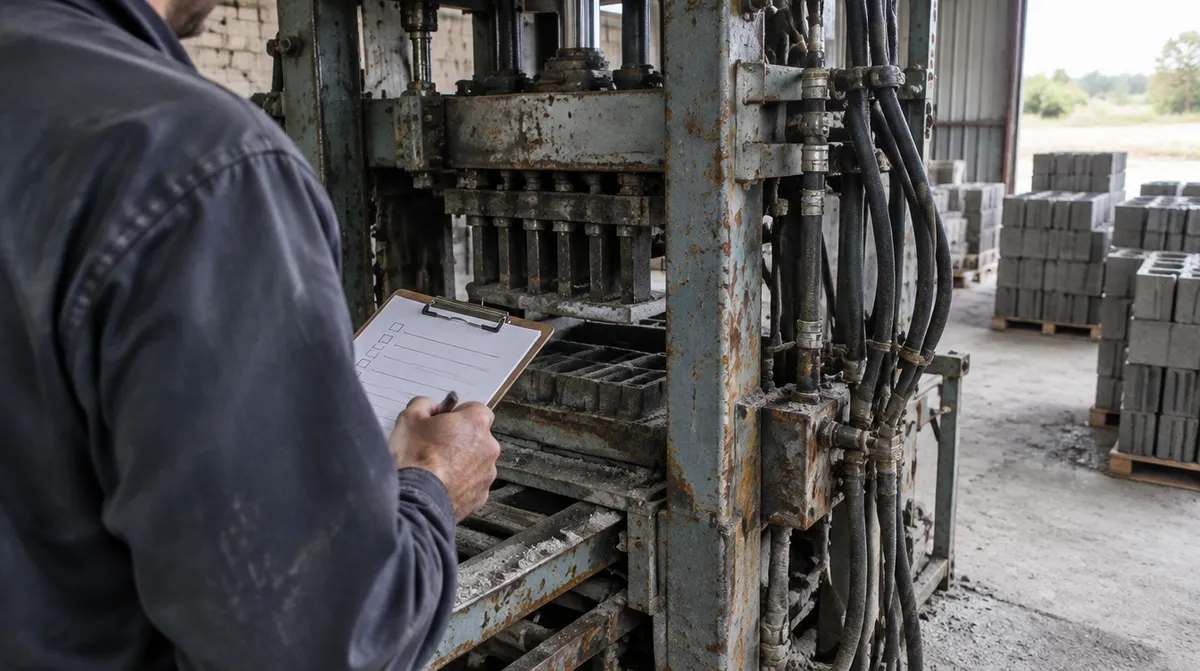
Producing interlocking bricks requires equipment such as a press, mixer, screen, and conveyor belt, of which the press is the most important. Interlocking brick presses come in two types: manual and hydraulic.
Manual Interlocking Brick Machine
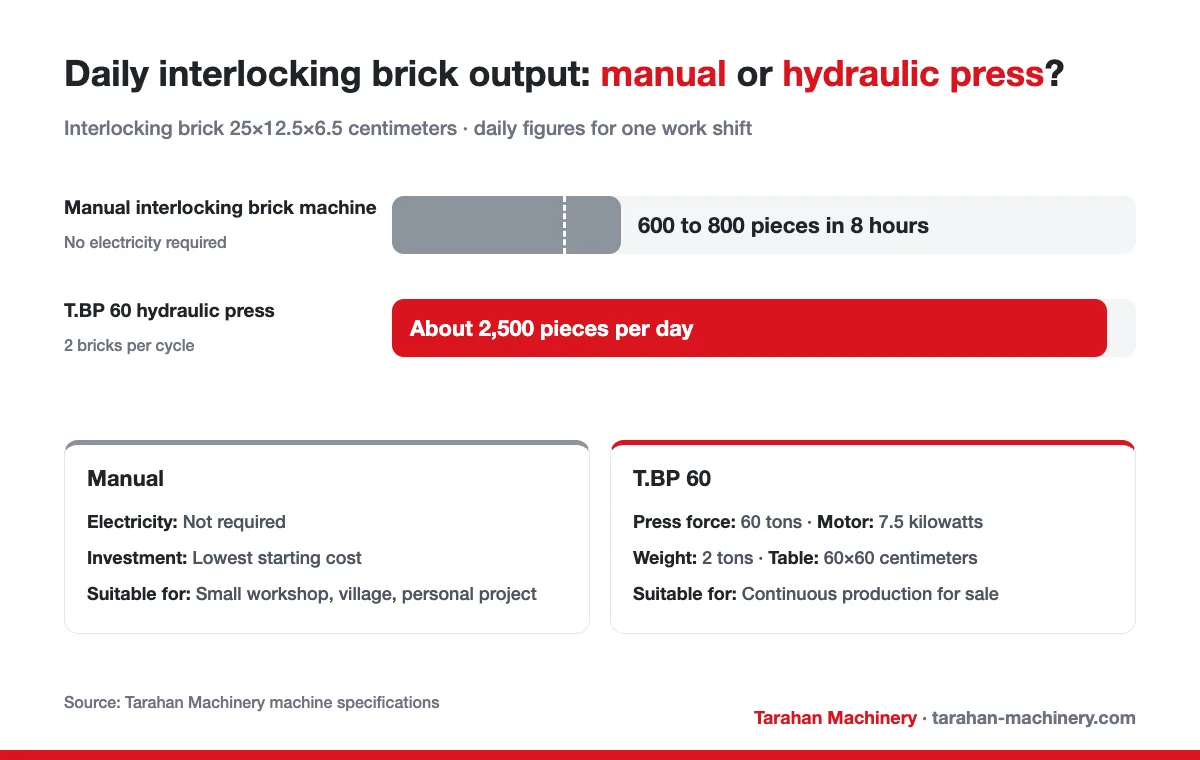
A manual interlocking brick machine (sometimes also called a manual brick making machine) is operated by hand with low press force and has a production capacity of about 600 to 800 bricks per day. These machines cost less, but their compaction quality and output are lower.
Hydraulic Interlocking Brick Machine
These machines use a hydraulic system to apply more pressure to the brick, giving the interlocking brick greater strength. Thanks to the power of the hydraulic system, these presses produce about 2,500 to 7,000 bricks per day. For example, the Tarahan brick press machine is built in models from 60 to 600 tons, and its smallest model, the T.BP 60, makes 2 interlocking bricks of 25×12.5×6.5 cm per cycle and about 2,500 bricks per day.
Hydraulic machines cost more, but they are also more productive. If you are in an area where labor is cheaper, a manual interlocking brick machine can be a good choice. If you are short of workers or need more capacity, a hydraulic machine is the more sensible option. To start on a smaller budget, you can also browse the used machine listings.
Manual Brick Machine or Hydraulic Press: A Comparison by the Numbers
Most people looking for a manual brick making machine want to start with as little capital as possible. Before you buy, compare these three things: daily output, power requirements, and the kind of work you do. The table below is based on the specifications of Tarahan Machinery equipment.
| Feature | Manual interlocking brick machine | T.BP 60 brick press | Larger presses (T.BP 100 to T.BP 600) |
|---|---|---|---|
| Output | 600 to 800 bricks in 8 hours | 2 bricks per cycle; about 2,500 bricks per day | Depends on the mold and press table size |
| Electricity | Not required | 7.5 kW electric motor | 11 to 84 kW |
| Press force | Operator’s hand force | 60 tons | 100 to 630 tons |
| Machine weight | — | 2 tons | 3 to 12 tons |
| Best for | Low-cost startup, small workshop, village use, and building for your own needs | Continuous production of interlocking bricks for sale | Industrial production and other brick types such as refractory, Lefton, and facing brick |
How Does the Tarahan Manual Interlocking Brick Machine Work?
On a manual machine, the operator fills the mold with a moist mix of soil, sand, or stone powder and cement, compresses it by hand, and removes the brick from the mold. Because the force comes from the operator’s hands, the machine needs no electricity and can work on a project site or in a village without industrial power. This simplicity makes it the cheapest way to start producing interlocking bricks. The trade-off is that brick compaction and daily capacity are lower than with a hydraulic press, so the quality of the mix and proper curing matter more.
Which One Should You Choose?
- If you are making bricks for your own house or project and do not have three-phase power, a manual machine is enough.
- If you want to sell interlocking bricks on a continuous basis, the difference between 600 to 800 bricks and about 2,500 bricks per day can justify the higher cost of the T.BP 60 press.
- If you also plan to make refractory, Lefton, or facing bricks in addition to interlocking bricks, go for the larger presses.
Interlocking Brick vs. Interlocking Block
Interlocking bricks and interlocking blocks are both built on the idea of units that lock together and use less mortar, but an interlocking block is usually a larger concrete unit, often produced on a block making machine. One of the best-known interlocking block systems was designed by a Mexican company. It consists of six interlocking block models, with metal rods placed at intervals of about 80 cm so that pipes and wiring can pass through the wall without trouble.
Interlocking blocks are produced on two groups of block making machines: mobile and stationary. Given the special shape of these blocks and the importance of dimensional accuracy, we recommend a stationary block machine; for a full comparison of the two groups, read our article on mobile vs. stationary block making machines. The designers at Tarahan Machinery also modeled all six interlocking block units in CAD software and calculated their exact dimensions through wall-layout tests so the blocks can be laid without problems. If you are considering industrial production of these blocks, the steps, equipment, and workshop layout are covered in our guide to setting up an interlocking concrete block production line.
Choosing the Right Machine for Interlocking Brick Production
With the right blend of raw materials and a machine matched to your needs, the interlocking brick can be a good alternative in the construction industry. The choice of machine depends on economic conditions, labor, target production capacity, and project requirements. Machine prices also vary by model and production capacity.
Tarahan Machinery specialists offer a free consultation to help you choose the right machine for your project and get a price quote. For more information, call the sales department at +98 41 3630 4464.

Submit Comment: